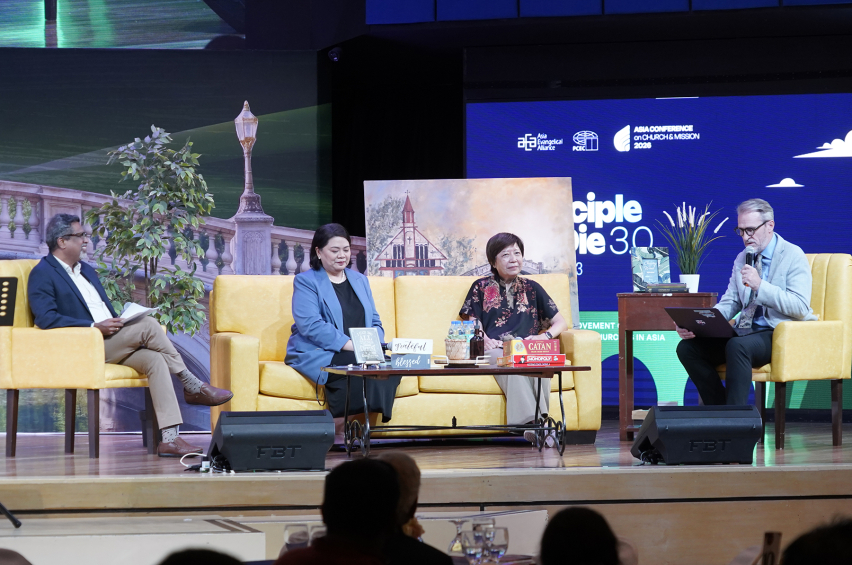
Closing out the Asia Conference on Church & Mission on Thursday, June 11, a panel of evangelical leaders warned that one of the most serious failures in the global Church is hiding in plain sight: the systematic displacement of parents as the primary disciplers of their own children.
The panel was the final session of ACCM 2026, a gathering of 210 delegates from 25 nations held June 9–12 at GCF South Metro in Alabang, Metro Manila. Organized by the Asia Evangelical Alliance in partnership with the Philippine Council of Evangelical Churches, the conference carried the theme "Disciple or Die 3.0" — the third in a series of regional gatherings focused on building a measurable movement of disciple-making churches across Asia by 2033.
Three panelists — Dr. P.C. Mathew, Ps. Grace Hee and Emmaloisa Malibiran-Salumbides — each addressed the same underlying concern from different angles: that churches have, largely without intending to, relieved parents of their responsibility to form their children in the faith, and that the consequences are visible across denominations and cultures.
'The family crisis is first of all a theological crisis'
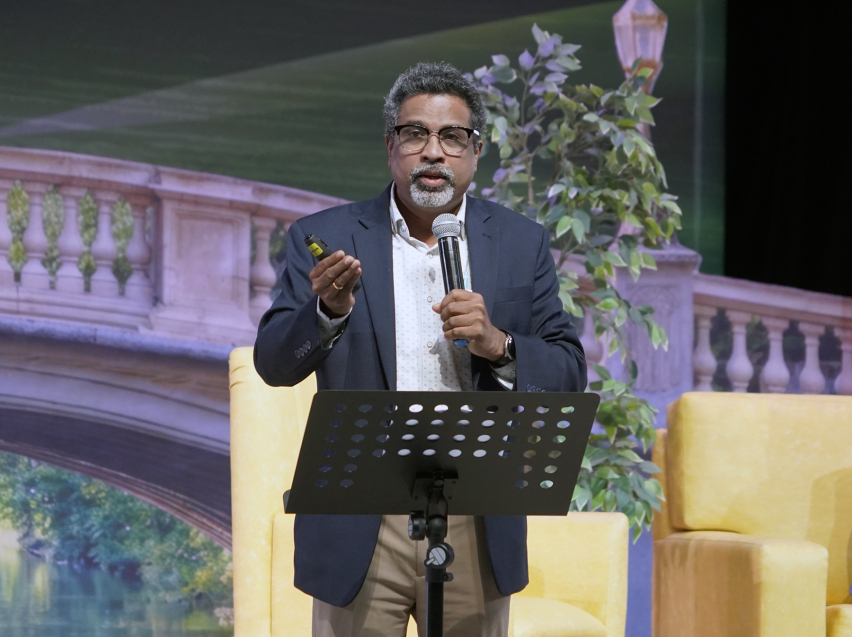
Mathew, who serves as global director of the World Evangelical Alliance's Family Challenge initiative and founder of UIM Family Research and Training Institute in South Asia, framed the problem in stark terms. Citing research from his home state of Kerala, India — where Christians make up 20 percent of the population but account for 50 percent of divorce filings in family courts — he said the data pointed to something deeper than a social problem.
"The church must face the truth that the family crisis is first of all a theological crisis," Mathew said, quoting theologian Albert Mohler. He argued that discipleship has long been measured by public performance — preaching, prayer, platform presence — while the home has been treated as a private matter beyond the church's concern. "He can abuse his wife but be an elder in the church," Mathew said. "He can be a very wrong parent, but he can talk about sharing the love of Jesus Christ."
Mathew outlined four reasons he believes family discipleship is essential to the church's mission. Family, he argued, was God's original mechanism for expanding the kingdom — citing Genesis 18, where God's covenant with Abraham is explicitly linked to Abraham teaching his household to walk in his ways. In the New Testament, he noted, Paul's criteria for church leadership were not theological credentials or gifts, but a man's faithfulness within his own home. "He was not assigning to any youth pastors and leaders," Mathew said. "The discipling of the next generation was entrusted first and foremost to parents."
He also connected family discipleship to both the Great Commission and the return of Christ, pointing to the closing verses of Malachi, where the forerunner's task is described as turning the hearts of parents to their children and children to their parents. "When Christ returns in glory, he's not merely looking for isolated individuals," Mathew said. "He desires to see households walking together in faith."
He closed with an image of an eagle: "One wing of this eagle is the church and the other wing is the home. If your one wing is flapping well, but your other wing is not flapping, the eagle will not fly high."
'Church is not about attendance. Church is about living life.'
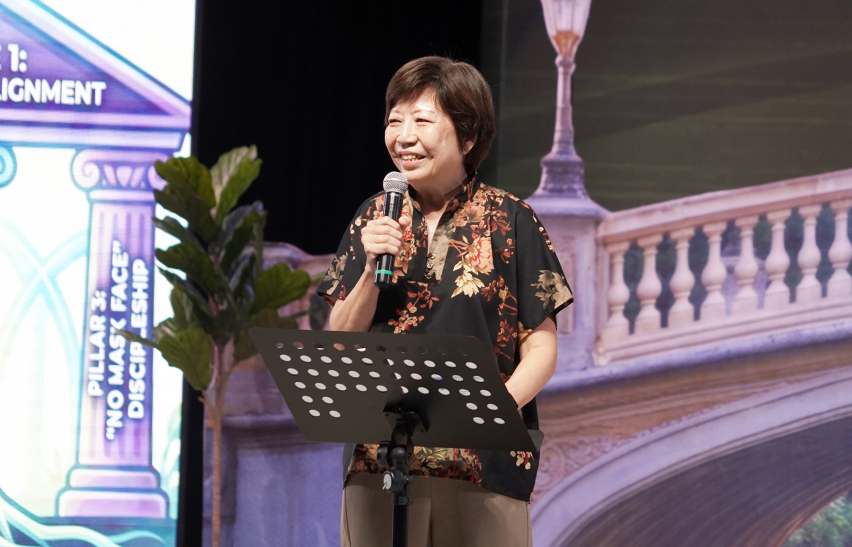
Ps. Grace Hee, executive director of the Asia Evangelical Alliance Women Commission, offered a ground-level account of how one Malaysian congregation began rethinking its approach to families — and how slowly that change came.
The process started during the COVID-19 pandemic, she said, when lockdowns forced families back together and made plain that church life had been built around programs rather than people. "I believe there was a major reset to the kingdom of God," Hee said. "It was there that we realized that church is not about attendance. Church is about living life."
Her church identified three convictions that reoriented its ministry. The first was that family units function like organs in the body of Christ — when they are unhealthy, the whole church suffers. The second was the particular importance of fathers. "For the longest time, physical development of our children, emotional development, education, spiritual formation — all standard to land on mother," Hee said, noting that fathers have been the missing link in many households. Research, she said, shows that fathers uniquely impart security, identity, morality and a sense of potential to their children. The third conviction was that the church and the home must function as one team, not competitors. "From a child's perspective, church has stolen my father, church has stolen my mother, and I've been left alone in my own home," she said. "It's not supposed to be that way."
The congregation's response involved four practical steps: building accountability within its pastoral leadership team, intensifying corporate prayer, making Sunday gatherings a place where scripture on family life was taught systematically, and developing what Hee called a "family lifecycle" map — a chart tracking major life transitions from birth to old age, with the church deliberately preparing families for each one.
That last element, she said, was designed to address a pattern the church had seen repeatedly: people drifting from faith not because of rejection but because no one had prepared them for the crossing. "When young working adults go into the working world without preparation, they fall into a hole," Hee said. "When our children's church age hits puberty, they are asked to go into youth. It's a big cliff. There's no one to help them transition."
'Our task is to build stronger little churches'
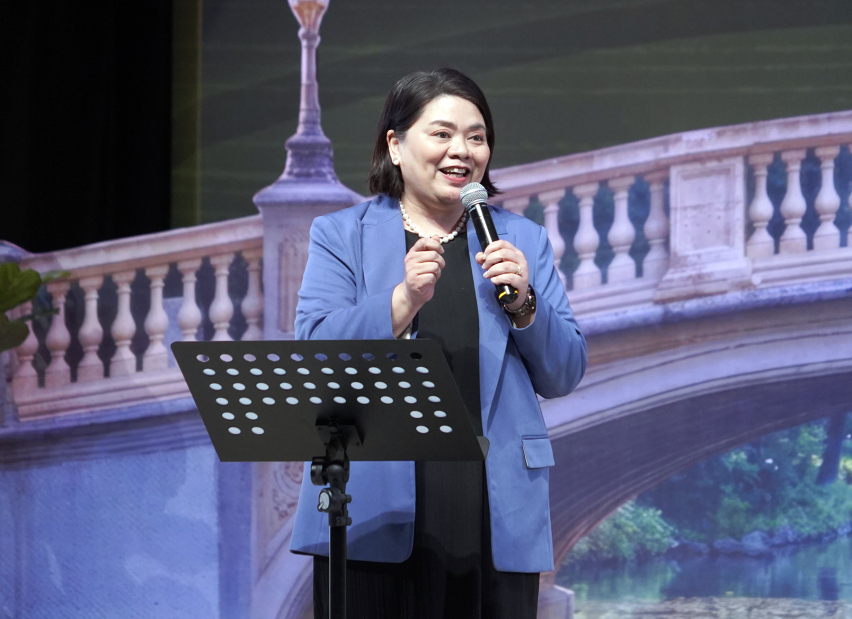
Emmaloisa Malibiran-Salumbides, who leads the Family Commission of the Philippine Council of Evangelical Churches, addressed the practical implications for church leaders and cited a Barna Research finding that 42 percent of pastors wish they had spent more time with their own children while they were growing up. The statistic, she said, was not a condemnation of pastoral ministry but a warning. "If shepherds can become so consumed with caring for God's household that they neglect their own households, then the church must revisit the theology of ministry and leadership."
Drawing on 1 Timothy 3:4–5, she argued that Paul's linking of household management to church leadership was not incidental — it was the preparation. "Paul does not separate household leadership from church leadership," she said. "He sees the former as preparation for the latter."
She proposed four shifts in how churches view the home. The first was recognizing the family as the primary discipleship community rather than a recipient of ministry. The second was reorienting church resources toward equipping parents — pointing to a survey of gathered delegates that showed family discipleship scored just 2.7 out of five as a church priority, with correspondingly low budget allocations. "The measure of successful children's ministry is not attendance," she said. "The measure is whether parents are becoming more effective disciple makers to their own children."
The third shift was integrity between public ministry and private life, and the fourth was building a multigenerational vision, drawing on Psalm 78's image of one generation declaring God's works to the next.
Malibiran-Salumbides also addressed the question of broken homes, which had been raised during an earlier conference workshop. "It is difficult, it is far from ideal, but it is possible," she said, as long as at least one member of a family remains committed to moving it toward its God-given design. She illustrated the point with the story of a Filipino single mother who, after coming to faith and being discipled within a local church, raised children who became a pastor, a sports coach and a public servant — one of them an advocate for anti-corruption reform.
"If Jonathan Edwards was correct that every Christian family should be a little church," Malibiran-Salumbides concluded, "then our task as church leaders is not simply to build bigger churches. Our task is to build stronger little churches."
ACCM 2026 was the third gathering in a series convened by the Asia Evangelical Alliance under the "Disciple or Die" banner, following assemblies in Ulaanbaatar, Mongolia in 2024 and near Seoul, South Korea in 2025.