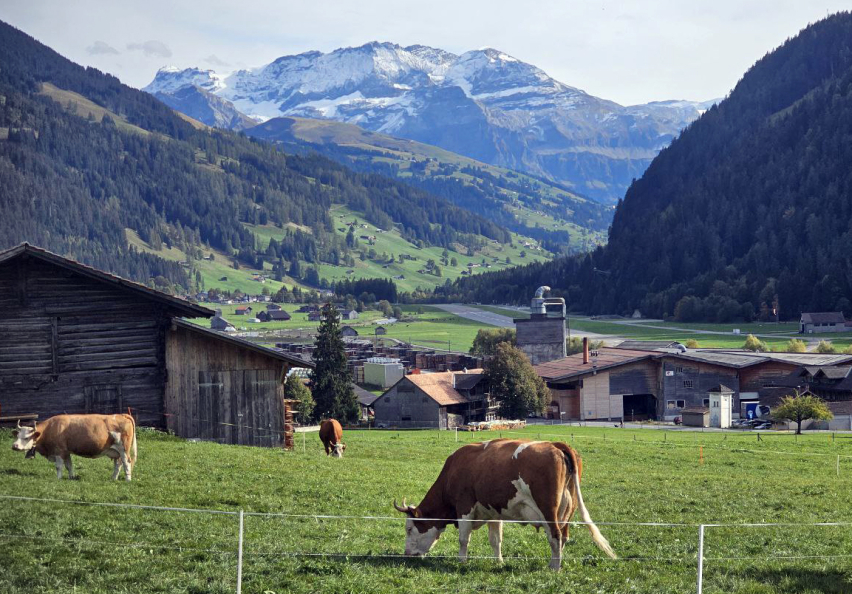
A new form of church designed specifically for farmers has taken root in eastern Switzerland, reshaping traditional worship schedules and formats to fit the rhythms of agricultural life, according to a report by Dienstagsmail.
Known as the “Puure-Church” — Swiss German for “Farmers’ Church” — the initiative was launched in 2019 in the St. Gallen Rhine Valley to address a practical challenge: many farmers are unable to attend conventional Sunday morning services because of early barn duties and the year-round demands of livestock care.
“When church bells ring at 9:30 a.m., many farmers are still finishing their work in the barn or are just getting into the shower,” Ernst Leibundgut, a farmer from Altstätten and one of the founders, told Dienstagsmail. “We want to make it as easy as possible for farmers. We meet at a suitable time, at 11:30 a.m., the children are looked after, and there is something to eat.”
The project was started by Leibundgut, his wife Corinna, and two other couples. Their aim was to bring Christian faith into the everyday realities of farming families, whose work schedules and social patterns differ significantly from urban or office-based professions.
“When you are a farmer, you experience life differently,” Leibundgut said. “You have a different daily rhythm, a different social environment and different concerns. Except perhaps during holidays, you work all year round — sometimes up to 24 hours a day, seven days a week — often together with your spouse. That affects family life.”
Held every third Sunday, the gatherings draw between 40 and 80 participants from across the Rhine Valley, Werdenberg, Toggenburg and the Appenzell region. Attendees range from young children to seniors over 80. The meetings are hosted in accessible community spaces, including a workshop facility in Rüthi.
The church operates in partnership with the local Reformed congregations of Altstätten and Grabs-Gams and is supported by Pastor Thomas Beerle of Salez. The initiative is funded through voluntary donations and is led by an interdenominational team.
Participants come from a variety of Christian backgrounds — Reformed, Catholic and free church traditions — as well as individuals with no formal church affiliation. Organizers describe the Puure-Church as an open space centered on faith but not confined to denominational structures.
At a recent gathering reported by Dienstagsmail, freelance pastor and adult educator Barbara Beusch spoke about the life of Niklaus von Flüe, the 15th-century Swiss farmer, husband and father of 10 who left his family at age 50 to live as a hermit devoted to God. The presentation was followed by table discussions in which participants reflected on the complexity of his decision and discussed how to make room for faith amid the pressures of daily life.
Leibundgut emphasized that faith is not restricted to traditional church buildings. “God’s blessing can be received just as well in rubber boots while mucking out the barn,” he said. “It doesn’t require an enclosed space. Nature itself is a source of divine strength.”
Beyond Sunday meetings, the Puure-Church organizes two annual farm festivals featuring music and fellowship. It also hosts occasional Bible and discussion evenings for women and special events such as beer brewing or golf outings.
Organizers say the goal is to create a supportive network where farming families can cultivate relationships and draw spiritual strength for their work and home life. They describe farming not only as a profession but as a calling rooted in the biblical mandate to “cultivate and care for the earth” (Genesis 1:28).
As agricultural communities across Europe face economic pressures and social isolation, the Puure-Church represents a locally driven effort to adapt church life to the practical realities of rural living while maintaining a focus on Christian faith and fellowship, Dienstagsmail reported.