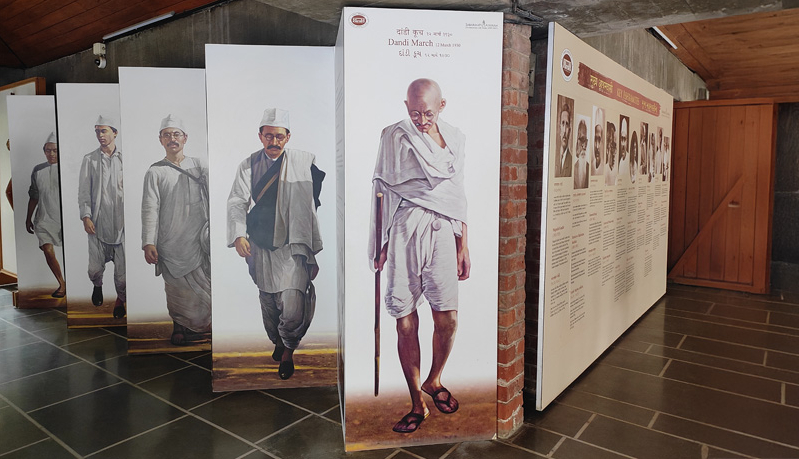
The Indian government officially observes the anniversary of Mahatma Gandhi’s death on January 30 as Martyrs’ Day. It is also known in Hindi as Shaheed Diwas, marking the day in 1948 when Gandhi was assassinated by Nathuram Godse. It's ironic that Prime Minister Narendra Damodardas Modi celebrates this day while practicing in India exactly what Nathuram Godse, the assassin, stood for.
The actions of the police and other state officials demonstrate the opposite of what Gandhi stood for.
Government leaders, including the Prime Minister, typically gather at Raj Ghat or Gandhi Smriti in Delhi for tributes, wreath-laying, and a two-minute national silence at 11 AM. Past events emphasized Gandhi’s legacy of non-violence and national sacrifices, with exhibitions and prayers held nationwide. While, at the same time, the actions of the police and other state officials demonstrate the opposite of what Gandhi stood for—evil practices take place day by day.
He explicitly warned against turning India into a state only for Hindus.
Gandhi rejected the idea of an explicitly Hindu state and advocated for a secular India where all religions enjoy equal respect and coexist. He explicitly warned against turning India into a state only for Hindus, seeing it as a threat to national unity and survival.
Gandhi viewed India as a religiously diverse society and championed a state order that elevates no religion as the state religion. Instead of Western-style separation of religion and politics, he demanded a state that shows equal respect to all faiths.
Gandhi was deeply rooted in Hinduism personally and saw it as a core part of Indian culture. At the same time, he criticized movements that turned Hinduism into a nationalist ideology of superiority and opposed exclusively Hindu-oriented state definitions.
A free India must be politically open to all religious communities.
He repeatedly emphasized that Hindus and Muslims are "like brothers" belonging to the same political community. For him, this meant a free India must be politically open to all religious communities and not defined as a "Hindu-Rashtra" (Hindu nation).
Gandhi would argue against today’s Hindutva under Prime Minister Modi by condemning it as a betrayal of true Hinduism, emphasizing non-violence, religious equality, and unity over supremacy and division. He criticized Hindutva-like ideologies during his life for fostering hatred and inequality, viewing them as antithetical to his vision of a pluralistic India where all faiths coexist as brothers.
Gandhi rejected any notion of Hindu superiority, insisting Hinduism thrives through love and service to all, not domination over Muslims or minorities. He would decry Modi's policies like the Citizenship Amendment Act as creating division and exclusion, echoing his warnings against partitioning society by religion.
He would oppose Hindutva's promotion of vigilantism, lynchings, and institutional bias.
Non-violence (ahimsa) defined Gandhi's politics. If alive today, he would oppose Hindutva's promotion of vigilantism, lynchings, and institutional bias against Muslims as cowardly and un-Hindu. Gandhi fasted against communal violence and urged Hindus to protect minorities, directly challenging RSS-BJP rhetoric that labels dissenters as threats.
Gandhi championed sarva dharma sambhava—equal respect for all religions—against Hindutva's Hindu Rashtra, which he saw as insecure and destructive to national unity. He would criticize Modi's temple inaugurations on mosque sites and textbook revisions as erasing diversity, arguing true Hinduism absorbs and uplifts. It does not assimilate by force.
Gandhi's vision was naive and destined to fail.
To understand why Gandhi's vision was naive and destined to fail in India, we must evaluate his philosophy and religious views within a broader context. This includes his complex relationship between Hinduism, Christianity, and Western human rights thinking.
Gandhi in contrasting perspective
Mohandas Karamchand Gandhi (October 2, 1869–January 30, 1948), later known as Mahatma Gandhi, was politically and intellectually the most important leader in India during its battle for and ultimate achievement of independence, but he wasn't the only influence for change.
After studying law in England, Gandhi gained experience with nonviolent resistance tactics against the British as a lawyer in South Africa fighting for the rights of Indians. When he returned to India, he fought for India’s independence, for Hindu-Muslim unity, for the abolition of the caste system, and especially for the rehabilitation of the pariahs, the “untouchables” (casteless), whom Gandhi called “Harijans,” or children of God.
Gandhi deployed a variety of nonviolent tools such as employee strikes, refusal to pay taxes, human blockades, and hunger strikes, which to this day have had many imitators from a wide range of groups.
Regarded as a leading figure by generations of alternative thinkers.
Gandhi was and is regarded as a leading figure by generations of alternative thinkers. German Gandhi researcher Michael Blume, for example, sees Gandhi’s program as the ideal basis “for non-violent opposition in Western industrialized countries and the global alternative movement, which sees itself as a peace movement, an ecological movement, a women’s movement, a class struggle, or as a liberation movement in the Third World.”
Although Gandhi is considered a national saint in India, since his death his convictions have had relatively little influence in his home country. In contrast, Gandhi has had an astonishing impact in the Christian world.
There is usually limited study of Gandhi’s extensive writings.
He is often mentioned in the same breath as Martin Luther King as a pioneer of Christian political ethics, as if he had been a Christian theologian as King was. Behind this commendation, however, there is usually limited study of Gandhi’s extensive writings, such as his programmatic work, Sarvodaya (Universal Uplift). Instead, Christians seem to relate to Gandhi on the basis of a firmly established tradition of admiration reminiscent of the saints.
Contrary to Blume's claim, it is difficult to understand how Gandhi could become a hero of the women’s movement too. Although Gandhi observed that women certainly had more rights among the English than among the Hindus, he never applied these principles to his wife or in his own family.
He was uninterested in the fate of black people in South Africa.
Furthermore, the anti-racism movement would also seem to have chosen an inappropriate idol in Gandhi, as he was uninterested in the fate of black people in South Africa and never strongly opposed Hindu nationalism in India either.
Gandhi’s impact in perspective
Without in any way justifying the injustice of colonial rule and without wishing to devalue all of Gandhi’s merits, we propose that the often-praised successes of Gandhi deserve greater critical scrutiny.
- India’s independence was more a result of the Second World War and its global consequences for the United Kingdom as a colonial ruler than of the non-violent resistance led by Gandhi, and there were other forces in India that were threatening to use violence to achieve the same ends, which also influenced the outcome.
- Nonviolent resistance only worked because Gandhi faced an opponent who was still largely Christian. Gandhi beat the Christian-influenced English at their own game. Had the British been Muslim or Hindu, it would be unlikely that Gandhi’s approach would have had as much influence as claimed.
- Gandhi’s proclaimed Hindu-Muslim unity failed completely. Independence ended in an enormous bloodbath of fleeing Muslims and Hindus, millions of deaths, and a division of the nation into two countries (India and Pakistan in 1947, with Bangladesh following in 1971). The consequences of this division and the violent tensions between Hindus and Muslims have not been overcome to this day. With his assassination, Gandhi himself was a victim of the continuing violence between Hindus and Muslims.
- Although the abolition of castes found its way into the Indian constitution, it did not become part of everyday life in India. India’s constitution does not reflect Gandhi’s thinking or Hindu political traditions. Rather, it reflects Christian, Anglo-Saxon, and Dalit traditions.
Gandhi in Christian perspective
Some critical remarks regarding Gandhi’s outsized influence in the Christian world are also warranted.
- Gandhi first adopted many Hindu practices, such as vegetarianism, through the mediation of Europeans who, turning away from the Christian West, sought their salvation in the teachings of other religions. His faith was therefore already a partially Europeanized form of Indian tradition.
- Gandhi was significantly influenced by European thinkers such as Rousseau, Ruskin, and Thoreau. He was also strongly influenced by the writings of Leo Tolstoy, including the Russian’s rewritten and greatly amended life story of Jesus.
He exchanged letters—later published—with Tolstoy, whose view that one should not oppose evil. Gandhi understood in the Hindu sense of ahimsa (not being harmful to living beings) and asahayoga (non-cooperation with evil).
Gandhi probably became acquainted with Christian-influenced ideas in this roundabout way. Only after he was famous did he familiarize himself more with Christianity. - Despite his Christian interlocutors and the many invitations he received to participate or speak at Christian conferences and major events, Gandhi was an energetic opponent of Christian mission and accepted as truth only those Christian views which corresponded to the inherited teachings of Indian Jainism, which were deeply rooted in his thinking from early on.
Thus, although he praised the Bible and the Koran (see his Collected Works XXI, p. 246; Collected Works XXVIII, p. 111), he rejected their traditional interpretation and substituted his own understanding of the texts over and against traditional orthodoxies of each faith. - Gandhi was not a follower of Hinduism as understood or practiced by the majority of Indians. Rather, he was significantly influenced by two Indian religions that developed from Hinduism, Jainism and Theravada Buddhism.
This is the only way to understand how Gandhi could endorse the superiority of Indian culture and Hinduism’s claim to universality (see his creed, Collected Works XXI, pp. 245-246) and at the same time reject the Hindu caste system and the Hindu struggle against the Muslims.
For him, the ultimate goal in life was a state attained through several rebirths.
For him, the ultimate goal in life was a state attained through several rebirths called moksha, i.e., “salvation” or “self-realization” in the Hindu sense, which Christians can understand only as self-dissolution, not the salvation and Kingdom of God promised in Jesus.
While Gandhi will remain a significant figure in popular twentieth century thinking, followers of Jesus should be wary in attributing too much to Gandhi’s thinking and practice. As we approach India’s Martyrs’ Day on January 30, we need look no further than Jesus in his full biblical context to guide our engagement with society and tyranny.
Rev. Dr. Richard Howell is Principal of the Caleb Institute in Delhi, India and the Executive Secretary of the Evangelical Fellowship of India’s Council of Churches, an alliance of Evangelical and Pentecostal churches. He was formerly the general secretary of the Asia Evangelical Alliance and committee member of the Global Christian Forum.
Written with...
Archbishop and Professor Thomas Paul Schirrmacher, the President of both the International Council of the International Society for Human Rights in Frankfurt and the International Institute for Religious Freedom in Costa Rica and Bonn. He was Secretary General of the World Evangelical Alliance from 2021 to 2024. Prior to this, he served the WEA for 25 years in various roles, including Associate Secretary General for Theological Concerns and Intrafaith and Interfaith Relations. He travels to over 50 countries a year, meeting heads of state and government, religious leaders, and heads of churches of all confessions on behalf of the persecuted church, as well as fighting human trafficking and corruption.