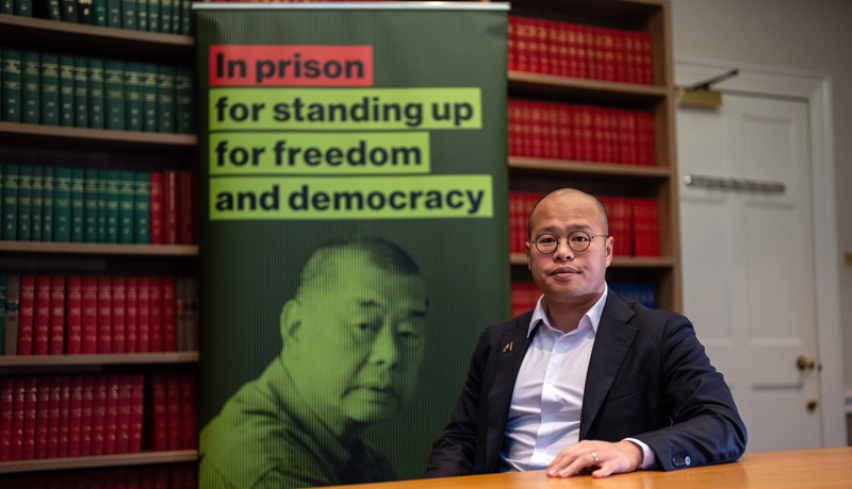
Hong Kong business tycoon and prominent pro-democracy activist Jimmy Lai was sentenced to a horrendous twenty years in jail on Monday February 9th, 2026. It’s a virtual death sentence for the 78-year-old diabetic, the most high-profile victim of the world’s most draconian National Security Law, passed on July 1st, 2020, whose vague and sweeping provisions visions slap a criminal label on anyone who advocates for freedom.
Who is Jimmy Lai?
What is not so well known is that he was only sentenced because he is a Christian!
Lai became a devout Roman Catholic Christian in 1997, a year after the former British colony was handed back to China. He could have fled the city quite a few times in the past years. He is a rich man. Much of his fortune is protected in other countries. He owns many homes around the world. He even holds a British passport.
He felt God wanted him to stand up for freedom and pay the price.
But he stayed because he felt God wanted him to stand up for freedom and pay the price when the Chinese overlords were reneging on promises make before the 1997 handover to introduce universal suffrage into the territory by 2007.
For the last 1500 days, Lai has been in solitary confinement in a Hong Kong jail. Yet despite being denied the sacraments, he prays for long periods daily, produces religious art on cards, and tells his family from his cell; “I know I must have done the right thing. The Lord has rewarded me with sweet joy and love.”
Jimmy Lai's Hong Kong
I used to live in Hong Kong, and I loved living there. But the reason it was such a great place to be was it was open, free, unbuttoned, remarkably so compared to cities like Singapore which were tight, buttoned up, run by authoritarians. Journalists used to say, “It’s the only city in Asia through which the world is allowed to flow.”
That Hong Kong has gone. Of course, to walk around Kowloon’s Nathan Road or Central district today, you wouldn’t notice at first. The manic consumerism remains, the pavements thronged with giggling young people, and the wealthy flaunt their bling as they always have. But the place used to have truth-telling newspapers; freedom of thought for academics, a pro-democracy movement electing its own politicians to the legislature, and a local government committed (we thought) to honoring its promises in the Basic Law to introduce universal suffrage in 2007.
Realizing that Beijing would never allow democracy as promised, protesters took to the streets.
Tiring of excuses and realizing that Beijing would never allow democracy as promised, protesters took to the streets most significantly in 2014 and 2019, only to see the authorities ignore the legislature and impose its paranoid National Security Law at midnight on July 1st, 2020. The unique significance of this was caught well by Max Clifford (a close friend of Lai) in his book, Today Hong Kong, Tomorrow the World:
“The Communist destruction of the territory’s liberties marks the only time in contemporary history when a totalitarian government has destroyed a free society—has shuttered a free press and ended free speech and freedom of assembly, and curtailed the right to be presumed innocent, the right to a jury trial, and the right to hold private property without the government arbitrarily seizing it... The free world ignores the tactics on display there at its peril.”
I never thought that Hong Kong would turn out like this. That a law like this could ever pass. That kangaroo courts would do the bidding of political behemoths in a far-off city. That John Lee, the Chief Executive of the Territory—a position previously occupied by people of great ability and integrity like Chris Patten and Anson Chang—would opine like a quisling (a collaborating traitor), squawking that Lai’s sentence was “deeply gratifying” for his “heinous and utterly despicable” crimes.
It feels like a part of me has been painfully cut out.
A free and great city was once part of my life. That is no longer the case and it feels like a part of me has been painfully cut out. I have grieved, but the Lai sentencing brings the grief back with a sickening rush.
Why Jimmy Lai?
Why did China throw the book at Lai? Why twenty years, which is so obviously an overreaction to his influence? The answer lies in the paranoia of Mao Tse Tung, who famously said of revolution, “It only takes a single spark to set a prairie alight.” If that’s true, here’s the kicker—it’s also true of a counter revolution! Thus, all dictators are paranoid about any dissent, no matter how trivial, because that might be the spark that would sweep them from power just as a tiny spark swept them into it.
He put the faces of the pro-democracy students on the T shirts of his Giordano clothing company.
Jimmy Lai was always such a potential spark. After the Tiananmen massacre of students on June 4th, 1989, he put the faces of the pro-democracy students on the T shirts of his Giordano clothing company.
He was a hard driving businessman and moderated only slightly with his conversion in 1997. His famous newspaper Apple Daily was a proverbial gloves off tabloid that did not spare the establishment and gave voice to the pro-democracy movement when other tycoons sought to kowtow to Beijing.
He became a major bank-roller of critics of the Beijing overlords.
He became a major bank-roller of critics of the Beijing overlords. The language of the sentencing called him the “mastermind’ of the pro-democracy movement, as he was accused of organizing a conspiracy to invite foreign collusion and publishing seditious material.
He was not the cleverest face of the pro-democracy movement—that was the barrister Martin Lee (another devout Roman Catholic), but he was its wealthiest and probably its cheekiest.
His strongest local supporter has been a Roman Catholic Cardinal, Joseph Zen, now in his early nineties and who attends every court hearing and smiles his support, even though he too has fallen foul of the National Security Law for arranging funds to pay the legal fees of pro-democracy protesters. His support has been as unwavering as the Vatican’s silence under Pope Francis and now Pope Leo has been deafening.
The fate of Jimmy Lai
Jimmy Lai will not die in jail.
Jimmy Lai will not die in jail, however. The Chinese government will let him out playing their bizarre game of trying to show that they are the ones who will exercise compassion and kindness.
The British and American governments have been consistent in bringing up his case with President Xi. His release might be planned as a sop to President Trump, slated to visit Beijing possibly as early as April.
Particularly powerful have been the words of Yvette Cooper, the British Foreign Secretary; “I again call on the Hong Kong authorities to end his appalling ordeal and release him on humanitarian grounds, so that he may be reunited with his family.” London is also looking for a concession gesture after granting permission for the Chinese super-embassy in the city.
China will not want him to die in prison. And they won’t take too long to release him if he is ailing. If Jimmy Lai became a martyr that would be a disaster and they know and fear it.
Lai may attain what we could consider to be Bonhoeffer status for his suffering and indeed the works of the German theologian who was executed for his opposition to Hitler are reportedly among Jimmy's favorite reading.
Get ready for Jimmy Lai’s global fifteen minutes of fame when he is released. Hang on every word. He will probably speak too of the “sweet joy and love” experienced in the cell. Whatever his words, they will be ones for all of us to live by!
Originally published by on the Five4Faith Substack. Republished with permission.
Dr Ronald MacMillan has forty years as a journalist, scholar and activist in helping the persecuted. He co-founded the world’s first news agency to focus on religious conflict, News Network International, and authored the definitive book on persecution in 2006, entitled Faith That Endures: The Essential Guide to the Persecuted Church. He is currently President of a Speech Tuition Company enabling leaders to change the world for the better through their words, and Chairman & Global Analyst of the world’s first Think Tank focusing on religious freedom, The International Institute for Religious Freedom. He is based in the UK.
The International Institute for Religious Freedom (IIRF) was founded in 2005 with the mission to promote religious freedom for all faiths from an academic perspective. The IIRF aspires to be an authoritative voice on religious freedom. They provide reliable and unbiased data on religious freedom—beyond anecdotal evidence—to strengthen academic research on the topic and to inform public policy at all levels. The IIRF's research results are disseminated through the International Journal for Religious Freedom and other publications. A particular emphasis of the IIRF is to encourage the study of religious freedom in tertiary institutions through its inclusion in educational curricula and by supporting postgraduate students with research projects.