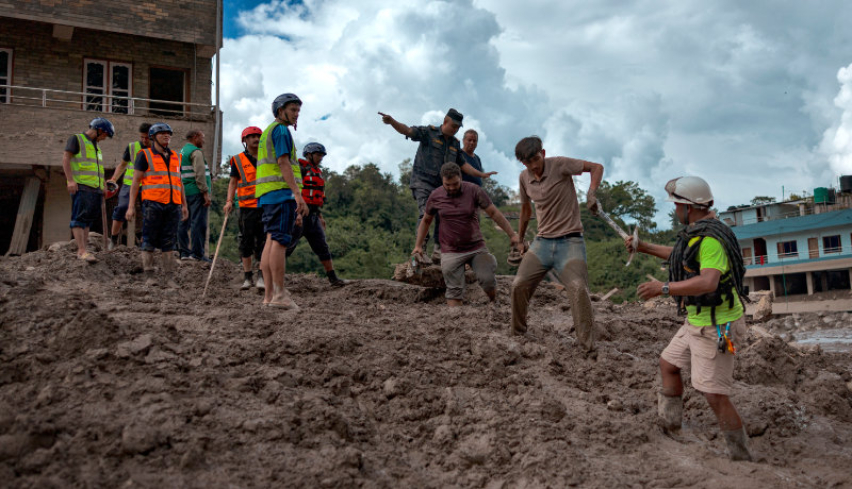
My heart breaks when I read the news in the papers and media narrating the story of August 26th in Nepal. I am deeply grieved by what happened on that day. Lives were lost. Fathers and mothers lost their children, children lost their parents, and parents lost their own aging parents. Schoolchildren remain missing, and survivors are traumatized by the shock. Hundreds are injured. Entire homes have vanished. The scale of the loss cannot be captured in words.
Water in the Trishuli reportedly rose as much as nine meters in just thirty minutes, tearing through settlements across a 72-kilometer stretch.
On the morning of August 26, a glacier collapse near Langtang in the Himalayas triggered a massive ice-rock avalanche that thundered down the Lhende Khola–Bhote Koshi–Trishuli river system on the Nepal-Tibet border. Water in the Trishuli reportedly rose as much as nine meters in just thirty minutes, tearing through settlements across a 72-kilometer stretch and devastating the districts of Rasuwa, Nuwakot, and Dhading.
Bodies were carried as far as 240 kilometers downstream into India.
As at early September, over a thousand deaths have been confirmed in Nepal, with thousands more still listed as missing, and hundreds injured. Bodies were carried as far as 240 kilometers downstream into India. Tunnels at hydropower sites became makeshift shelters and death traps alike, with rescue teams still working to reach those trapped inside.
Distributing... aid to the people who actually need it has proven difficult.
What troubles me is not only the disaster itself, but what has followed it. The government took charge of the rescue operation, yet was slow and, in the crucial early hours, reluctant to let neighboring nations join the effort when every hour mattered most. Relief has been collected, and continues to be collected, yet distributing that aid to the people who actually need it has proven difficult.
Many NGOs and international agencies are asking for help. However, I have watched something painful unfold alongside the genuine generosity: a kind of competition on social media over who can be seen reaching the affected areas first.
Not relief but torture—a dehumanizing of the victims.
Too often, the people arriving on the actual site are not truly helping but creating confusions among people, sharing their pictures on social media. Imagine being a flood survivor and having one visitor after another ask you to recount your suffering, over and over, for the camera. That is not relief but torture—a dehumanizing of the victims.
This does more harm than good. Why have we lost our sense of humanity in the midst of humanitarian work? What is needed is for individuals and agencies to step in together where the government has fallen short, rather than working in isolation, each trying to attach their own name and reputation to the story of their generosity.
The government of Nepal has, at times, seemed more eager to advocate on the global stage about climate justice than to do the hard, humble work on the ground.
Where is our thinking about the future, about how people will actually rebuild their lives? Instead, we have spent our energy debating whose fault this is. Who is responsible for glacier melt in the Himalayas? There may be real truth worth examining in that question, but that conversation belongs in the right forum, at the right time. It is not the conversation for a moment when people in Trishuli and Rasuwa need food and clean water today. It is telling that the government of Nepal has, at times, seemed more eager to advocate on the global stage about climate justice than to do the hard, humble work on the ground.
Another side of this story is how Christian NGOs and churches have projected themselves in the social media, and not always wisely. Even mainstream Christian NGOs appear competitive in displaying their staff, their rescue vehicles, and their relief materials in the social media. What message do we want to convey to the world, and especially to the victims on the ground, when one person's tragedy becomes another's viral moment?
When I look at Christian NGOs and churches my grief deepens further.
When I look at Christian NGOs and churches my grief deepens further. I have seen leaders posting images of victims—some of whom have never spent meaningful time among rural communities, having lived comfortably in Kathmandu their whole lives.
Now I see their vehicles and their sunglasses at flood-affected sites, curated for the camera. They can reach a global audience and raise support quickly. But too often, the affected people become little more than material for sustaining an organization's image and funding.
There are those who quietly and genuinely serve people in need.
I want to be careful here that I am not speaking in general terms. There are those who quietly and genuinely serve people in need, and one will not notice them on social media. Their work is real, and it deserves honor even in its invisibility.
I sometimes wonder why Christian NGOs show less urgency in sharing the good news than they do in a high-urgency situation like this one. Perhaps the sustainability of the NGO, and fear of the government matters more to them than the sustainability of the people themselves.
Why do we hesitate to name the urgency of sharing the gospel?
Far less have we heard anyone speak of the urgency of eternity, and of the good news that people desperately need in moments exactly like this one. Why do we hesitate to name the urgency of sharing the gospel? Why do we not see how deeply the good news is needed, not only for temporal bodies only, but for their eternal being? How many of us see the present event as end times when the world interprets it as climate change and climate justice?
May the Lord give us eyes to see this moment rightly—to serve without seeking to be seen, to set aside our arguments about blame for the catastrophe until people have bread and shelter, and to remember that the hour is short and the harvest is great. May we be found faithful stewards of both bread for our stomachs and the Bread of Life for our souls via the gospel in the days ahead.
Janak BC is an MPhil (leading to PhD) scholar in English at the Graduate School of Humanities and Social Sciences, Mid-West University, Nepal. He has been associated with Nissi Church Surkhet and teaches Biblical Hermeneutics to rural church pastors and leaders. Now, he is exploring Karnali's literature, observing how literary narratives reproduce or challenge the dominant discourse of Karnali as an underdeveloped region.