The two most common predictions in the world of geopolitics and faith I kept hearing in the last twenty years were these: “The Cuban Communist government is about to fall”, and “The Islamic clerical rule in Iran will be swept away, definitely before 2030, because everyone hates the clerics.”
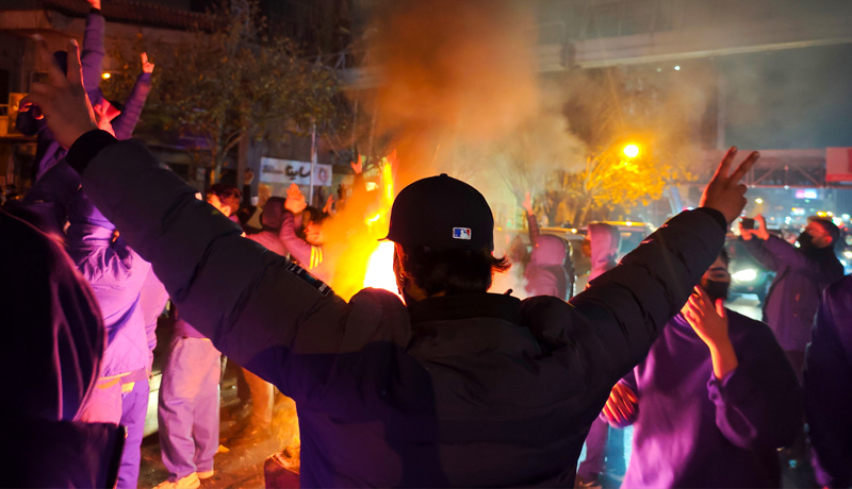
But is this about to happen imminently, in Iran, now that we are nearly a month into the most extensive grassroots protests at the appalling management of the economy by Iran’s failing, ruthless, clerical leaders?
Maybe, although social scientific insight seems to suggest not.
Revolutions only succeed if you are kicking in a rotten door.
It is commonly said that revolutions only succeed if you are kicking in a rotten door. And certainly, the Iranian regime is rotten to the core, but a revolution is a lot more than kicking in a door.
The great Christian sociologist Jaques Ellul in his book, Autopsy of Revolution, agreed that revolutions start from “people who sense that somehow, if the situation continues, they are bound to perish,” and that fits with what is happening today in Iran.
The people have nothing to lose—except their lives, and the guns have been turned on the protestors, killing thousands so far. Importantly, it is the merchant class that took to the streets first. The 40% devaluation of the currency has crushed their chances of economic survival, and as a group they are not traditionally the first to become protestors.
The problem in Iran is a divided opposition with no plan.
But Ellul is careful to add that to make a successful revolution rebels must have a plan “for changing the destiny that has hitherto led to oppression.” Spartacus, he said, was a rebel without a plan. His rebellion succeeded initially but failed be it cause “He had no conception of government or administration… His rebellion introduced no new principle into Roman society.” Similarly, the problem in Iran is a divided opposition with no plan.
The most modern analysis of what makes protests succeed or fail in toppling unpopular and autocratic regimes comes from academics Steven Levitsky and Lucan Way. In their 2022 book, Revolution and Dictatorship, they insist an authoritarian government will endure if their society has three elements:
- A cohesive ruling elite that stays together in crisis.
- A powerful and loyal coercive apparatus, for example, a strong and loyal military and police.
- A weak and divided opposition that cannot really mount sustained political activity against the regime.
They conclude, “dictatorships that can create cohesive elites and strong but subservient militaries and police forces while keeping opposition movements weak and divided are more likely to be resilient.”
Most observers do not think we are about to witness the toppling of the Iranian regime.
This is why most observers do not think we are about to witness the toppling of the Iranian regime now. The clerical elite seems tight and knows how to circle the wagons. The Islamic Revolutionary Guards Corp (IRGC) numbers one million strong and loyal so far, even to the extent of obediently turning their guns on the protestors.
As for the protestors themselves, they do not constitute an organized movement. If all they can offer is the return of the 65-year-old son of the former Shah (who was no democrat and ran a dreadfully corrupt regime), this is a problem because he is well short of a charismatic counter revolutionary figure.
Could American and Israeli backed interventions create the change? Maybe. They have four instruments, but all are blunt.
- First, they can bomb key military targets and degrade the capacity of the Revolutionary Guards to continue the massacres. Last June, American bombs took out twelve of the commanders of this unit.
- Second, they can flood the country with Starlink connectivity, enabling protestors to coordinate and work around the internet blackout.
- Third, they can mount cyberattacks especially on the surveillance technologies that hamper the protestors.
- Four, they can arm the warring Kurdish and Baluch insurgents.
No one wants a civil war in the wake of regime collapse.
The problem though is that no one wants a civil war in the wake of regime collapse, especially the other Middle Eastern powers such as Saudi Arabia and Turkey.
Still, the triggers to regime collapse are mysterious. After all, no one predicted the fall of the Berlin Wall in 1989, or the subsequent collapse of the Soviet system in 1991. For that matter, few thought the Shah would fall.
There is an infamous CIA memo dated August 1977, five months before the start of the revolution: “The Shah will be an active participant in Iranian life well into the 1980’s…There will be no radical change in Iranian political behavior in the near future.”
Mysterious triggers might include the IRGC concluding that they have no interest in serving their clerical masters anymore and sue for a change that protects their massive economic interests. Or the Iranian military stepping in to stop the massacres of the people.
Crucially, intelligence is perennially sketchy on the unity of the ruling clerical caste, and there is good evidence that the network of Islamic mullahs in the mosques—who formerly supported the Ayatollah Khomeini and the radical layman and former President Mahmoud Ahmadinejad—are not going out of their way to bolster the regime today.
The last hundred years has seen three large scale movements away from Islam to Christianity.
Religiously though, Iran has an outsized significance on another level. The last hundred years has seen three large scale movements away from Islam to Christianity—in Indonesia in the 1960’s, in recent Algeria among the non-Arab tribes, and in present day Iran, where many Muslims see the Islamic revolution as a violation of deeper Persian identity, which should be recovered.
That this movement is in the hundreds of thousands, and maybe the millions, has many excited, especially as so much more of the population could conceivable be described as in a state of “post-Islam”, defined as “one born or converted into Islam who no longer believes in its fundamental truth claims.”
Who knows what society would follow the fall of the clerical elite in Iran? It may not be a democracy, at least in the shorter term, but it would be one that was not so committed to funding the expensive jihadi proxies around the world of the former regime. That would be amazingly good news for all people of faith and none in 2026 and beyond.
This kind of Islamic theocracy has no credibility in the 21st century world.
Yet even if the regime survives, it will endure as a striking example that this kind of Islamic theocracy has no credibility in the 21st century world, since it cannot feed its people, grant basic stability and peace to the society, nor take its place in the international world as a positive influence for good.
All it can offer is an oppressive, backward, ignorant version of a grand religion that used to offer so much more to the world. Protestors have been chanting “Mullahs get back to your mosques”, and “the best cleric is a dead cleric”.
In no other country in recent times has there been such a vast turning against the Islamic religion. Shia leaders in the wider world are embarrassed and annoyed, since they are normally quietist and non-political in their stances, and some even regard as apostasy Khomeini’s teaching that the “guardianship of the jurist” should apply to the political realm at all.
Clerics of Iran have tied Islam far too closely with the state.
Confided one Ayatollah in Iraq, “The foolish clerics of Iran have tied Islam far too closely with the state, so that as the people reject an unpopular and incompetent regime they feel they have to reject the religion too—this is a disaster.”
“Post Islam” has never had a greater sponsor than today’s Iranian regime, with its grim-faced clerics and gun toting guards. Whether it stays or goes, millions will keep finding freedom from the yoke of Islamic extremism.
Originally published by on the Five4Faith Substack. Republished with permission.
Dr Ronald MacMillan has forty years as a journalist, scholar and activist in helping the persecuted. He co-founded the world’s first news agency to focus on religious conflict, News Network International, and authored the definitive book on persecution in 2006, entitled Faith That Endures: The Essential Guide to the Persecuted Church. He is currently President of a Speech Tuition Company enabling leaders to change the world for the better through their words, and Chairman & Global Analyst of the world’s first Think Tank focusing on religious freedom, The International Institute for Religious Freedom. He is based in the UK.
The International Institute for Religious Freedom (IIRF) was founded in 2005 with the mission to promote religious freedom for all faiths from an academic perspective. The IIRF aspires to be an authoritative voice on religious freedom. They provide reliable and unbiased data on religious freedom—beyond anecdotal evidence—to strengthen academic research on the topic and to inform public policy at all levels. The IIRF's research results are disseminated through the International Journal for Religious Freedom and other publications. A particular emphasis of the IIRF is to encourage the study of religious freedom in tertiary institutions through its inclusion in educational curricula and by supporting postgraduate students with research projects.