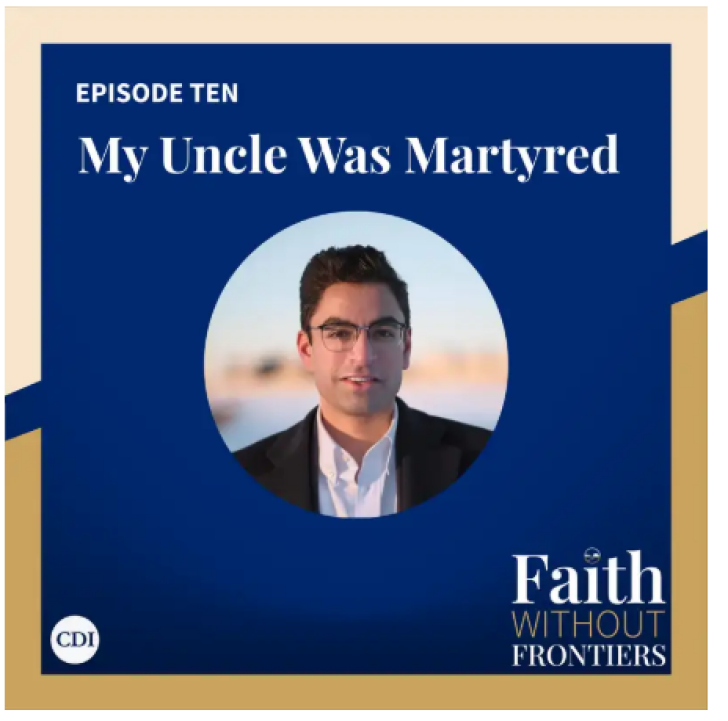
For David Bhatti, religious freedom is not simply a political issue. It is part of his family story.
The 29-year-old Canadian lawyer was born in Pakistan and immigrated to Canada with his family when he was about a year old. His parents wanted to raise their children in a country where they could practice their Christian faith without fear. Yet they also made sure David and his sister maintained close ties to their Pakistani heritage, returning regularly to visit relatives and preserving their Urdu and Punjabi languages.
In today's episode of Faith Without Frontiers podcast, Bhatti discusses how his family’s history, his Christian faith and the assassination of his uncle, Shahbaz Bhatti, shaped his commitment to religious freedom and public service.
Shahbaz Bhatti began advocating for persecuted Christians and other religious minorities as a teenager. At 12, during a Good Friday service, he told his parents he felt called to stand up for persecuted Christians. He later founded organizations that brought together Christians and members of other minority faiths, seeking to promote unity and human dignity across religious communities.
In 2008, Shahbaz Bhatti became Pakistan’s first Christian to serve in a federal cabinet position when he was appointed Minister for Minorities Affairs. During his time in government, he pursued reforms aimed at strengthening the rights and representation of religious minorities, including measures related to employment, political representation and national recognition of minority communities. Among his achievements was the establishment of Aug. 11 as National Minorities Day, a day that continues to recognize the contributions of religious minorities to Pakistan.
Bhatti was also known internationally for his opposition to the misuse of Pakistan’s blasphemy laws, which he sought to reform because of their vulnerability to abuse and their impact on religious minorities.
The threats against his uncle intensified as he continued his advocacy. Despite being offered opportunities to leave Pakistan for his safety, Shahbaz Bhatti refused, telling others that he could not abandon his “suffering brothers and sisters in Christ.” He was assassinated in March 2011. David was 15 at the time.
His uncle’s example became a defining influence on his own path. David began volunteering in Canadian politics as a child and eventually became involved with the Conservative Party, believing political engagement could provide a means of advancing religious freedom and human rights.
He recently ran for a federal Conservative nomination in Edmonton but was unsuccessful. The experience, however, has not diminished his interest in public service. “My end goal is not just to have political office, just for the sake of it,” he says, explaining that he wants to pursue issues involving international human rights and religious freedom.
Having worked and studied in Canada, the United Kingdom and the United States, and having engaged with lawmakers and international organizations, Bhatti says he wants to see Canada reclaim a stronger role in defending human rights and fundamental freedoms worldwide.
The conversation also offers a challenge to Christians who may be hesitant to enter politics: engage, understand policies and hold elected representatives accountable.
Bhatti’s story demonstrates how one family’s commitment to serving others, together with the example of a martyred uncle, can shape a lifelong calling to defend the freedom and dignity of others. The full conversation with David Bhatti is featured in today’s episode of Faith Without Frontiers.