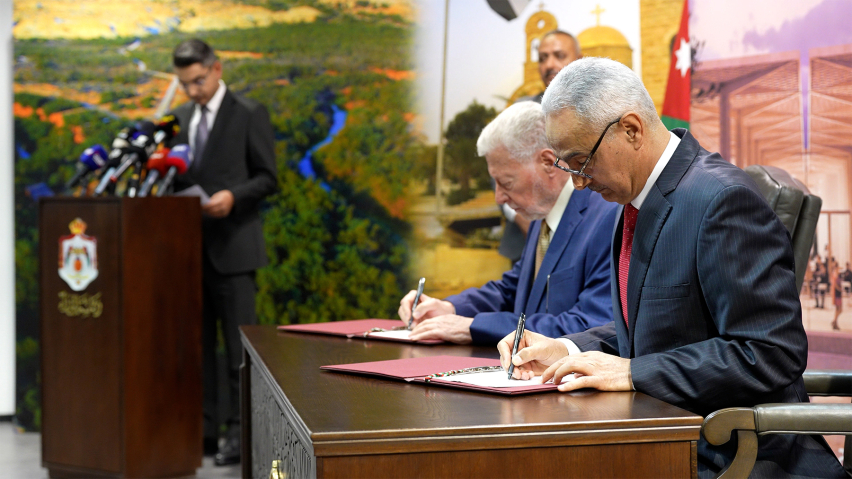
The Jordanian government has taken a significant step to intensify preparations for the second millennium celebration of the Baptism of Jesus Christ at the Baptism Site, the government announced Aug. 11.
The steering committee will be chaired by Prime Minister Jafar Hassan, who will also chair the high-level national committee alongside senior cabinet ministers, church leaders, tourism-related officials, private-sector professionals, and Christian civil society.
Plans for the site on the east bank of the Jordan are expected to include developing land adjacent to the Baptism Site into an authentic, biblical-style village for Christian pilgrims and visitors, a museum of the Baptism of Jesus Christ, a green corridor, and the development of the site's infrastructure.
Senator Michael Nazzal, chairman of the Tourism Committee in the Senate, told Christian Daily International that the prime minister's decision elevates official interest and encourages all Jordanian state institutions to participate in ensuring the success of this historic event.
Four agreements were signed Aug. 12. During the signing of agreements for the implementation of key projects within the National Project for the Development of the Lands Surrounding the Baptism Site of Jesus Christ (Al-Maghtas), Minister of Tourism and Antiquities Imad Hijazin commented, "We view these agreements as more than just cooperation documents; they represent a shared commitment, a national responsibility, and a strategic partnership that contributes to the success of this national project, strengthens Jordan's presence on the international stage, and highlights its unique cultural and human heritage."
The agreements include implementing a package of projects totaling approximately $120 million on land adjacent to the Baptism Site, covering an area of 1,400 dunams (140 hectares or 346 acres). This includes the design of the Baptism Site Museum at a cost of $50 million, designs for a comprehensive pilgrim and visitor village at a cost of approximately $40 million, infrastructure work at a cost of $27 million, and the construction of a green corridor at an estimated cost of $3 million.
Tharwat Al-Masalha, chairman of the Board of Trustees of the Baptism Site Development Corporation, told CDI that these projects aim to create a global event befitting the site's spiritual and historical significance and Jordan's humanitarian mission. He added, "Today, we are taking an important executive step by signing a number of agreements related to the project."
Al-Masalha said that funding for the village has been secured from Abu Dhabi, while the Church of Latter-day Saints (the Mormons) has agreed to cover 50% of the cost of the Baptism Museum.
The Baptism Site Museum project will be built on a 5,500-square-meter site (1.36 acres). The project also includes establishing an integrated village for pilgrims and visitors, enhancing the experience of visiting the Baptism Site. The Royal Society for the Conservation of Nature will be responsible for designing the green corridor.
According to the project timeline, preliminary work for the museum and the integrated village for pilgrims and visitors will begin at the end of the first quarter of 2027, with main construction work commencing at the end of the second quarter of the same year. The projects are expected to be completed during the first quarter of 2029.
Biblical references of the Baptismal site
Senator Nazzal framed the milestone not as a regional affair but a global one, describing it as a celebration of a central event in Christianity "which is the 2,000-year celebration of the baptism of Jesus Christ."
Nazzal referred to the Bible, stating that John the Baptist was based in "Bethany beyond the Jordan." He said that while people may have access to the river, the site itself and the river's course have changed over centuries. "The Israelis have access to the river, but the site itself and the river were not there 2,000 years ago."
"The riverbeds change locations," he explained, adding that the Jordan River passed differently during the period when Christianity's early churches were built. "And it passed actually on the Jordanian side… in front of one of the old churches in the site itself." An exhibition, Jordan, the Dawn of Christianity, is due to open at the Bible Museum in Washington, D.C., in the spring of 2027.
The Jordanian tourism expert and member of the Senate said that the continued construction of churches on the Jordanian side strengthens the case. "Confirmed by the Vatican, by the Greek Orthodox Church, and by all other churches that have built new churches on the site itself. So yes, the baptism site is on the Jordanian side of the river."
Senator Nazzal described the reality of early Christian persecution and exclusion. "2,000 years ago, Jesus was not welcome on the west side of the river or in Jerusalem. And that's why all the old churches and all the antiquities that relate to Christianity started in Jordan and not in Palestine."
Hope for increased tourism, especially from the US
While Jordanian tourism has been severely hurt by the war in Iran, Nazzal sounded optimistic about the return of American pilgrims and tourists. He called the United States market "lucrative," noting that marketing Jordanian Christian sites must be made to a broad Christian audience.
"Marketing the baptismal site and Christianity and the Dawn of Christianity to all denominations is of utmost importance." He described Jordanian air service as enabling growth, noting that Royal Jordanian flies to multiple U.S. destinations. "Royal Jordanian now is flying to five destinations in the U.S., and we hope to add more destinations, specifically LA and Florida."
In a portion of the interview framed as an address to church pastors in America, Nazzal emphasized Jordan's openness and historic role in early Christianity. He recalled historical ties to the United States via air travel and framed early visitors as Christian pilgrims. "Our first tourists that came were Baptists and were Southerners and were people that came to visit the holy sites."
And Nazzal repeated his argument that "Christianity started on the east bank of the Jordan River."