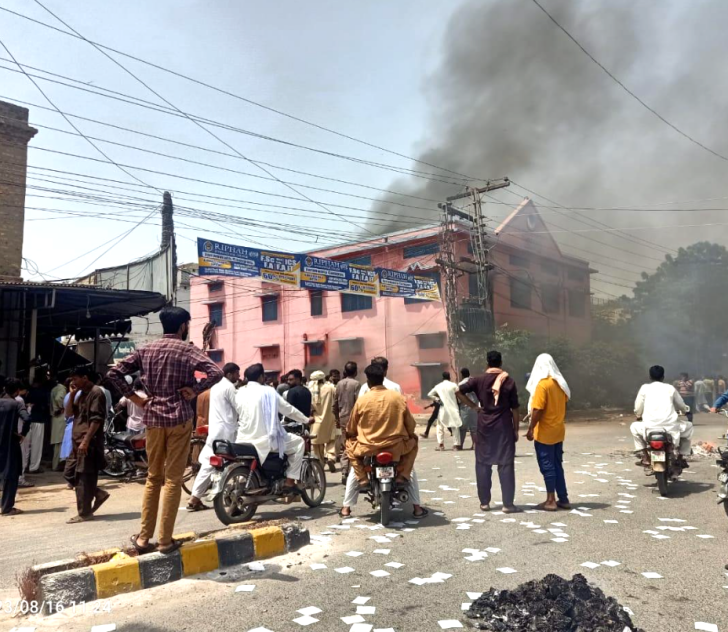
A court in Pakistan on Monday (July 13) sentenced the first person to be convicted for anti-Christian violence in Jaranwala in August 2023, handing him 10 years in prison while acquitting 13 others due to flawed investigations, sources said.
Judge Waseem Mubarik of the Faisalabad Anti-Terrorism Court (ATC) convicted and sentenced Irfan Yousaf, a Muslim, in two cases related to the desecration and arson of the Salvation Army Church and Peace Mission International Church during the Aug. 16, 2023, mob violence, said attorney Niaz Aamer.
The attacks erupted after two Christians were falsely accused of desecrating the Quran and insulting Muhammad, the prophet of Islam. Hundreds of Muslims led by leaders of a now proscribed extremist party, Tehreek-e-Labbaik Pakistan, rampaged through Christian neighborhoods, burning 26 church buildings and damaging or looting at least 86 homes of Christians.
The court announced verdicts in three cases involving attacks on three churches, Aamer, who was part of the prosecution team, told Christian Daily International-Morning Star News. The First Information Reports (FIRs) named 14 suspects and between 100 and 150 unidentified suspects.
“Irfan Yousaf, who operated the crane used to demolish the Salvation Army Church and Peace Mission International Church, was the principal accused in two cases,” Aamer said.
The court relied on forensically authenticated video evidence to convict Yousaf but acquitted the remaining 13 defendants because the prosecution failed to establish their guilt beyond reasonable doubt, he said.
“The acquittals resulted from defective police investigation and insufficient evidence,” Amer said, adding that the Punjab Province government would file appeals of the acquittals in the Lahore High Court as a matter of policy regarding cases registered under anti-terrorism laws.
The court strongly criticized police conduct in all three judgments, finding that officers failed to intervene effectively as the violence unfolded, neglected to call for reinforcements, secure forensic evidence or make prompt arrests, and delayed registration of the cases for six days, Aamer said.
“The judge noted that police damaged the prosecution through poor evidence collection and flawed identification lineups,” Aamer said. “These shortcomings directly contributed to the acquittal of the co-accused.”
Despite the acquittals, the court ordered police to trace and arrest the remaining 100 to 150 unidentified suspects who remain at large, the lawyer said.
Aamer urged authorities not only to apprehend those involved in the attacks but also those who incited the mobs responsible for attacking churches and Christian homes.
The latest acquittals follow a similar ruling last year, when the same anti-terrorism court acquitted 10 Muslims accused of setting fire to the Salvation Army Church building and looting the home of Christian resident Siddique Masih.
Masih’s attorney, Akmal Bhatti, previously told Christian Daily International-Morning Star News that the June 4, 2025 acquittals stemmed from an intentionally deficient police investigation.
“The police ignored compelling evidence against the accused and failed to conduct a proper investigation,” Bhatti said then, adding that Masih had positively identified the suspects during a jail identification parade.
Pakistan’s Supreme Court has repeatedly criticized the pace and quality of investigations into the Jaranwala violence. On March 31, a two-judge bench headed by Chief Justice Yahya Afridi ordered the Faisalabad ATC to conclude all Jaranwala-related trials within six months. The court also directed police to immediately arrest all absconding suspects while hearing Punjab government petitions seeking cancellation of bail granted to suspects in 22 cases arising from the attacks.
The intervention followed earlier criticism by the top court. In February 2024, a three-judge bench led by then-Chief Justice Qazi Faez Isa sharply rebuked the Punjab government’s progress report, describing it as inadequate and ordering officials to submit a revised report within 10 days.
“I am feeling ashamed that only 18 charge sheets were submitted in the case in the last six months,” Isa told a provincial law officer during the hearing.
He also questioned Pakistan’s commitment to protecting religious minorities while officials criticize Islamophobia abroad.
At the time, the Punjab government reported that 22 criminal cases had been registered, 304 suspects arrested and charge sheets submitted in 18 cases. The Supreme Court, however, found the report lacking key information about suspects, prosecution progress and the status of individual cases.
Separately, the Lahore High Court in October dismissed petitions by Christian groups and individuals seeking a judicial inquiry into the attacks. Justice Asim Hafeez ruled that the court lacked jurisdiction to order a judicial commission, noting that multiple Joint Investigation Teams had already completed their inquiries.
The two Christians whose alleged desecration of the Quran triggered the violence were later acquitted after a trial court found they had been falsely implicated by another Christian following a personal dispute.
Despite repeated government assurances of accountability, rights advocates say justice has remained elusive. According to Amnesty International, more than 5,200 people allegedly participated in the Jaranwala attacks, but only about 380 were arrested, leaving the overwhelming majority of suspects at large.
“Of the arrested suspects, 228 were released on bail and charges against 77 others were dropped,” Amnesty International’s Babu Ram Pant said in a statement marking the first anniversary of the attacks. He warned that weak investigations and prosecutions had fostered “a climate of impunity.”
Blasphemy allegations in Pakistan have frequently triggered mob violence, particularly against religious minorities. Although the country’s blasphemy laws prescribe severe penalties, including death, no one has been executed by the state for blasphemy. Nevertheless, accusations alone often spark vigilantism, communal unrest and deadly attacks.
International human rights organizations continue to express concern over the treatment of religious minorities in Pakistan. In its 2026 World Watch List, Open Doors ranked Pakistan eighth among the countries where Christians face the most severe persecution and discrimination.