
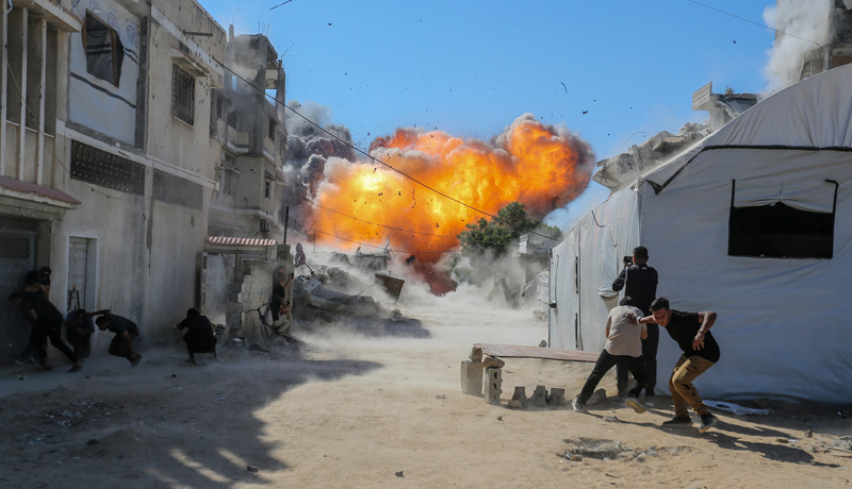
Israel’s military campaign in Gaza following the Hamas-led attacks of 7 October 2023 (a campaign that the UN Commission of Inquiry and several major human-rights organizations have concluded amounts to genocide) has generated not only unprecedented levels of destruction but also a remarkable revival of biblical language in contemporary political and religious discourse.
Profound questions about the theological imagination shaping the war.
Since the campaign began Israeli political leaders, religious figures, military rabbis, and public commentators have repeatedly invoked biblical narratives to frame the reality. References to Amalek, divine judgment, sacred revenge, and the destruction of enemies have appeared in political speeches, sermons, social media, and public debate. Such language has often accompanied calls for overwhelming military force and the devastation of Gaza, raising profound questions about the theological imagination shaping the war.
While international attention has focused on allegations of war crimes, crimes against humanity, and genocide, the theological dimensions of the conflict have received far less scrutiny. Yet behind the rhetoric of Amalek stands an even larger biblical narrative: the Book of Joshua.
If Amalek represents the enemy to be destroyed, Joshua provides the paradigm of conquest itself. The Book of Joshua narrates Israel's divinely sanctioned conquest of Canaan, including the destruction of cities, the removal of populations, and the possession of the land.
These texts have generated ethical discomfort and theological debate.
Throughout Jewish and Christian history, these texts have generated ethical discomfort and theological debate because they appear to authorize forms of violence that stand in tension with later biblical teachings.
The significance of Joshua in the present context is not accidental. As scholars such as Rachel Havrelock have shown, Joshua occupied an important place in the imagination of early Zionist thinkers and in the formation of modern Israeli identity.
Narratives... from the margins into the center of public discourse.
Long before October 7, themes of conquest, settlement, inheritance, and redemption of the land were embedded within various streams of Zionist thought, Israeli education, and Religious Zionism. The events of October 7 did not create these narratives. Rather, they brought them from the margins into the center of public discourse.
The revival of conquest language has not been limited to Israel. For decades many leaders within American Christian Zionism have interpreted the modern state of Israel through biblical narratives of covenant, conquest, and territorial promise.
Violence has increasingly been sacralized and framed as participation in God's purposes.
Following October 7, some Christian leaders openly supported military actions in Gaza through the language of holy war, divine judgment, and absolute victory. In both Jewish and Christian contexts, violence has increasingly been sacralized and framed as participation in God's purposes.
Against this backdrop, the recent statements of Pope Leo XIV questioning the continuing viability of just war theory are particularly significant. The just war tradition sought to restrain violence through principles of proportionality, discrimination, and civilian protection. Yet what we are witnessing today appears to move beyond the limits of just war altogether and toward a different paradigm—the paradigm of conquest.
The central theological question... is whether the paradigm of Joshua's conquest should continue to function as a model for political action.
The central theological question facing Christians today is not simply whether contemporary wars satisfy the criteria of just war theory. Rather, it is whether the paradigm of Joshua's conquest should continue to function as a model for political action. To answer that question, Christians must examine Joshua's role in modern political theology and ask how these narratives are transformed by the life and teachings of Jesus Christ.
Joshua, national identity, and the formation of modern Israel
Joshua's modern significance cannot be understood apart from the role of education and collective memory in the formation of Israeli national identity. From the earliest decades of Zionism, biblical narratives became central to the project of nation-building.
Joshua emerged as a powerful symbol of return, settlement, sovereignty, and possession of the land.
School curricula, youth movements, archaeological projects, public commemorations, and national ceremonies connected modern Jews with ancient Israel. Within this process, Joshua emerged as a powerful symbol of return, settlement, sovereignty, and possession of the land.
The Hebrew Bible functioned not only as a religious text but also as a national narrative. Through educational institutions and civic culture, generations of Israelis learned to see themselves as participants in a historical story stretching back to biblical Israel. Joshua therefore became more than a biblical figure; he became part of the symbolic language through which the nation understood itself.
The revival of Joshua and Amalek language after October 7 did not emerge in a vacuum. These narratives had long existed within sectors of Religious Zionism, nationalist thought, and Israeli civil religion. What changed was not their existence but their public visibility.
The trauma of October 7 activated deeply rooted narratives of existential struggle.
The trauma of October 7 activated deeply rooted narratives of existential struggle, sacred revenge, and national destiny. References to Amalek, conquest, and divine judgment became increasingly visible in political rhetoric, sermons, military discourse, and social media.
Alongside this revival emerged a powerful discourse of sacred revenge. Fear, grief, humiliation, and anger were often expressed through biblical categories that framed the conflict as a struggle against absolute evil. In such an atmosphere, overwhelming retaliation could easily be understood not only as strategically necessary but as morally and even religiously justified.
The danger is that biblical narratives become political programs.
The danger is that biblical narratives become political programs. Texts originally rooted in an ancient context are transformed into contemporary mandates. The distinction between justice and revenge becomes blurred, and criticism of military violence is portrayed as betrayal of the nation or opposition to God's purposes.
American Christian Zionism and the theology of conquest
The embrace of conquest theology did not begin in Israel.
The embrace of conquest theology did not begin in Israel. For decades many leaders within American Christian Zionism have interpreted modern Israel through the lens of biblical conquest narratives.
The modern State of Israel is often viewed as the direct continuation of ancient Israel, and biblical promises regarding land and sovereignty are applied to contemporary political realities with little attention to historical context or theological development.
Following October 7, these ideas became more visible. Hamas was frequently described as a modern Amalek, while Israel's military response was interpreted through the framework of Joshua's wars. Calls for the defeat of Hamas often expanded into rhetoric supporting the destruction of Gaza itself. Political leaders and religious commentators spoke of total victory, overwhelming force, and the elimination of enemies.
War is no longer understood merely as political conflict but as participation in a cosmic struggle between good and evil.
While many Christians expressed concern for civilians and called for peace, their voices were often overshadowed by narratives emphasizing conquest and divine judgment. The result was a renewed sacralization of violence. War is no longer understood merely as political conflict but as participation in a cosmic struggle between good and evil.
This development should concern Christians everywhere. When violence becomes sacred, moral restraints are weakened. Opponents cease to be human beings created in God's image and become obstacles to God's purposes. The language of conquest transforms political enemies into enemies of God.
Many Christians from Africa, Asia, and Latin America have offered an important corrective. Coming from societies marked by colonialism, occupation, and displacement, they often read Joshua from the perspective of those who experience conquest rather than those who exercise it.
Social location profoundly shapes biblical interpretation.
Their readings remind us that social location profoundly shapes biblical interpretation and that conquest narratives sound very different when heard from the perspective of the vulnerable.
Jesus and the transformation of holy war
How Joshua is to be read after Jesus Christ?
The decisive question for Christians is not whether Joshua belongs in scripture but how Joshua is to be read after Jesus Christ.
Many Jews in the first century expected a Messiah who would resemble Joshua or David—a leader who would defeat Israel's enemies and restore national sovereignty. Yet Jesus consistently rejected this path. Significantly, Jesus and Joshua share the same name, Yehoshua, but embody radically different visions of God's kingdom.
Joshua enters the land through conquest. Jesus announces the kingdom through repentance, healing, forgiveness, and reconciliation. Joshua defeats enemies. Jesus commands his followers to love them. Joshua's victories are achieved through military power. Jesus' victory comes through the cross.
Jesus commands his disciples to love their enemies.
This contrast reaches its clearest expression in Jesus' teaching. In the Sermon on the Mount Jesus commands his disciples to love their enemies, bless those who curse them, and pray for those who persecute them. When Peter draws a sword in Gethsemane, Jesus commands him to put it away. The kingdom of God will not be established through violence.
The cross therefore represents a profound transformation of holy war. God's victory is revealed not through the destruction of enemies but through self-sacrificial love. In Christ, reconciliation replaces conquest, forgiveness replaces revenge, and peacemaking replaces domination.
Christ must be the lens through which all Scripture is interpreted.
Whenever Christians use Joshua or Amalek to justify violence against contemporary enemies, they risk reading Jesus through Joshua rather than Joshua through Jesus. The New Testament reverses this order. Christ must be the lens through which all Scripture is interpreted.
Beyond conquest: a Christian response
The Church today faces a critical choice. It can continue to sacralize violence through the language of conquest, or it can recover its vocation as a community of reconciliation.
This does not mean ignoring evil, abandoning justice, or denying the right of societies to protect their citizens. It means refusing to allow biblical narratives of conquest to become theological justification for collective punishment, dehumanization, or the destruction of civilian populations.
Churches should challenge the misuse of Scripture in public discourse.
Practically, churches should challenge the misuse of Scripture in public discourse. Christian leaders should speak clearly when biblical language is employed to justify indiscriminate violence.
Seminaries and theological institutions should teach difficult texts such as Joshua responsibly and in light of Christ. Christians should advocate for international law, the protection of civilians, humanitarian assistance, and peaceful resolution of conflict.
The Church must recover the courage to be a prophetic community.
Perhaps most importantly, the Church must recover the courage to be a prophetic community. In times of war, religious institutions often become chaplains of national power. The biblical prophets, however, challenged kings, confronted injustice, and defended the vulnerable. The Church is called to continue that tradition.
The devastation of Gaza, the revival of Amalek rhetoric, and the renewed appeal to Joshua's conquest narratives reveal that the debate is about far more than military strategy. At stake is the moral and theological vision that shapes our understanding of God, humanity, and violence itself.
In Jesus Christ, holy war is transformed.
The question confronting Christians today is therefore not simply whether a particular war is just. It is whether conquest remains the model for God's people. The answer of the New Testament is clear. In Jesus Christ, holy war is transformed.
The path of conquest gives way to the path of reconciliation. The sword yields to the cross. The Church's calling is not to destroy enemies but to love them, not to sanctify violence but to bear witness to the God who reconciles the world to himself.
Professor Dr. Salim J. Munayer is the founder of Musalaha, an organization dedicated to fostering reconciliation between Palestinians and Israelis and other divided communities in the Middle East. He served for several years as Academic Dean at Bethlehem Bible College and has authored several theological books focusing on theology, reconciliation, and justice. Professor Munayer currently serves as the MENA Region Team Lead for the Peace and Reconciliation Network (PRN) of the World Evangelical Alliance (WEA).








