
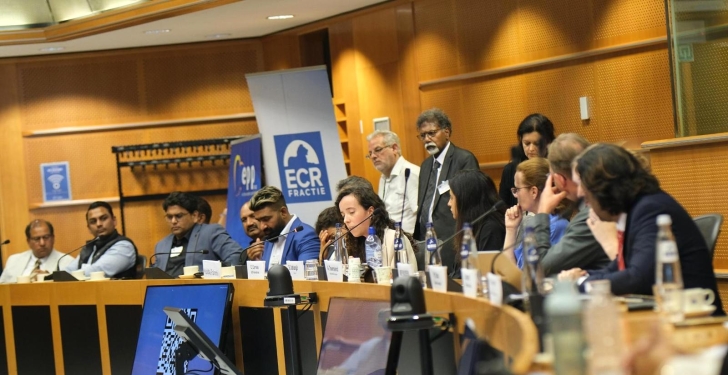
Members of the European Parliament (MEPs) and rights advocates on Tuesday (July 14) urged Pakistan to strengthen protections underage Christian and Hindu girls and other religious minorities, frequently subject to forcible conversion to Islam and marriage to those who kidnap them.
Jointly hosted at the European Parliament by MEP Bert-Jan Ruissen of the European Conservatives and Reformists (ECR) Group and MEP Matej Tonin of the European People’s Party (EPP) Group, the event examined how the European Union (EU) can more systematically raise concerns over forced conversions, child marriage and the protection of religious minorities in its bilateral engagement with Pakistan, according to a press statement by Jubilee Campaign Netherlands.
Efforts by the EU to raise concerns include monitoring under the Generalized Scheme of Preferences Plus (GSP+) trade framework, Jubilee noted.
The discussion followed the European Parliament’s July 9 adoption of a resolution on the case of Maria Shahbaz, a 13-year-old Christian girl allegedly abducted, forcibly converted and married, calling for stronger protections for girls in Pakistan.
Opening the event, MEP Tonin said the international community must not overlook vulnerable communities and urged Pakistan to uphold the rights of its religious minorities. Ruissen, who played a leading role in advancing the resolution, called for sustained international engagement to address the abduction, forced conversion and child marriage of Maria and other minority girls.
“Girls like Maria deserve protection, justice and a safe return to their families – not to be placed back into the custody of those accused of abusing them,” Ruissen said, according to Jubilee.
Human rights lawyer Sulema Jahangir said Pakistan already has legal provisions that could be used to prosecute child marriages involving girls under 16 as statutory rape cases, but criticized inconsistent judicial enforcement.
She said some courts had issued rulings that circumvented existing child protection laws by relying on interpretations of Islamic jurisprudence that permit marriage after puberty rather than applying Pakistan’s statutory law.
“The problem is not the absence of legal protections, but the failure to apply them consistently,” Jahangir said. “When courts disregard child protection laws, accountability is undermined and vulnerable girls are left without effective legal remedies.”
She added that forced religious conversions often isolate girls from their families, making it significantly more difficult for them to seek justice or return home.
Joseph Janssen, advocacy officer at Jubilee Campaign Netherlands, said Pakistan’s child marriage laws were applied inconsistently, particularly in cases involving Christian girls.
“The European Parliament’s resolution sends a clear message that the international community expects Pakistan to protect vulnerable minority girls, prosecute those responsible and uphold the rule of law,” Janssen said. “It strengthens our resolve to continue advocating for these children.”
During the event, Jubilee Campaign Netherlands and Voice for Justice launched a report, “Stolen Girls: Exposing the Hidden Suffering of Christian Minor Girls in Pakistan,” documenting 210 alleged cases of abduction, forced conversion, child marriage and sexual violence involving Christian girls between 2019 and 2026.
Nearly 89 percent of the documented cases occurred in Punjab Province, while 83 percent of the victims were under 18 years of age, according to the report.
“These are not isolated incidents,” Janssen said. “Our research identifies a consistent pattern of abuse targeting Christian minor girls across Pakistan.”
He said the report found an average age difference of 23 years between victims and the men they married, with many alleged perpetrators between 40 and 60 years old.
The report also alleged widespread document manipulation.
“In most documented cases, the girls’ Christian names were changed following conversion, and marriage records frequently recorded false ages to portray them as adults,” Janssen said.
He also criticized judicial procedures in such cases.
“Many girls are asked to testify while still living under the control of their alleged abductors,” he said. “Statements obtained under those circumstances cannot reasonably be regarded as free or voluntary, yet courts often rely on them alongside disputed documents when deciding custody.”
Referring to Maria, Janssen said her case reflected a broader pattern.
“Behind every documented case is a child whose future has been taken away and a family still waiting for justice,” he said, urging the Pakistan government to criminalize forced religious conversions, place abducted minors in independent shelters pending legal proceedings, investigate forged conversion and marriage documents, prosecute those responsible, and strengthen child protection mechanisms.
Attendees observed a moment of silence after watching video testimonies from families whose daughters remain missing or in the custody of alleged abductors.
Anna Townsend, author of “Our Sisters: The Fight for Justice for Christian Women Forced into Marriage in Pakistan,” said the testimonies illustrated the lasting trauma experienced by victims and their families.
Professor Shahid Mobeen noted that Pakistan benefits from the EU’s GSP+ trade preferences, which are linked to commitments on human rights, sustainable development and good governance.
“The GSP+ framework gives the European Union an important opportunity to encourage Pakistan to strengthen protections for religious minorities and ensure that the economic benefits of preferential trade are matched by meaningful human rights progress,” he said.
Hulda Fahmi of Jubilee Campaign said the EU should evaluate implementation, not merely ratification, of the 27 international conventions required under GSP+.
“Trade preferences should be accompanied by meaningful human rights compliance. There should be no tolerance for forced religious conversions or child marriages,” she said.
Carmen Correas, legal counsel with ADF International, briefed participants on Maria’s case and called for greater judicial training to ensure Pakistan’s domestic laws are interpreted consistently with its international human rights obligations.
The panelists also urged Pakistani authorities to make greater use of the National Database and Registration Authority (NADRA) to verify the ages of children before marriage, arguing that electronic verification could help prevent the falsification of age records.
The speakers noted that as the EU prepares to implement its revised GSP Regulation in January, the new framework will allow for a faster suspension of trade preferences in cases involving exceptionally serious human rights violations.
International advocacy groups continue to rank Pakistan among the world’s most difficult countries for Christians. In its 2026 World Watch List, Open Doors ranked Pakistan eighth among the 50 countries where Christians face the most severe persecution, citing systemic discrimination, mob violence, forced conversions, bonded labor and gender-based violence.








