
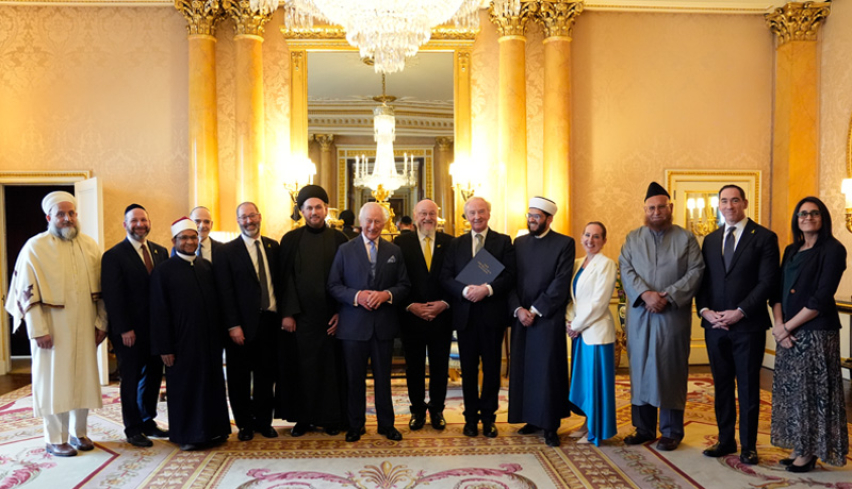
As reported already by Christian Daily International, King Charles III has changed the religious wording in the recently published Sovereign Grant Annual Report and Accounts 2025–26, the Royal Household's annual report.
The previous report described one of the King's constitutional roles as: "Head of the Church of England and Defender of the Faith." (Strictly speaking, the constitutional title is "Supreme Governor of the Church of England", although the report itself used the more colloquial expression, "Head of the Church of England".)
The new report instead states: "His Majesty is Supreme Governor of the Church of England and protects the space for Faith within the multi-faith nation."
It also says that the King has "a special role in bringing communities and faiths together."
Contrary to some media reports, this is not a constitutional change. The King's historic and official titles (Defender of the Faith and Supreme Governor of the Church of England) remain unchanged. They continue to appear in his official royal style, in the Coronation Oath, on official seals and on British coinage ("FID DEF", Fidei Defensor). Any formal alteration of these constitutional titles would require legislation by Parliament.
The new wording nevertheless reflects a position that Charles has expressed for more than thirty years.
The new wording nevertheless reflects a position that Charles has expressed for more than thirty years. As Prince of Wales, he remarked in a well-known 1994 interview that he would rather think of himself as "Defender of Faith" than "Defender of the Faith", because he wished the monarch to be regarded as protecting people of all religions.
Following criticism, he clarified in 2015 that he had no intention of abandoning the historic title. Rather, he argued that one could remain Defender of the Faith while also acting as a protector of people of different faiths in a religiously diverse society.
Nevertheless, both the history of this debate and the new wording raise questions. They suggest either that the distinction between the King's constitutional roles has not been expressed with sufficient clarity or that the terminology has unintentionally blurred an important constitutional distinction.
Two distinct constitutional roles
The British monarch exercises two distinct constitutional functions.
The British monarch exercises two distinct constitutional functions.
A) Supreme Governor of the Church of England
As Supreme Governor of the Church of England, the monarch performs a specifically ecclesiastical function deriving from the English Reformation and the subsequent constitutional settlement.
This role applies only to the Church of England. It has not applied to the Church in Wales since its disestablishment in 1920, nor to the Church of Ireland since its disestablishment in 1871. It has never applied to the Presbyterian Church of Scotland, whose constitutional relationship with the Crown is entirely different, nor to the Roman Catholic Church, the Orthodox Churches, or the evangelical Free Churches.
11 million people identify themselves as Anglican in England... almost 30 million now identify with no religion.
According to the 2021 Census, approximately 11 million people identify themselves as Anglican in England, representing roughly 16 percent of the total UK population. Christians belonging to other churches, including Catholics, Presbyterians, Methodists, Baptists, Pentecostals, independent churches and Anglicans outside England, significantly outnumber members of the Church of England. Around 6–7 million people belong to non-Christian religions, while almost 30 million now identify with no religion.
B) Head of State
As Head of State, the monarch has a constitutional duty to serve all citizens equally, regardless of religion or belief, and to uphold the constitutional order and the human rights of all citizens, including freedom of religion or belief.
The Crown protects the freedom of religion or belief.
These two roles are complementary but distinct. The Crown protects the freedom of religion or belief of Muslims, Jews, Hindus, Christians of every denomination, humanists, atheists and others when acting in its constitutional capacity as Head of State. This responsibility is not an extension of the monarch's ecclesiastical office within the Church of England.
The new wording risks blurring this distinction.
Why the new wording matters.
The wording can easily suggest that these are different aspects of one and the same religious office.
By combining the historic office of Supreme Governor of the Church of England with language about protecting "Faith within the multi-faith nation" under one description of the King's role, the report appears to merge the monarch's ecclesiastical office within one established church in England with the Crown's broader constitutional responsibilities towards all citizens throughout the United Kingdom. Even if this was not intended, the wording can easily suggest that these are different aspects of one and the same religious office.
This may unintentionally create several misunderstandings.
1. It may distort historical continuity.
Queen Elizabeth II consistently defended the religious liberty of all her subjects.
Queen Elizabeth II consistently defended the religious liberty of all her subjects while remaining firmly committed to her constitutional role as Supreme Governor of the Church of England and Defender of the Faith. The constitutional distinction already enabled previous monarchs to fulfill both responsibilities simultaneously. The new wording could inadvertently suggest otherwise.
2. It leaves the position of other Christian churches unclear.
If the King's intention is to emphasize his concern for all faith communities, it would be equally appropriate to acknowledge explicitly the many millions of Christians who do not belong to the Church of England. Roman Catholics, Presbyterians, Methodists, Baptists, Pentecostals, Orthodox Christians and members of independent churches together considerably outnumber members of the established Church of England. They, too, fall under the Crown's responsibility to protect freedom of religion or belief.
3. It overlooks citizens with no religion.
International human rights law protects freedom of religion or belief, not merely religious faith.
The report speaks of protecting "Faith" within a multi-faith society, yet almost half of Britain's population now identifies with no religion. International human rights law protects freedom of religion or belief, not merely religious faith.
Article 18 of the Universal Declaration of Human Rights and the International Covenant on Civil and Political Rights protects the rights of religious and non-religious people alike. A constitutional formulation should therefore encompass both believers and those holding non-religious convictions.
4. It may create constitutional and theological ambiguity.
Charles has repeatedly spoken of acting as a protector of people of all faiths. Understood civically, this is entirely appropriate for a constitutional monarch. However, when this language is presented immediately alongside his office as Supreme Governor of the Church of England, some readers may infer that the monarch exercises a broader form of religious leadership extending beyond Anglicanism.
Religious freedom does not require the monarch to occupy a religious role in relation to other churches or religions.
Neither the British constitutional settlement nor the traditions of Britain's other churches and faith communities support such an interpretation. Religious freedom does not require the monarch to occupy a religious role in relation to other churches or religions.
On the contrary, many Christian traditions in Britain (including the historic Nonconformists and later Dissenters) struggled precisely for freedom from state control over the official Church. Their concern was not opposition to the monarchy as such, but resistance to royal authority in ecclesiastical matters. That historical distinction remains relevant today.
5. A further constitutional question: the King's role in interfaith dialogue.
The report also states that the King has "a special role in bringing communities and faiths together." This raises a constitutional question that is distinct from both his role as Supreme Governor of the Church of England and his duty as Head of State to protect freedom of religion or belief.
As Head of State, he is well placed to encourage civility, social cohesion and respectful dialogue across British society.
Few would question the value of peaceful relations between religious communities or the King's personal commitment to mutual understanding and respect. As Head of State, he is well placed to encourage civility, social cohesion and respectful dialogue across British society.
Whether it is constitutionally desirable, however, for the Sovereign to assume a distinctive leadership role in organized interfaith dialogue is a different matter. Interfaith dialogue is most credible when it takes place voluntarily between religious communities as equal partners, rather than under the initiative or patronage of the State. The constitutional role of the Crown is to guarantee the equal freedom of all religions and beliefs, not to guide or direct their relationships with one another.
An active leadership role in interfaith dialogue may unintentionally create uncertainty about the constitutional boundaries of that ecclesiastical office.
Moreover, because the Monarch simultaneously serves as Supreme Governor of the Church of England, an active leadership role in interfaith dialogue may unintentionally create uncertainty about the constitutional boundaries of that ecclesiastical office.
Some may interpret such a role as implying a wider religious authority extending beyond the Church of England, even though no such authority exists in British constitutional law or in the traditions of Britain's churches and faith communities.
The King can therefore make an important contribution by encouraging mutual respect and protecting the equal freedom of all religious and non-religious communities. Yet that objective may ultimately be served best when the Crown acts as an impartial constitutional guarantor of liberty rather than as a leading participant in organized interfaith engagement.
Conclusion
King Charles is entirely right to emphasize that the Crown should protect the freedom of religion or belief of every citizen, regardless of religion or worldview. Indeed, this is one of the defining characteristics of a modern constitutional monarchy.
However, that civic responsibility belongs to the monarch's office as Head of State, whereas the office of Supreme Governor belongs exclusively to the constitutional relationship between the Crown and the Church of England.
Greater conceptual clarity would better serve both the Church of England and Britain's increasingly diverse society.
The traditional British constitutional settlement has long succeeded in keeping these two roles distinct while allowing the monarch faithfully to fulfill both. The wording adopted in the Sovereign Grant Annual Report 2025–26 risks obscuring that distinction. Greater conceptual clarity would better serve both the Church of England and Britain's increasingly diverse society.
Archbishop and Professor Thomas Paul Schirrmacher is the President of both the International Council of the International Society for Human Rights in Frankfurt and the International Institute for Religious Freedom in Costa Rica and Bonn. He was Secretary General of the World Evangelical Alliance from 2021 to 2024. Prior to this, he served the WEA for 25 years in various roles, including Associate Secretary General for Theological Concerns and Intrafaith and Interfaith Relations. He travels to over 50 countries a year, meeting heads of state and government, religious leaders, and heads of churches of all confessions on behalf of the persecuted church, as well as fighting human trafficking and corruption.
The International Institute for Religious Freedom (IIRF) was founded in 2005 with the mission to promote religious freedom for all faiths from an academic perspective. The IIRF aspires to be an authoritative voice on religious freedom. They provide reliable and unbiased data on religious freedom—beyond anecdotal evidence—to strengthen academic research on the topic and to inform public policy at all levels. The IIRF's research results are disseminated through the International Journal for Religious Freedom and other publications. A particular emphasis of the IIRF is to encourage the study of religious freedom in tertiary institutions through its inclusion in educational curricula and by supporting postgraduate students with research projects.








