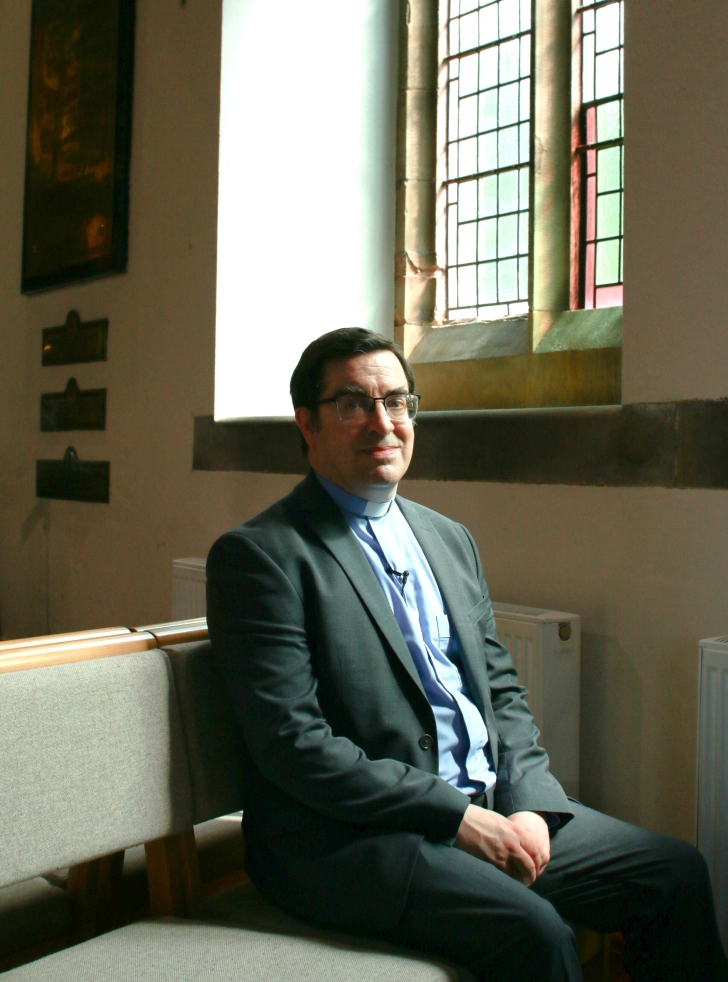
An Anglican priest in England has secured a confidential legal settlement in a conflict stemming from a sermon he delivered on LGBT+ ideology at a secondary school.
Following a seven-year legal battle, the settlement overturns a Church of England “safeguarding” blacklist record against the Rev. Bernard Randall that had barred him from public ministry.
The legal breakthrough followed a major ruling at the Employment Appeal Tribunal on March 4, 2025, in London, where Judge James Tayler set aside a previous tribunal ruling against the priest. Tayler ordered a full retrial and commanded Trent College to pay £20,000 (about $24,500) in court costs to Randall.
The Christian Legal Centre representing Randall, 53, has since finalized a confidential settlement with the school.
“Seven years have been taken from me for doing my duty as a CofE chaplain in a school with a CofE ethos,” Randall said in a press statement from rights group Christian Concern. “I encouraged pupils to think, to debate, and to love their neighbors whatever they believed. No minister, teacher or chaplain should be punished for upholding Christian teaching in a Christian setting.”
The conflict began in June 2019 when administrators at Trent College, an independent school with a Church of England ethos in Long Eaton, Derbyshire, dismissed Randall from his role as school chaplain. The termination followed a chapel sermon in which Randall told students that they could reasonably question and debate modern LGBT+ ideologies from an orthodox Christian standpoint.
According to the Christian Legal Centre, the chapel sermon directly responded to an institutional push within the school. In June 2018, Trent College invited the external advocacy group Educate and Celebrate to conduct staff training. During that session, the group’s founder, Elly Barnes, explicitly encouraged school staff to “smash heteronormativity” and embed queer theory across the entire school curriculum, including the nursery.
Randall expressed pastoral concerns to senior school leadership regarding the appropriateness of this material, highlighting the tension between the advocacy group’s program and the school’s Christian foundation. Despite his objections, school leadership adopted the gender identity curriculum in January 2019 and excluded the chaplain from subsequent consultations.
In June 2019, a pupil approached Randall, asking why students were required to accept transgender ideology in a Christian school environment. Randall addressed the issue by delivering a sermon titled “Competing Ideologies,” which emphasized traditional Christian teachings on marriage and identity while encouraging mutual respect and open debate among students.
Without Randall’s knowledge, Trent College administrators reported the chaplain to the British government’s counterterrorism watchdog, known as Prevent, for alleged “religious extremism.” Administrators also flagged him to the Local Authority Designated Officer (LADO) as a potential safeguarding risk.
Both external agencies investigated the reports and concluded that Randall posed no risk and had no case to answer. The LADO completed its assessment within 24 hours, determining the matter was an internal employment dispute over beliefs rather than a genuine safeguarding concern.
Despite the findings of secular authorities, Trent College Headmaster Bill Penty issued a letter to Randall in August 2019, stating that the chaplain’s conduct amounted to gross misconduct and resulting in his dismissal.
Randall appealed the decision internally. While the school overturned the dismissal and reinstated him, it issued a final written warning and imposed strict management instructions that directly censored his chapel addresses.
“My case has revealed the extent of the corruption within the Church, our schools and in the judiciary, and should deeply concern us all,” said Randall. “It has been an extraordinary journey, and one I never would have dreamed I would have had to bear. My faith and loyalty to the Church has been tested to the extreme. I have experienced many dark hours, but I have come through it and now want to get on with my life and get back to what I have always loved and been passionate about doing: serving Jesus and his Church.”
By January 2020, Randall commenced legal proceedings against Trent College, alleging direct and indirect discrimination under the Equality Act 2010, harassment, victimization and unfair dismissal. Later that year, following COVID-19 pandemic lockdowns, the school reduced the full-time chaplaincy role to a part-time position of seven hours per week during term time.
Unable to accept the reduction, Randall faced redundancy, prompting him to widen his lawsuit in April 2021 to include unfair dismissal and victimization.
Meantime, the safeguarding team at the Diocese of Derby reviewed the 2019 sermon by Randall on gender identity. Diocesan officials initiated an internal “safeguarding” process despite receiving no formal complaints of misconduct or abuse against the priest.
The process culminated in the Diocese of Derby blacklisting Randall from public ministry by denying him a Permission to Officiate (PtO) license after his redundancy. Randall described the subsequent investigations as highly irregular, noting that officials routinely refused to specify the exact “safeguarding” allegations they were investigating.
In July 2021, diocesan leaders informed Randall that he must undergo an independent safeguarding assessment by a specialist psychologist whose primary work involved evaluating serious sex offenders. Randall refused to comply, arguing that submitting to such an assessment amounted to a tacit admission of wrongdoing where no evidence of harm existed.
With domestic legal avenues stalled, Randall filed a formal misconduct complaint in July 2022 against the Bishop of Derby, the Rev. Libby Lane, under the Clergy Discipline Measure 2003, alleging that her office’s safeguarding process had become abusive.
The Most Rev. Justin Welby, then Archbishop of Canterbury, intervened by dismissing the complaint and refusing permission for a formal investigation into Bishop Lane. He also declined to refer the case to the National Safeguarding Team.
The Church’s senior legal officer for clergy discipline, Gregory Jones KC, subsequently reviewed the decision, however, and ruled that the Archbishop had misunderstood his powers and was “plainly wrong.”
Jones described the diocese’s handling of Randall’s safeguarding status as “egregious” and a “gross” error, finding no evidence to support claims that the priest posed a risk. Consequently, Jones remitted nine of Randall’s 13 allegations back to Bishop Lane for a formal response.
The internal delay continued until the President of Tribunals, Dame Sarah Asplin, concluded that the Church’s handling of the case was “highly unsatisfactory.” Asplin ordered the entire disciplinary process to restart from the beginning, though she declined to recommend direct disciplinary action against Bishop Lane.
While the internal church conflict persisted, Randall’s initial employment case went to trial at the Nottingham Justice Centre in September 2022 before Employment Judge Victoria Butler and two lay members, including trade unionist Jed Purkis. In February 2023, the tribunal ruled against Randall on all counts, upholding the school’s actions and asserting that the chaplain held an “extreme view” of Educate and Celebrate.
The judgment fell apart a year later during a separate, parallel legal case handled by the Christian Legal Centre involving a teacher known as Hannah, who had faced dismissal for raising safeguarding concerns over child gender transitioning. During that March 2024 hearing, lawyers discovered a series of highly anti-Christian and anti-conservative social media posts authored by Purkis, the same lay panel member from Randall’s case.
Purkis’ online statements included assertions that “only atheists should be allowed to run for office” and profanity-laced criticisms of Christians. Confronted with the evidence, Judge Butler recused the entire panel, causing the hearing to collapse. The Judicial Conduct Investigations Office subsequently issued a formal rebuke to Purkis for judicial misconduct.
This disclosure formed a core pillar of Randall’s appeal, which commenced on March 4, 2025. Judge Tayler determined that the original tribunal’s ruling against Randall was legally “unsafe” due to apparent panel bias. Rather than proceeding to a hostile retrial, Trent College agreed to pay the £20,000 cost order and negotiated the confidential settlement that resolved the employment dispute.
In parallel with the workplace settlement, the Diocese of London executed an independent safeguarding review recommended by the Church’s senior legal officers to address the ongoing ministerial ban. The independent investigator conclusively cleared the priest, finding no evidence of harm.
“After full consideration and review of the available information I cannot establish, on the balance of probabilities, that harm was caused by the delivery of the sermons,” the investigator’s report concluded. “My recommendation... is that the investigation finds the concern or allegation was unsubstantiated and there are no ongoing safeguarding concerns.”
Despite clearing Randall of all safeguarding allegations, the investigator’s final report criticized his approach, stating that “more constructive cooperation with the process by Dr. Randall could have enabled it to be brought to an earlier conclusion.” The report added that Randall’s firm belief that his actions were entirely correct showed a failure to fully understand the broader objectives of modern safeguarding structures.
Randall’s legal team criticized that addendum, arguing it indicates a desire within the Church of England to punish clergy who uphold official church doctrine. They noted that the House of Bishops explicitly declared in 2021 that the content of Randall’s sermon contained nothing outside the authorized teaching of the Church of England.
At the same time, Educate and Celebrate quietly dissolved following a series of external scandals. The Charity Commission closed the organization down after one of its prominent patrons, Stephen Ireland, received a 24-year prison sentence for committing multiple sexual offenses against children.
Andrea Williams, chief executive of the Christian Legal Centre, called the end of the legal battle a major vindication but demanded reform within the denomination.
“Bernard Randall has endured one of the most extraordinary and disturbing cases we have ever supported,” Williams said. “Secular bodies repeatedly vindicated him, but the Church of England, the institution that should have supported him the most, repeatedly failed him. Schools, churches and public bodies must learn from this case and protect, rather than punish, lawful Christian expression.”
Williams publicly called on the current Archbishop of Canterbury, the Rev. Sarah Mullally, to meet urgently with Randall to discuss the wider implications for clergy freedom of speech.
Randall has completed all mandatory training and satisfies the national criteria to receive a Permission to Officiate license.
Bishop Libby Lane’s office has not issued a public statement indicating when or how the Diocese of Derby intends to support the priest’s return to full-time active ministry.