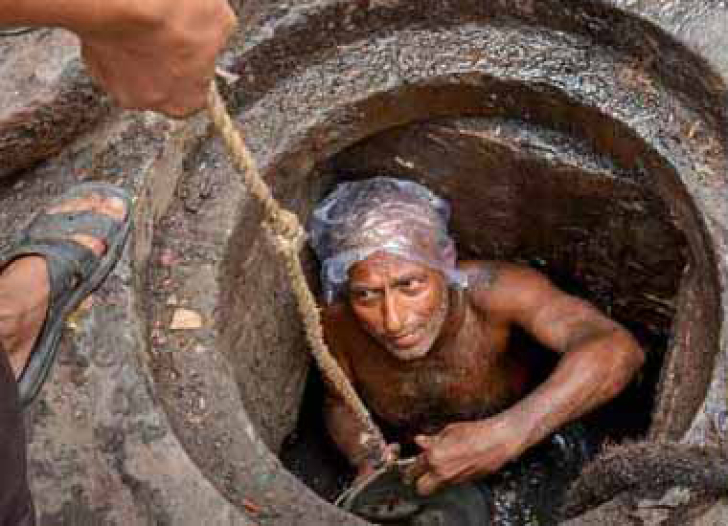
The National Commission for Human Rights (NCHR) has filed a landmark constitutional petition before the newly established Federal Constitutional Court (FCC), seeking an end to manual sewer cleaning – a practice that has claimed the lives of dozens of Christian and other sanitation workers over the years.
The petition marks a significant legal step toward protecting one of Pakistan’s most marginalized labor groups.
Heard on Nov. 21 by a three-judge bench headed by FCC Chief Justice Aminuddin Khan, the petition highlighted the severe and often fatal risks sanitation workers face due to unsafe working conditions, the absence of protective equipment and lack of training. NCHR argued that forcing workers into sewers without safety measures violates fundamental constitutional rights, including the rights to life, dignity, equality and a secure working environment.
The petition was based on NCHR’s inquiry report, titled “Risk of Sanitation Work in Pakistan,” which documents extensive complaints, deaths, injuries and unsafe conditions faced by sanitation workers across the country between 2022 and 2024. According to the report, the commission received multiple complaints of sanitation workers who lost their lives while on duty.
NCHR further submitted that Pakistan lacks a uniform national health-and-safety framework for sanitation work. In the absence of regulatory enforcement and emergency response mechanisms, workers are routinely exposed to toxic gases, life-threatening injuries and preventable deaths, it added.
According to advocacy group Sweepers Are Superheroes, at least 84 sewage workers have died across 19 districts of Pakistan in the past five years.
During the Nov. 21 hearing, NCHR’s pro bono counsel, Barrister Iqbal Nasar, informed the bench that just a day earlier, another sanitation worker had died inside a gutter in Sindh. He stressed that such “inhumane working conditions” demanded urgent government intervention.
Following the arguments, the FCC issued notices to the respondents, including the Water and Sanitation Agency, waste management companies, and provincial governments.
“Manual cleaning of gutters is brutal and dehumanizing. No person’s life should be put at risk for a task that should never require human hands in the first place,” NCHR Chairperson Rabiya Javeri Agha told the media after attending the hearing.
Agha emphasized that mechanization, proper training, and strict enforcement of occupational safety standards are essential to protect sanitation workers, who predominantly come from marginalized religious and social backgrounds.
Sanitation work in Pakistan remains deeply stigmatized and is widely viewed as a caste-based occupation tied to religious minorities such as Christians and Hindus.
The 2021 report Shame and Stigma in Sanitation by the Centre for Law & Justice (CLJ) links the profession to centuries-old caste structures in the subcontinent.
“This ruthless practice has died down to a large extent in Pakistan, but sanitation is probably the only occupation where this traditional caste structure continues,” the report notes.
A July 2025 Amnesty International report, titled “Cut Us Open and See That We Bleed Like Them,” found that sanitation workers in Pakistan face systemic discrimination, hazardous conditions and caste-based exclusion in public-sector employment.
Amnesty noted that sanitation work is overwhelmingly assigned to non-Muslims from so-called “lower castes,” often without offering them real alternative employment options.
This caste and religion-based marginalization results in widespread violations of fundamental rights – including dignity, life, safety and freedom of association – as well as restrictions on access to labor protections, fair wages, and safe working conditions, despite constitutional guarantees and Pakistan’s international human rights obligations, it stated.
The situation is even more precarious for women sanitation workers, who face “triple discrimination” at the intersection of caste, religion, and gender. Nearly half the women interviewed for the report reported workplace harassment.
The report also noted that stigmatization has made sanitation workers vulnerable to violence, including in cases involving blasphemy allegations. It cited several cases of Christian sanitation workers accused of blasphemy, including the country’s most high-profile blasphemy victim, Asia Bibi.
Data collected from nearly 300 government job advertisements (2010 to March 2025) showed that many explicitly required applicants to be non-Muslim or from “lower castes,” reinforcing historical caste-based employment patterns and effectively pushing non-Muslim workers into sanitation roles.
Amnesty’s review of five government agencies found that Christians were disproportionately employed not only in the lowest pay grades, but specifically in sanitation positions.
The report also identified three employment categories of sanitation workers –permanent, contractual and daily-wage – with government bodies across Pakistan resisting the regularization of workers. This denial of regular employment deprives them of job security, benefits, and legal protections. In many cases, sanitation workers are excluded from the legal definition of “worker,” and when they are included, the laws fail to cover temporary and daily-wage employees.
Sanitation workers interviewed in the study were found to be poorly covered by social security and welfare schemes and lacked awareness of the services available to them.
“Workers across all districts reported that their salaries were insufficient to cover their basic needs,” the study found, adding that they were routinely exposed to unsafe and hazardous working conditions. Most sanitation workers also reported receiving neither protective equipment nor training in occupational health and safety.