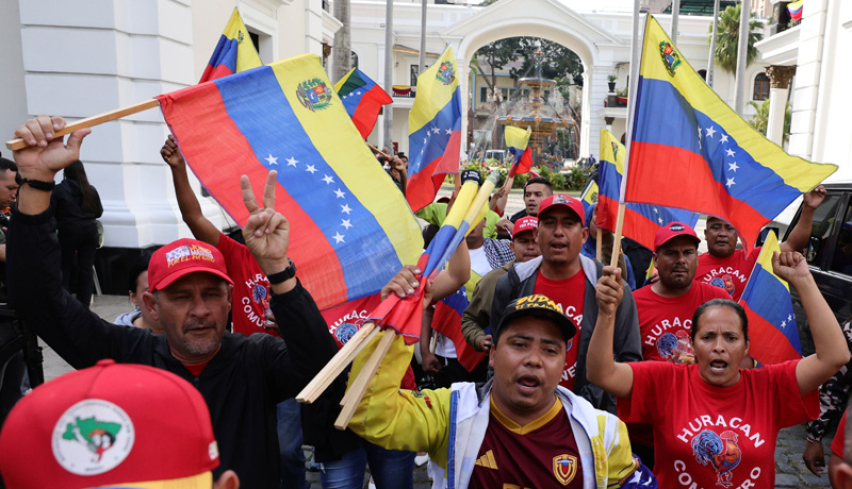
Between the ideological fervor that floods social networks and the extreme stances regarding the events that took place in Venezuela, one question goes unanswered: what do the Venezuelans themselves feel?
While Christians from other countries opine, celebrate, or condemn from a distance, the voices of those in exile and those still in the country reveal pain, hope, fear, and faith, remembering that at the center of the conflict there are people who bear the consequences of more than two decades of dictatorship.
The Evangelical church... has ceased to be alien to political discussions.
For some time, the Evangelical church, in general, has ceased to be alien to political discussions. Social networks are the preferred venue to bring to light the thinking of thousands of Christians who feel the need to express themselves on this matter. Any event is celebrated or criticized with the same zeal by Evangelicals who have assumed specific political positions.
The average Venezuelans... were seldom asked how they felt.
The events of Saturday morning, January 3, 2026, in Venezuela are a testament to this, sparking countless expressions on social media. Voices in favor of American intervention for the liberation of the oppressed Venezuelan people and voices that still found arguments to defend Nicolás Maduro’s dictatorship. In the middle of it all, the people—the average Venezuelans—were seldom asked how they felt, and what was going through their heart and mind.
Christians readily take strong positions on distant situations.
An important question lingers: how much can fanaticism escalate in Christian opinion that is distant from the reality of a different country? Yet, within their networks, such Christians readily take strong positions on distant situations, either attacking or defending foreign regimes or interventions as if they actually knew what was going on or were directly involved.
Many Christians who celebrate the North American incursion into Venezuela, as well as those who defend Maduro’s dictatorship, express themselves from their ideologies. That is quite clear with each post published in that vast sea of opinion on social media platforms like Facebook, X, TikTok, WhatsApp groups, and other networks.
But do they have a friend or acquaintance who is actually Venezuelan? Have they sought an insider perspective? Has anyone asked a hundred, ten, five, or at least one Venezuelan how they feel at this moment?
After reading a flood of posts full of blind fanaticism—on one side and the other—one can only conclude that we are disrespecting Venezuelans by opining from afar, from the comfort of our couches and behind the protective screens of our computers.
Offer a comment more charged with empathy than ideology.
Did anyone make the effort to consult Venezuelans about what is going in their heart and mind while in exile or hunkered down in a country governed by a tyrant? Or, at least as a courtesy, ask what future they envision for themselves, their families, and their people, so that they could offer a comment more charged with empathy than ideology?
Flashback to old Egypt
Of course, the fall of any dictatorial regime is celebrated, regardless of the country. Of course, one can also discuss the methods. Was an invasion necessary? Was it the last resort? Was it a necessary evil for liberation?
Moses comes to mind as a biblical example. He exhausted all means of dialogue with Pharaoh to free Israel from the oppression it lived under in Egypt. Once that was done to no effect, the plagues came, which resulted in the supernatural death of the firstborn.
Every liberation in human history contained an element of violence and even collateral damage.
Was it necessary to get to that point? Why did God allow it? Was it a resource aimed to soften, even if only for a while, Pharaoh’s heart? We can continue speculating, justifying, or condemning. The truth is that every liberation in human history contained an element of violence and even collateral damage.
It should be clarified that we do not endorse, legitimize, or justify any kind of violence; the parallel is merely presented as a historical example so we can understand that the use of extreme measures is often necessary (as a last resort). Furthermore, I have no desire to establish a comparison between Moses and Trump!
Back to Venezuela
As events unfold as decided by powerful people, the peace and well-being of ordinary people, the Venezuelan people in this instance, is often furthest from their minds. But, in the long run, that is what matters most.
Those of us who are people of faith should ask God for peace in the country.
Off the back of this major disruption, there is now reconstruction to be done. But that has to be the prerogative of the Venezuelans themselves. And those of us who are people of faith should ask God for peace in the country that many say they love, but from the convenience of their keyboard. I have read little in that direction in all the commentary so far (there was some, of course, but very little).
Authorized voices
I am able to contribute a handful of sentiments from Venezuelans scattered across the world, who found that fleeing the situation was the only way to pursue a future for themselves and their families. Here is an example of their heart and mind captured in brief...
“The truth is seen yet not believed! We Venezuelans have lived for more than 20 years in such an extreme, dark, aberrant situation that for a moment you think resignation would be your only life.
Since dawn (Saturday) we have been watching events live, and a bitter taste is what I personally feel. My children lost part of their childhood, their friends, their cousins, their grandparents. They had to go to an unknown country, not knowing the language, and adapt to survive, to evolve.
A bitter taste remains as we remember all the innocent, unarmed dead.
That is what the current government subjected us to. A bitter taste remains as we remember all the innocent, unarmed dead during peaceful protests that were carried out from the heart because there was no food, because of the grave insecurity that prevailed.
Today (Saturday), divine justice roared like a lion over the hyenas that laughed thinking they were in command. There is a God, let no one doubt it. There is justice.
Long live Venezuela! Long live Christ!”
(Alexis Principal, musician and pastor, residing in the United States)
Mixed feelings of joy, uncertainty, fear.
“In the early hours of January 3, I woke up to the news that they had intervened in my country, taking Maduro and his wife. In that instant I was surprised, I thanked God. I had mixed feelings of joy, uncertainty, fear, but I immediately remembered the word of God, and his promises calmed me. We continue praying for our country, asking God that he be glorified through his instruments and that what has to happen, happens. Venezuela is under the shadow of the Omnipotent.”
(Larry, music producer, residing in Venezuela)
“Today we woke up with the news that for years millions of Venezuelans, inside and outside Venezuela, have awaited. January 3, 2026, marks the beginning of the end of a dictatorship that oppressed the Venezuelan people and brought them to the brink of misery.
Continue praying, for it will be a difficult process.
From me, a Venezuelan woman, I ask that you continue praying, for it will be a difficult process. Share news only from reliable sources. May Venezuela be an inspiration for countries sunk in dictatorships and for those beginning to flirt with extreme leftism. My prayer is with all Venezuelan families and with the political prisoners. Free Venezuela!”
(Tatihana Pozo Puccini, writer, residing in the United States)
I thank God for everything, my hope is set on him and I know he will act according to His will.
“I had a sensation of joy and terror. My whole body trembled. I began to cry out to my God to act with justice and truth… At that moment many thoughts flooded my mind but I began to think of God’s promises for his children. I called my loved ones to see how they were and everything was fine. They were scared, but that was normal. I thank God for everything, my hope is set on him and I know he will act according to His will.”
(Lehabim, singer, residing in Venezuela)
“We are living with an inexplicable feeling with since this (Saturday) dawn. To witness justice amid so much impunity leads us to thank God. We pray for the Venezuelan people and for full freedom. May the Lord bless the people of Venezuela!”
(Efraín Ocando, journalist, residing in the United States)
I felt, for the first time, a spark of hope. I felt joy.
“When I heard the news of Nicolás Maduro and Cilia Flores’s capture, something inside me shook. After more than 20 years in exile, and with more than 30 relatives who also had to flee, it was as if, for an instant, the grief of so many years found a respite. I felt, for the first time, a spark of hope. I felt joy.
I felt like selling everything and returning to the land that shaped me. I feel like being part of the history that rebuilds a nation broken into pieces; of being part of a new Venezuela. The pain of exile does not disappear, but today a dream reawakened. And I believe, in my heart, that God has not finished his work in our nation. Finally, divine justice has arrived… and it has arrived to stay. I love you, Venezuela. I love you free and sovereign.”
(Virginia Ferrer, entrepreneur, residing in Mexico)
“The first feeling I had was one of much excitement and happiness. The Venezuelan diaspora is in limbo but a feeling of freedom and hope accompanies us for now. That justice is in process is a reason to celebrate, but there is still the fall of the entire regime to come.”
(Carlos Páez, exiled journalist).
Long live Venezuela! Long live Christ!
Originally published by Diario Cristiano. Translated and republished with permission.
Damián Sileo is an Argentine journalist and director of VidaCristiana.com.