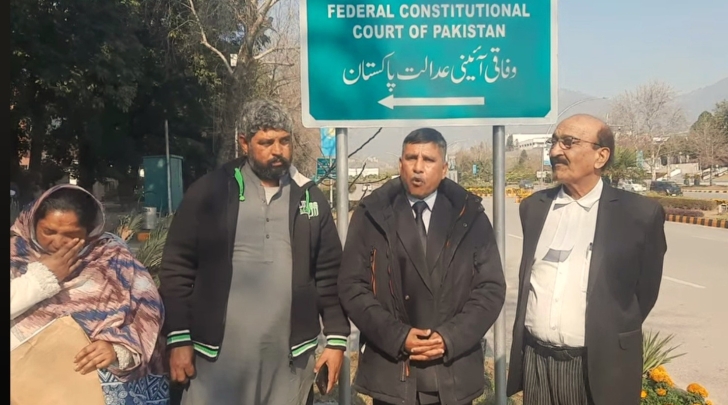
A court in Pakistan on Wednesday (March 25) upheld the marriage of a forcibly converted 13-year-old Christian girl to the Muslim man accused of kidnapping her, sending a wave of anguish and alarm through the Christian community.
Christian rights advocates and civil society groups strongly condemned the verdict by the Federal Constitutional Court (FCC), which granted custody of young Maria Shahbaz to Shehryar Ahmad, a 30-year-old Muslim alleged to have forcibly converted and married her.
Maria was abducted on July 29, and since then, her family has repeatedly sought judicial intervention to recover her, without success.
In a detailed judgment issued on March 25 – nearly two months after its short order on Feb. 3 – a two-judge bench comprising Justice Syed Hasan Azhar Rizvi and Justice Muhammad Karim Khan Agha ruled that Maria was of “mature age” and therefore in the lawful custody of her “husband.”
The court held that sharia (Islamic law) permits Muslim men to marry women from Ahl al-Kitab (People of the Book), and found that Maria’s conversion to Islam was valid. It stated that no formal rituals are required for conversion beyond a declaration of faith, accepting an affidavit attached to the alleged fake marriage certificate and a Islamic seminary-issued certificate as sufficient proof.
“In Islam, no specific rituals are required for a non-Muslim to be regarded as having embraced the faith,” the judgment stated, adding that a declaration affirming core beliefs is sufficient to establish conversion. “What is required is a declaration and recitation of the Kalima, with belief in the Oneness of Allah, the Finality of the Prophethood of the Holy Prophet Muhammad, and the Holy Quran, as well as belief in earlier Prophets, Divine Scriptures, and the Day of Judgment.”
Addressing assertions by Maria’s father, Shahbaz Masih, that she was a 12-year-old minor at the time of the illegal marriage, the court dismissed documentary evidence of her age as “unreliable.” The judges cited inconsistencies in the father’s initial police report and delays in the issuance of official records, including her birth registration and National Database and Registration Authority (NADRA) documents.
The ruling also pointed to discrepancies in family records, including a narrow gap between the reported birth dates of Maria and her younger sibling. It further noted that Maria herself had listed her date of birth as Feb. 1, 2007, in the marriage certificate and appeared older in court.
“Her physical appearance before the court also suggests a more advanced age,” the judgment stated, concluding that the available documents could not be relied upon to establish that she was a minor.
Verdict Reviled
The controversial judgment drew sharp criticism from rights groups and activists, who argue that the court disregarded key evidence and prior findings indicating that the marriage was unlawful.
Safdar Chaudhry, whose Raah-e-Nijaat Ministry provided legal assistance to the Masih family, said the court had ignored critical investigative material.
“The judges overlooked the police’s reinvestigation report, the reinstated FIR [First Information Report], and testimony from the investigating officer indicating that an illegal marriage had been contracted with a minor, with no official record at the relevant union council,” Chaudhry told Christian Daily International-Morning Star News. “They also failed to consider that the girl remained in the custody of the accused for over six months, raising serious concerns about coercion.”
The rights defender also questioned the two-month delay in issuing the detailed judgment, calling it a “travesty of justice,” and said the family would challenge the ruling before a larger bench.
“If superior courts refuse to recognize official birth documents, there is little hope for protecting underage minority girls,” Chaudhry said.
Tehmina Arora, director of advocacy for Asia at ADF International, described the verdict as “deeply alarming” for Pakistan’s religious minorities, particularly Christian and Hindu minority communities.
“The court cannot attribute legal capacity or consent to a minor based solely on her statement while ignoring documentary evidence,” she said. “In such cases, claims of consent are often made under coercion, particularly where vulnerable minority girls face systemic pressure and intimidation.”
Human rights advocates say the case reflects a broader and recurring pattern in Pakistan, where minority girls – some reportedly as young as 10 – are abducted, forcibly converted and married to Muslim men. Victims are frequently pressured to give statements in favor of their alleged abductors, while courts often discount official age documents and validate such unions, returning girls to their alleged captors as “legal wives.”
In a strongly-worded statement, the Minority Rights March (MRM) said it was “appalled” by the FCC’s ruling.
“The court not only refused to restore custody of the victim to her father but effectively legitimized her continued cohabitation with her abductor under the guise of a ‘Nikah,’ [Islamic marriage certificate]” the statement said. “While child marriage is recognized as a crime, declaring the marriage itself valid is self-contradictory and undermines the very purpose of child marriage restraint laws.”
The group also criticized the court for endorsing a coerced religious conversion.
“It is alarming that the highest judicial forum has delivered a verdict that risks emboldening those who abduct and abuse minor girls from minority communities under the cover of marriage,” the statement said, warning that the ruling could weaken constitutional protections for religious minorities.
MRM urged the Attorney General of Pakistan to seek a review of the judgment and called on lawmakers to strengthen child marriage laws, including provisions that would render such marriages void from the outset.
It also called on prosecutors to pursue criminal proceedings under existing laws and to recover Maria from the custody of the accused.
“This verdict has neither resolved the question of the victim’s age nor addressed the underlying criminal allegations,” the statement said. “The state must act to ensure justice is not denied.”
Pakistan, where more than 96 percent of the population is Muslim, ranked eighth on Open Doors’ 2026 World Watch List of countries where Christians face the most severe persecution.