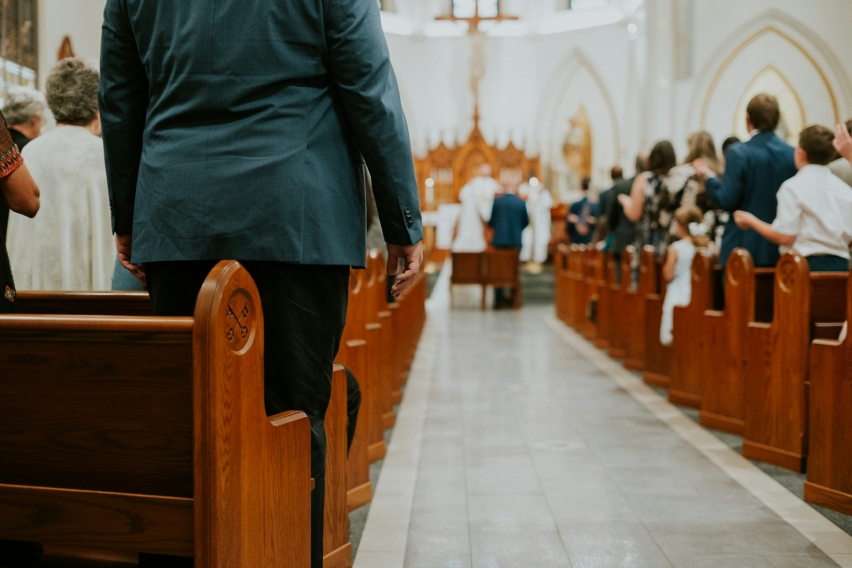
Eight million more Americans attended a Christian church service at least twice in 2025 compared to two years earlier, according to new research from American Bible Society — a development the organization calls encouraging even as its data expose widening gaps in who is and is not showing up.
The findings come from the fifth chapter of American Bible Society's 16th annual State of the Bible report, released Wednesday. The chapter, focused on church health, draws on a nationally representative survey conducted by NORC at the University of Chicago and covers church attendance, spiritual vitality, and the role of church leadership in congregants' lives.
The share of Americans who never or seldom attend a Christian church service dropped 4 percentage points since 2024 — equivalent to roughly 8 million people crossing the threshold of attending at least twice a year. Both Generation X and Millennials drove much of the shift: among Gen X, weekly or more frequent attendance rose from 49% to 54%; among Millennials, from 39% to 42%.
Generation Z moved in the opposite direction. The youngest adult cohort saw attendance fall from 46% to 42% over the same two-year period, making it the only generation to record a decline.
The picture is sharper still when broken down by gender. More than half of Christian men in the United States do not attend church on a monthly basis, and one in five reported never attending at all. Dr. John F. Plake, American Bible Society's chief innovation officer and the editor-in-chief of the State of the Bible series, said the data points to a specific pastoral challenge.
"The data reveals opportunities for church leaders to reach out to specific people — especially young men — and guide them toward a richer, deeper relationship with God and their church through regular engagement with Scripture," Plake said.
Men who do attend are somewhat more likely than women to worship in person. About 20% of male churchgoers attend services remotely, compared with 30% of women.
Among those who do attend — defined in the study as attending at least once every six months — satisfaction levels are high. Churchgoers rated their congregations an average of 8 out of 10 for spiritual health, with 10 out of 10 being the single most common response.
The survey assessed church health across five areas: whether congregations challenge members toward spiritual growth, create relational opportunities for that growth, deepen biblical understanding, promote community service, and whether pastors model spiritual disciplines themselves.
Across all five measures, women report higher satisfaction than men in every generation, and Gen Z men record the lowest satisfaction scores of any group. The pattern holds across denominational lines, with Mainline Protestants and Roman Catholics registering weaker attendance figures despite strong identification with their traditions.
One of the study's most consistent findings links Bible engagement to church satisfaction. Among churchgoers who said they were very satisfied with their congregation, more than 80% also agreed or agreed strongly that church leaders were helping them connect with the Bible. Plake said the pattern points to a structural reality.
"We see a consistent pattern that healthy churches keep the Bible at their core," he said.
The research does reveal what the American Bible Society describes as a broader dichotomy: while overall attendance figures remain mixed, those who are actively participating report genuine spiritual growth and satisfaction — suggesting individual congregations may function more healthily than national trends alone would indicate.
NORC at the University of Chicago fielded the survey using its AmeriSpeak panel between January 8 and 27, 2026. Responses came from 2,649 adults across all 50 states and the District of Columbia, conducted through online and phone interviews.
Three additional chapters of State of the Bible: USA 2026 are scheduled for monthly release through November 2026, covering forgiveness, the supernatural, and generosity. The fifth chapter is available at StateoftheBible.org.