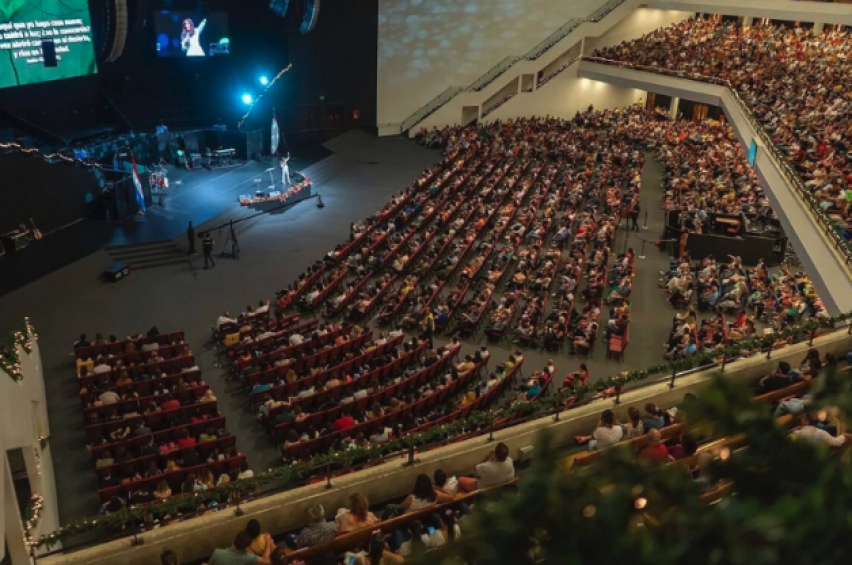
Fifty-five percent of respondents in Latin America identified as Catholic and 19% as evangelical, according to the Latinobarómetro 2025/2026 report on religion, published this month. Another 18% said they had no religion or identified as atheist or agnostic. The survey asked people aged 18 and older in 17 countries an open-ended question about religion.
Paraguay recorded the highest share of Catholic identification, at 82%, followed by Mexico and Ecuador, both at 69%. Peru and Bolivia each reached 67%, and Colombia and Venezuela each recorded 60%. In Argentina, 55% identified as Catholic, 15% as evangelical and 23% said they had no religion or identified as atheist or agnostic.
Honduras, Guatemala and El Salvador lead in evangelical identification
Honduras reached 44% evangelical identification, followed by Guatemala at 43% and El Salvador at 42%. According to the report's table, the share of respondents who identified as evangelical exceeded the share who identified as Catholic in all three countries.
The gap was 6 percentage points in Honduras, 5 in El Salvador and 2 in Guatemala. Panama and the Dominican Republic followed, with 34% and 31% evangelical identification, respectively.
Uruguay had the highest share of respondents who said they had no religion or identified as atheist or agnostic, at 49%. By comparison, 35% identified as Catholic and 7% as evangelical. Chile recorded 27% in that category and Argentina 23%.
Catholic identification falls over three decades
Latinobarómetro's historical series places regional Catholic identification at 80% in 1995 and 55% in 2025/2026, a drop of 25 percentage points. Among the countries the report compares across both periods, Panama went from 89% to 46%, Paraguay from 93% to 82% and Mexico from 77% to 69%.
The report, "La religión en América Latina, Latinobarómetro 1995 – 2025/2026" (Religion in Latin America), was published in November 2026 by the Corporación Latinobarómetro. It is based on 1,000 to 1,200 face-to-face interviews per country, with a margin of error of 2.8 to 3 percentage points. Its figures show a shift in the region's religious map over three decades.
Original reporting by Diario Cristiano, Christian Daily International's Spanish edition.