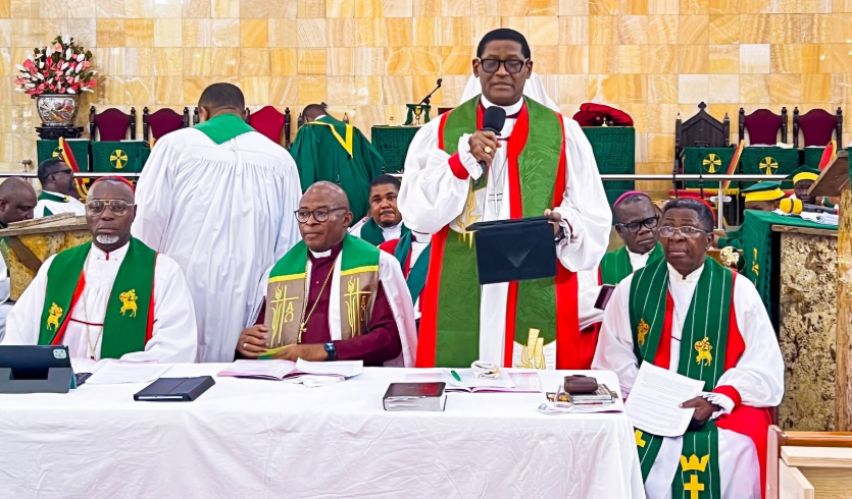
Leaders of three major Christian denominations in Nigeria have backed the establishment of state police, saying a more localized policing system could help address persistent kidnappings and violent crime across the country.
The position was contained in a communiqué issued after the 10th meeting of the Spiritual Advisory Council of Christ Church in Port Harcourt, Rivers state. The council brings together leaders of the Anglican, Methodist and Presbyterian churches.
The communiqué was signed by Ekpenyong Nyong Akpanika, prelate and moderator of the General Assembly of the Presbyterian Church of Nigeria, who chaired the meeting held on Sept. 5, and Elder Deinabo Tennyson Horsfall, secretary of the council.
The church leaders said they welcomed the Federal Government's efforts to restructure Nigeria's policing system through a proposed dual framework involving state and federal police commands.
They said the proposed system could produce a more localized and effective policing structure if properly implemented. The council also expressed concern over the continued recurrence of kidnappings and violent crimes despite what it described as recent gains by the government, armed forces and other security agencies.
The council urged the government and security agencies to urgently address what it called the “seemingly intractable” kidnapping situation and other violent crimes.
The position comes as President Bola Tinubu's administration and the National Assembly push forward with one of Nigeria's most significant proposed changes to its security structure.
In June, the Federal Government said significant progress had been made toward establishing state police following months of consultations involving the presidency, National Assembly and security authorities.
Femi Gbajabiamila, Tinubu's chief of staff, said June 4 that discussions on the framework had begun several months earlier following a directive from the president. He said the process required careful consideration of constitutional and legal issues and could not be implemented hastily.
Legal backing
The National Assembly subsequently advanced the constitutional process. The Senate passed a bill establishing state police services June 24 after more than two-thirds of senators voted in favor. The proposal would create a dual system consisting of a Federal Police Service and State Police Services.
Under the proposed framework, state governors would have a role in the appointment of commissioners of police, subject to confirmation by state Houses of Assembly and other safeguards. Governors would also be able to issue lawful written directives of a general policy nature concerning public safety and public order.
The legislation includes provisions intended to prevent state police from being used against political opponents. One provision states that a state commissioner of police could not arrest, detain, investigate or deploy force against a person, political party or group merely for criticizing the government, except in accordance with the law.
The proposal has attracted support from those who argue that policing should be brought closer to the communities where crimes occur. Supporters say state police could improve local intelligence gathering and allow authorities to respond more quickly to security threats.
But concerns over political interference remain.
Reuters reported in June that critics had warned state police could be misused by governors against political opponents or minorities. Other concerns include differences in funding between states, training standards and coordination between state and federal forces.
The constitutional process has also undergone changes since the initial votes in the National Assembly.
On July 14, the House of Representatives withdrew an earlier approval of a constitutional amendment bill on state police and began considering a revised executive proposal transmitted by Tinubu. The House passed the new executive bill for second reading after lawmakers said new issues required further review.
Tinubu had formally transmitted the State Police Bill to the House, describing it as part of his administration's effort to reorganize Nigeria's security architecture and create a constitutional pathway for state police services.
The administration has meanwhile been preparing for implementation if the constitutional changes are approved.
A Presidential Working Group on the National Policing Bill began drafting legislation in August. The group, chaired by Gbajabiamila, was tasked with developing the legal and policy framework that would accompany the creation of state police. The group said it was also reviewing memoranda and position papers submitted during a nationwide consultation.
Gbajabiamila said in August that the proposed framework would have to balance greater local policing powers with national safeguards.
“State police cannot mean 36 state militias,” he said, while also arguing that national standards should not become a way of re-centralizing day-to-day state policing.
The proposal has received support from other Christian leaders this year.
In June, the Christian Association of Nigeria backed the acceleration of constitutional and legislative measures to establish state police as part of a broader response to insecurity. CAN President Daniel Okoh made the call after a National Church Denominational Leaders Summit in Abuja, where the organization also called for stronger intelligence gathering and greater accountability from security agencies.
CAN's position followed concerns over killings, kidnappings and attacks affecting communities in different parts of Nigeria. The organization declared three days of national mourning in June for victims of violent attacks and abductions.
The latest call from the Spiritual Advisory Council therefore comes as the debate over state police moves beyond whether the system should exist and toward questions about how it would operate.