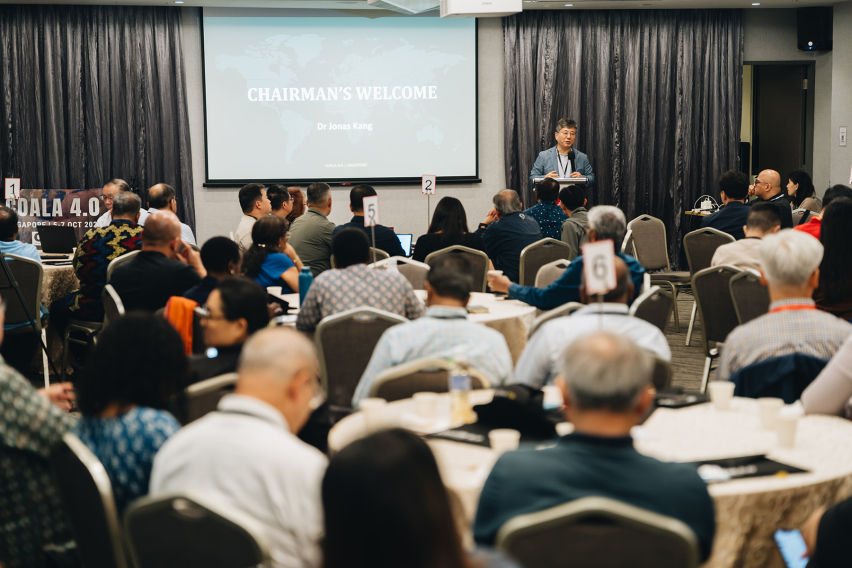
Churches in Asia, Africa and Latin America should welcome and oversee missionaries sent by one another, the chairman of the COALA mission network has said, arguing that the Global South now sends most of the world's cross-cultural missionaries.
The Rev. Jonas Kang, who also serves as general secretary of the Korea World Missions Association, made the proposal in his opening address to COALA 4.0, held Oct. 5-7 in Singapore.
The gathering of Majority World mission leaders ended with the release of the Singapore Statement, as previously reported by Christian Daily International. This report is part of CDI's post-event coverage of selected presentations from the meeting.
Kang told participants that because the economies of the West and the Global South cannot be compared on equal terms, churches in the South need to shape their own way of carrying mission forward.
Global South now sending majority of missionaries
According to figures Kang presented, missionaries from the Global South numbered about 31,000 in 1970, or 12% of those sent worldwide. By 2026, he said, that number had grown to about 277,000, or 61%, while the Global North sent about 178,000.
Most countries represented at COALA are now "both mission fields and mission force nations," Kang said. He added that churches in the non-Western world more closely resemble the church described in the Book of Acts than Western churches do.
Kang recalled that participants at COALA 2.0 in Bangkok, Thailand, where the movement was launched in 2024, agreed on several principles. Mission must depend on the power of the Holy Spirit and be centered on the local church, he said. Missionaries should be sent only at the request of a local church or organization, made through networks.
Finances are necessary, but they "must not occupy the most central place in mission," Kang said.
Using childbirth as an image to describe the missionary's role, he said, "Missionaries must remember that they themselves are not the mother giving birth to the child, but the midwife who assists the mother in giving birth."
Focus on unreached peoples
Kang said Global South mission movements are increasingly directing their efforts toward unreached and unengaged people groups, citing Matthew 24:14. He said the Latin American movement COMIBAM and the Movement for African National Initiatives (MANI) both prioritize such groups, and that MANI has committed to send its future missionaries only to them.
He pointed to a memorandum signed at COALA 3.5 between COMIBAM and a leading evangelical church in the Middle East and North Africa. COMIBAM has recently begun sending missionaries to the region, and the church has agreed to care for them, Kang said.
"I believe this represents mission that is biblically sound," he said.
Kang distinguished between "open access" nations, where churches exist and Christian workers can identify themselves publicly, and "creative access" nations, where Christians make up less than 2% of the population and sharing the gospel is restricted.
Noting that many COALA countries are economically weaker than those in the West, he asked churches in member nations to adopt a policy of receiving and overseeing missionaries sent from other member nations. He proposed that pastors and missionaries serve under a local denomination, and that lay missionaries belong to a local church and "give their best effort toward helping that church grow."
Kang also asked churches in each country to make their needs known, so that churches able to send missionaries can respond.
He acknowledged that churches in the Global South face growing hostility toward Christians in many parts of the world, including religious nationalism, state restrictions on religion and attacks by extremist groups.
A reshaped world Christianity
Citing the late missiologist Andrew Walls, Kang said the Southern form of Christianity is becoming the dominant expression of the faith. He identified three trends among non-Western Christians: reading Scripture within their own frameworks of thought, developing contextual theologies and sustaining a lively spirituality, much of it within the Pentecostal-charismatic stream.
These developments, Kang said, are only "a prelude to the reshaping of Christianity." He said the church worldwide must return to the gospel and give attention to what Scripture says.
Future church leaders, he said, will need to recover four features of Christian tradition: intimacy with God from the monastic tradition, immersion in the Word drawn from modern biblical scholarship, the self-denial and self-mastery of Puritan spirituality and the gifts of the Holy Spirit emphasized by the Pentecostal-charismatic movement.
"As the world church embodies these four features, Christianity will be able to express Christlikeness in both word and deed," Kang said.