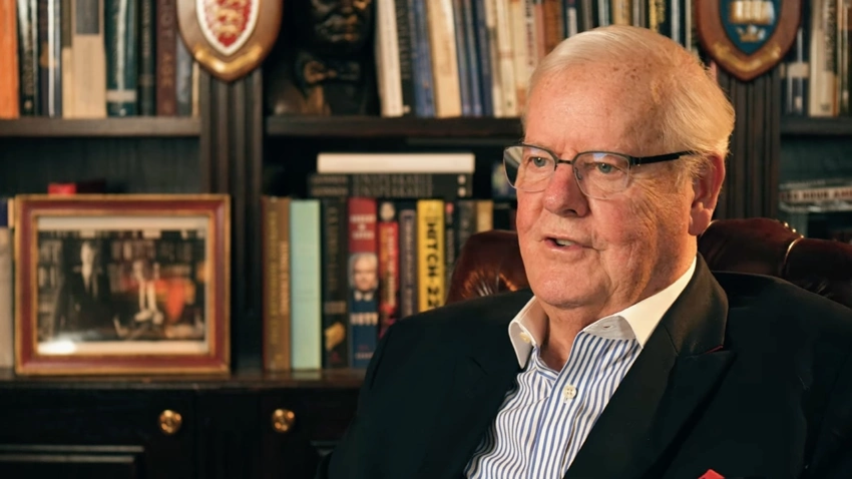
English writer and theologian Os Guinness recently received the 38th annual William Wilberforce Award from The Colson Center for Christian Worldview to honor his decades of helping Christians make sense of their calling in a post-Christian cultural moment.
"I think Guinness is in the tradition of Wilberforce, also of Francis Schaeffer and Chuck Colson, basically helping the Church think clearly about the moment by thinking about the past, and looking ahead toward the culmination of all things: the Kingdom," John Stonestreet, who serves as president of The Colson Center, told The Christian Post.
Stonestreet, The Colson Center and Focus on the Family worked with the 84-year-old Guinness last year on Truth Rising, a documentary about his worldview and life's work, which has included authoring more than 30 books, co-founding the Trinity Forum Society and serving as a guest scholar at the Woodrow Wilson Center for International Studies, as well as a visiting fellow at the Brookings Institution.
'How should we then live?'
The award Guinness formally received last Saturday at the 2026 Colson Center National Conference in Knoxville, Tennessee, was named for William Wilberforce, the British politician whose work was born from his Christian faith and ultimately led to the abolition of the transatlantic slave trade in the 19th century.
Noting Guinness has been "a prophetic voice for decades," Stonestreet told CP that The Colson Center determined him to be a worthy recipient of the prize because of "his ability to have really clear insight on the moment that we're in." He said Guinness shares with Wilberforce an ability "to understand what really mattered at the time and place he was in."
Born in 1941 in a Chinese village where his parents were serving as medical missionaries, Guinness saw firsthand during his childhood the ruinous consequences of communism, war and utopian attempts to establish the Kingdom of Heaven without God.
His family was swept up in the 1943 Henan famine that killed millions in three months, including two of his older brothers. From roughly ages 5 to 10, they lived in Nanjing, where he witnessed the climax of the Chinese Communist Revolution in 1949 and the beginning of Mao Zedong's reign of terror. By 1951, they were among the many Westerners who were expelled from China amid communist pressure.
They returned to England, where Guinness would go on to be educated in London and Oxford. During the cultural upheaval of the 1960s, he studied at L'Abri in Switzerland under the late Christian philosopher Francis Schaeffer, whose mentorship Guinness described as "revolutionary" as he was attempting to make sense of his generation's place in history.
In his seminal 1968 book, The God Who Is There, Schaeffer emphasized that Western civilization was entering a post-Christian era, having drifted from belief in biblical absolutes to the embrace of subjective morality. Pursuit of "personal peace and affluence" had become the animating force amid existential despair, Schaeffer said, and his famous question to Christians living in such a cultural moment was: "How should we then live?"
'There are no little people'
In The Dust of Death: The Sixties Counterculture and How It Changed America Forever, his first book published in 1973, Guinness built upon Schaeffer's observations by arguing that both the secular humanism of the Western establishment and the 1960s counterculture had failed to give humanity true meaning, leaving historic biblical Christianity as the only viable "Third Way."
In his 1997 bestselling book The Call: Finding and Fulfilling the Central Purpose of Your Life, Guinness wrote that God calls Christians to find meaning in their primary calling as followers of Jesus Christ, which infuses purpose into whatever other roles and stations they may have in life.
During a scene in Truth Rising, Guinness and Stonestreet discussed how the West's civilizational crisis of meaning has noticeably worsened over the past generation, leading to consequences that Stonestreet said are "now being felt on an individual and personal level."
"You're seeing all the chickens coming home to roost, and so people really feel now that things are degenerating rapidly, and they are," Guinness said.

Presenting Stonestreet with a historic signed copy of Wilberforce's classic 1797 book Practical Christianity, Guinness noted that it also contained a handwritten letter Wilberforce wrote to share his faith with a young couple, just months before he died in 1833.
Guinness observed that by spending his final days ministering to others, Wilberforce had offered an example of how Christians ought to live amid evil days.
"So the great man is still fighting slavery, and it was abolished three days before he died. But he's still reaching out in terms of his faith," he said. "And that is the best of the Christian faith, the best of evangelicalism: people who are actively engaged in life through their callings, but also prepared to share their faith in a wonderful way."
Guinness remembered Schaeffer's line that "there are no little people."
"In other words, every single one of us counts. We all matter, everyone made in the image of God; everyone, everywhere, in everything. It can turn around," he said.
"We all think, 'Well, I'm no Wilberforce. There's not a real difference that I can make,' but that's just not true," Stonestreet said. "We can make a difference in the world, and we're in this time and place in history because God wanted us there."
Faithfulness in little things
In a video shown at the award dinner last Saturday, Guinness stressed the importance of personal faithfulness in daily life, especially during a time of civilizational crisis. He dismissed the utopian notion that Christians are called to single-handedly change the world by pursuing worldly fame and power.
"I was brought up as a missionary kid in the China Inland Mission — Overseas Missionary Fellowship, as it is now — and the founder was Hudson Taylor, a great missionary," he said. "And he had a wonderful saying: a little thing is a little thing, but faithfulness in a little thing is a big thing. And I think we need to remember that."
"There's far too much heroism, the greatest of all time, and hall of famers, and all that sort of nonsense in this country. Who cares about celebrities and monuments and any of that? We're just called to be faithful in terms of who we are."
Guinness noted the Bible shows God mightily uses the quiet faithfulness of ordinary Christians to accomplish His Kingdom purposes.
"Am I being as faithful and enterprising and creative and sharing my faith as much as I can be? That's all that's up to us. You think of the boy with the loaves and the fish. Five thousand were fed. Who knows what the Lord will do with our lives if we just live faithfully to Him and give it back to Him?"
Originally published by The Christian Post.