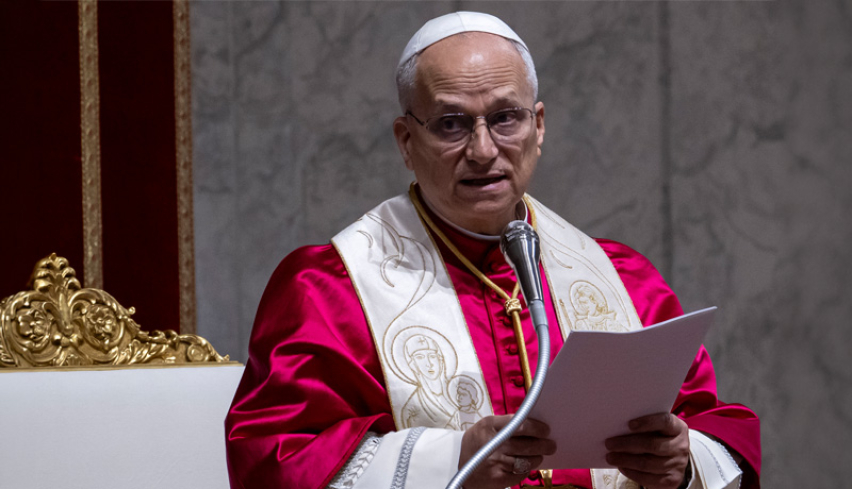
After listening to people dissect Pope Leo XIV’s first encyclical, Magnifica Humanitas, following its release on May 25, 2026, the world should not miss its urgent warning.
When the bishop of Rome speaks thoughtfully about human dignity in an age of artificial intelligence, Christians outside of the Catholic communion should pay attention.
I write as a Protestant evangelical. I do not recognize the magisterial authority of the pope. Evangelicals weigh such statements primarily by scripture, but also by theological truth, wisdom and natural law. But that does not mean we cannot listen and learn. When the bishop of Rome speaks thoughtfully about human dignity in an age of artificial intelligence, Christians outside of the Catholic communion should pay attention.
Some have dismissed the encyclical as too papal for evangelicals, too broad for Catholics, and too suspicious of free-markets for conservatives. But beyond pointing out its weaknesses, we should hear its warning.
Human dignity... is being threatened by new forms of dehumanization.
Pope Leo begins with a sobering claim: humanity is facing a “pivotal choice.” Human dignity, he says, is being threatened by new forms of dehumanization. Our urgent duty is to remain “profoundly human.”
Why such urgency? Perhaps because many of the people who know AI best have themselves been raising the loudest alarms. They are the ones who tell us:
- that AI may prove bigger than the Industrial Revolution
- that it will change every industry
- that the fusion of AI and robotics will make work optional
- that it will eliminate large portions of white-collar employment
- that it could produce staggering concentrations of wealth
- that it is harder to control than nuclear weapons
- that it carries both an enormous upside and a catastrophic downside.
Whether every one of these predictions proves true or not, they are sobering—especially because they come from those closest to the technology.
Humanity must choose between building a new Tower of Babel and building a city ordered toward human flourishing.
So Pope Leo turns to scripture. He says humanity must choose between building a new Tower of Babel and building a city ordered toward human flourishing. Babel represents technological power severed from God, wisdom, and human dignity. Jerusalem, as in Nehemiah’s day, represents a morally ordered work of rebuilding, shared responsibility, justice and communion.
That is a powerful contrast. I would add that Babel in scripture was not merely technological overreach. It was a unified act of pride and rebellion—building a civilization without God—constructing a proud tower, and pursuing human glory in place of God’s. And it brought judgment.
Still, the pope’s point is apt. He is not against technology. He affirms technology as a real good. But it is a subordinate good. It must remain a servant, not become a master. It must serve the person, not replace him.
AI may imitate certain functions of human intelligence... but it does not have a body or soul.
One of the most important passages in the encyclical is his explanation of the difference between artificial intelligence and human beings. AI may imitate certain functions of human intelligence. It may surpass us in speed and computation. But it does not have a body or soul.
It does not know joy or pain. It does not mature through relationships. It does not know from within what love, work, friendship, or responsibility mean. It does not possess moral conscience. It does not bear responsibility for consequences. It may simulate empathy, but it does not understand as a human person understands.
We must resist every post-human and transhuman temptation to confuse, merge, or replace the human person with the machine.
That is a crucial Christian point. We are not machines, and machines are not human. Human beings are made in the image of God. Consequently, we must resist every post-human and transhuman temptation to confuse, merge, or replace the human person with the machine.
From there, Pope Leo addresses a long list of concerns: the concentration of digital power in a few companies and states; economic inequality; surveillance and the loss of privacy; algorithmic bias in hiring; manipulation of information and public opinion; the crisis of truth; massive job disruption; autonomous weapons; children’s digital habits; the deformation of attention; and the need for moral, political and legal oversight of AI.
AI must be governed by human dignity, justice, and wisdom.
In all this, he is not rejecting AI. He is making the case that AI must be governed by human dignity, justice, and wisdom.
But along the way, he also detonates a few landmines for conservatives. He rejects free-market absolutism, echoing Catholic social teaching that markets must be morally governed and must protect the vulnerable.
He appears to go beyond standard Catholic just-war thinking when he says just-war theory is outdated. And he calls for “adequate regulatory tools” to guide AI toward the common good, a phrase that will send “big government” shivers down many spines.
Let me focus on regulation. Is Pope Leo simply conforming to the left’s ideology, as a recent Wall Street Journal editorial suggested? I do not think so.
Why would he call for oversight? Perhaps because of the extraordinary power of AI. Perhaps because even some of the AI leaders admit they do not fully understand how these systems work. They themselves have warned about AI’s “opaque behavior,” deception and even blackmail-like conduct in controlled test scenarios.
Yet these systems are rapidly being connected to education, finance, medicine, employment, surveillance and even weapons. Perhaps because some of these AI tools can now discover and exploit vulnerabilities at a speed and scale that challenges cybersecurity. Perhaps because AI leaders are predicting massive labor-market disruption.
Calling for oversight is not necessarily ideological. It may simply be prudence.
Under those conditions, calling for oversight is not necessarily ideological. It may simply be prudence. Power of this magnitude should be accountable to something higher than profit, speed, or geopolitical rivalry.
Of course, that raises the harder question: who should regulate AI?
Some companies appear more serious about internal safeguards than others. Anthropic, for example, has made safety and alignment central to its public identity. But self-regulation has obvious limits. Companies are racing one another for market share, investment, talent, and global advantage.
Will government step in? At the moment, that seems unlikely. The Trump administration believes regulation will weaken America’s position in the global AI race with China. International regulation, while desirable in theory, would be very difficult to negotiate, enforce, and verify.
A completely unregulated AI future... would place immense power in the hands of a small number of corporations, engineers, and investors.
And yet a completely unregulated AI future worries me. It would place immense power in the hands of a small number of corporations, engineers, and investors. The consequences would reach into finance, employment, education, medicine, surveillance, war, and even the formation of the human person. That is why the pope's call for oversight should not be dismissed as a partisan reflex.
Were there other shortcomings in the encyclical? I will mention two. First, I wish Pope Leo had said more about the challenge AI poses to faith and reason. In the university world, we are certainly seeing real benefits from AI. It can accelerate research, translate texts, summarize large bodies of material, and help students learn. For these breakthroughs I am grateful.
AI may become the chief gatekeeper of knowledge quietly shaping what future generations are allowed to know, remember, and question.
But many Christian educators are also deeply concerned. It’s not only that so-called "Big Tech" does not share a biblically Christian perspective. Nor is it only that AI may become the chief gatekeeper of knowledge quietly shaping what future generations are allowed to know, remember, and question. It also threatens to weaken reason itself.
How? By encouraging a vast cognitive outsourcing: summaries in place of original texts, synthesis in place of sustained argument, generated writing in place of the hard work of formulating our own ideas. But reading, reasoning, and writing are not merely ways of producing content. They are disciplines that form the mind.
This matters for the church. It also matters for the US American republic, which depends on well-formed citizens who can read carefully, think clearly, argue honestly, and distinguish truth from falsehood.
I wish Pope Leo had spoken more directly about the gospel.
Second, I wish Pope Leo had spoken more directly about the gospel.
Yes, he says that Catholic social doctrine is grounded in Jesus Christ who reveals the truth of humanity. He says Christ’s passion, death, and resurrection begin the work of renewal. He says AI must be interpreted in fidelity to the gospel, and that the gospel cannot ignore people’s concrete lives. All of that is true.
But I wish he had gone one step further. Because many in our age, including some in Big Tech, seem to be searching for salvation through technology. They look to transcendent machines rather than the transcendent God of the Bible. Some call this “technological messianism.” What an opportunity he had to say, in effect, “put not your trust in machines; look to Christ.”
AI may also help facilitate gospel conversations across the world, at any hour, in a person’s own language, in ways that are personalized and contextualized.
Related to that, I was surprised he did not say more about AI as a possible tool for advancing the Great Commission. Yes, he describes the digital world as “a new continent to be evangelized,” whatever that means. But AI may also help facilitate gospel conversations across the world, at any hour, in a person’s own language, in ways that are personalized and contextualized. For all its dangers, AI can still be used redemptively to help seekers find Christ.
Of course, no encyclical can say everything. And as an evangelical Protestant, I have my disagreements with Pope Leo. But I am glad someone of his stature spoke up with moral seriousness. I am glad he warned the world about the dehumanizing possibilities of AI. I am glad he offered a luminous account of the human person. And I am glad that, in the middle of a technological revolution, he pointed to Jesus Christ.
Dr. Donald Sweeting is a noted educator, minister and author. He was recently president and chancellor of Colorado Christian University. Previously he served as the president of Reformed Theological Seminary in Orlando, Florida, and prior to that he served as a pastor for 22 years. He holds a BA from Lawrence University, BA and MA degrees from Oxford University, and a Ph.D. from Trinity International University. He is the author of several books. His writings have been widely published by Townhall, Fox News, The Washington Times, The Jerusalem Post, and many other outlets. Dr. Sweeting and Christina have three adult sons and a daughter. He regularly posts his thoughts at donsweeting.com and can be followed on Twitter @dsweeting.