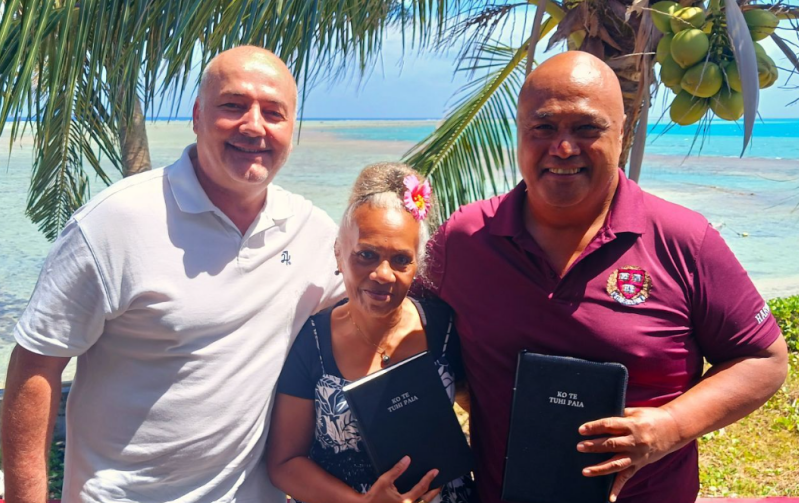
Pacific islanders on the small island nation of Tokelau have received the first complete Bible translation in their local heart language of Tokelauan.
Announcing the accomplishment on social media on Dec. 3, the United Bible Societies (UBS) hailed the news as a “historic milestone for one of the world’s most remote island nations.”
About 1,500 people live across the three isolated atolls Atafu, Nukunonu, and Fakaofo of the island nation located between Hawaii and New Zealand, and in the southern part of the ocean. Most of the islanders are Christians and their dialect is historically in the oral tradition rather than a written form.
“This achievement is a testament to the power of partnership and the perseverance of God’s people. It shows what can happen when translation, community, and faith come together,” said Neels Janse van Rensburg, Chief Executive Officer of Bible Society New Zealand (BSNZ).
“What makes this moment especially meaningful is the journey behind it,” explained the UBS.
“For a language that has been largely oral, this translation required deep collaboration with the community, careful linguistic work, and 26 years of patient partnership. We are grateful to everyone in Tokelau, the Bible Society New Zealand (BSNZ), and the wider global Bible translation community who contributed to this milestone.”
A launch of the complete Bible translation took place on the Fakaofo Atoll on Oct. 27. It coincided with Tokelau Language Week in Aotearoa (New Zealand). The BSNZ team visiting Tokelau for the launch were honored at a parliamentary sitting with an official “thank you” alongside a cultural evening of song and dance presented by the people from the three tropical coral atolls.
A “Toluma” traditional gift given to the BSNZ team comprised a wooden container used by the Tokelauans when canoe fishing at sea. It traditionally holds valuables and the caught fish, and is cleverly designed to float towards land should the canoe capsize.
Tokelau community leader and former Ulu-o-Tokelau (Tokelaun head of government), Kelihiano Kalolo, described the new Bible translation as “a very big event,” which also served to remind people of the importance in both preserving and strengthening the language.
“It will be good for the development of the spiritual life of people that will lead to harmonious living in the villages,” he said.
The work started as a structured project in 1996 with the launch of a translators’ workshop, following a “dream that had been for decades prior,” according to the UBS. The mission worked with BSNZ to make it a reality.
“Over the following decades, teams of translators, linguists, and advisors worked diligently to bring scripture to life in Tokelau’s own words,” added the UBS release.
“The task was monumental—not least because Tokelauan had long been an oral language, with early translators first needing to develop consistent written forms and grammar before translation could begin.”
The translation team included Ioane Teao who dedicated 23 years to the work and Rev. Tui Sopoaga, who chaired the translation committee.
They worked with Stephen Pattemore, BSNZ’s now-retired translation director, and eventually performed the final verse check in 2019.
Clare Knowles, Abi Das, and Daniel Harrison guided the final stages of typesetting, design, and publication, ensuring the Bible would be ready in time for the long-awaited celebration, according to the UBS.
Rensburg paid tribute to colleagues from UBS for their hard-working efforts in the project.
“UBS provided earlier translation advisory and consultancy services in the pioneering years of the project, technical tools, such as Paratext, and strategic guidance that were essential to this project’s success,” said van Rensburg.
The history of the translation originated with the idea of a Tokelauan Bible in the late 1960s when a number of Tokelauans migrated to New Zealand. Samoan Bibles served earlier generations but the new Tokelauans arriving in the country were not fluent in Samoan. They worshiped in their own language in the 1980s but there remained a prevailing need for Bibles that would make the Word of God accessible in their heart language.
“The need for Scripture in their native language became urgent,” stated the UBS.
Meetings about the issue took place in 1991 between the Pacific Islanders Presbyterian Church in Grey Lynn and Porirua, both suburbs in New Zealand. Consultations were also facilitated across Auckland, Hutt Valley, Rotorua, and Taupo.
A delegation subsequently visited Tokelau in 1994 to obtain approval for the translation project. The local government and church groups gave support and the project officially began in June 1996 under the Tokelauan Society for the translation of the Bible, in partnership with BSNZ and UBS.
“The Bible’s arrival represents a linguistic and cultural rejuvenation,” stated the UBS.
“For generations, Tokelauans have relied on the Samoan Bible for Old Testament readings and the portions available to them in Tokelauan. In 1999, the Gospel of Mark was published, and four years later, the Four Gospels were released. In 2009, the New Testament was launched with a celebration at Pahina Church.
“For the first time now in 2025, God’s Word in full can be read, heard, and cherished in Tokelauan.”