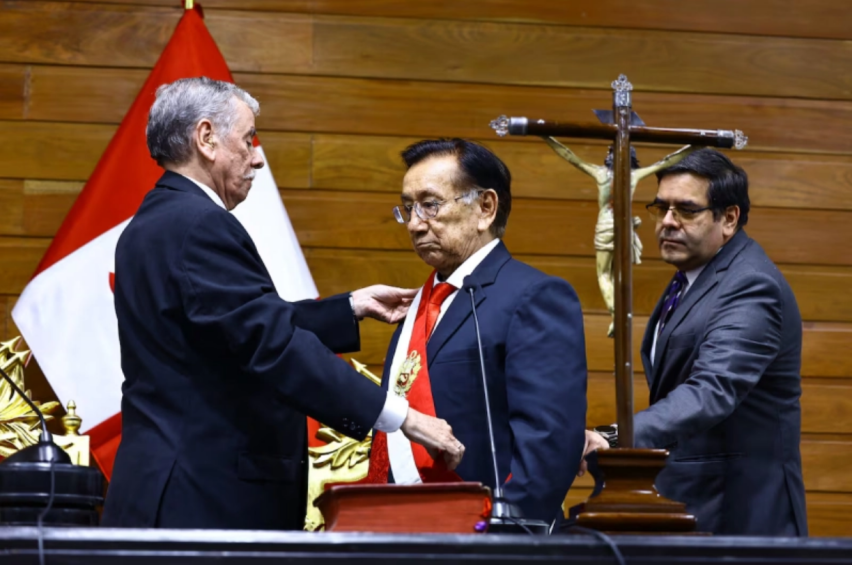
The appointment of José María Balcázar as president of Peru has drawn reactions across political and social sectors, amid ongoing institutional instability and the frequent turnover of heads of state. His appointment comes amid a political crisis that, according to analysts and social leaders, reveals structural weaknesses in Peru’s democratic system.
The president of the National Evangelical Council of Peru (CONEP), Enrique Alva, told Diario Cristiano, Christian Daily International's Spanish edition that the current situation reflects a process of institutional deterioration and a concentration of power in Congress. “Well, yet another change of president in Peru — a rather anomalous situation in a democratic system, an atypical case in Latin America, and I believe even globally,” he noted.
Alva said the instability stems not from social mobilization but from parliamentary decisions. “Peru’s problem is that these changes of presidents are driven by Congress. Congress has unilaterally modified several articles of the Constitution without public support,” he argued. He also warned that the legislative branch has positioned itself above the other branches of government. “It has assumed powers above the Executive and the Judiciary. Therefore, it has effectively made itself a superpower over the other branches,” he added.
The evangelical leader also criticized the lack of institutional balance. “In Peru, unfortunately, we do not have a balance of power among the branches of government. And when there is no balance of power, democracy becomes distorted; it becomes manipulable and ceases to function as a true democracy,” he said.
Regarding the new president, he expressed reservations about his background and leadership. “We are living through a crisis of democracy, a crisis of representation, and a crisis of political leadership in the country. There is none. This man has not been a political leader. His career was as a judge, and it ended poorly. He faced problems with the bar association, issues during his time as an alternate Supreme Court justice, and as a congressman his performance has also left much to be desired,” he remarked.
He also mentioned legal concerns surrounding Balcázar. “He has several legal issues. It is unfortunate that he is taking office under these circumstances. This situation makes him vulnerable to influence from Congress and gives Congress greater leverage,” he continued, warning that the cases are unlikely to move forward while presidential immunity remains in place.
While Alva did not cite a specific case, one of the most controversial aspects of Peru’s new interim president has been his past statements about sexual relations with minors, made when he opposed the law banning child marriage.
It appears that José María Balcázar’s selection as president of Peru was driven more by parliamentary agreements than by a clear ideological direction. His rise to power created divisions between Fuerza Popular and Renovación Popular and returned Perú Libre to the Executive branch.
In his first statements, Balcázar said, “We are not working to implement leftist policies in the Government Palace; that no longer exists. Those concepts of the left belong to the 18th century,” and he ruled out pardoning Pedro Castillo: “We do not have much time; we are not considering any type of pardon.”
Analysts argue that Congress’s decision may also reflect electoral calculations ahead of the April 12 elections, in a political environment marked by shifting alliances and institutional fragility.
Alva also expressed uncertainty about the new president’s ability to govern. “How will he proceed? The truth is, I have my concerns. How will this man govern when he has no governing experience?” he asked.
Nevertheless, the CONEP president expressed moderate expectations for the transition period. “I hope he makes an effort, setting aside his legal problems, to govern effectively and maintain the country’s economic direction,” he said. He added that, given the short duration of the administration, priorities should focus on security, social programs, and the electoral process. “He should guarantee an independent and clean electoral process, free of violence and conducted with full respect for the law,” he emphasized.
He also called for independence from international pressures and special interest groups. “The president should act with respect for the law and not become subject to lobbying or external pressures,” he stated. He also called for stronger foreign policy and efforts to prevent corruption.
Finally, Alva said evangelical leaders will continue to monitor the government’s actions. “As president of the Council, there will surely come a time when we will need to speak with him, but I also call for prayer and vigilance regarding his actions,” he concluded.
Originally published by Diario Cristiano, Christian Daily International's Spanish edition.