
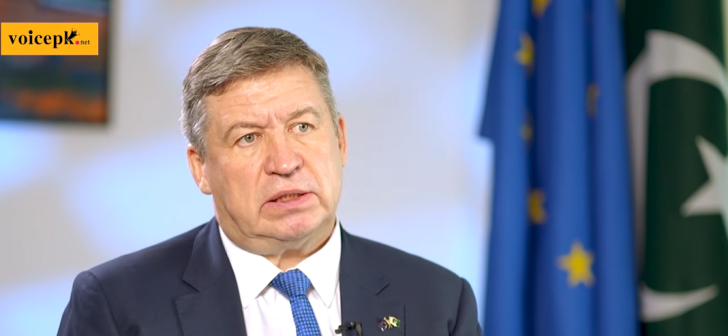
Pakistan’s continued access to a lucrative European Union trade preference could be jeopardized if Islamabad fails to demonstrate meaningful progress in protecting human rights, including the rights of religious minorities, the EU ambassador to Pakistan warned.
Raimundas Karoblis said on Monday (Aug. 31) that Pakistan’s continuation in the EU’s Generalized Scheme of Preferences Plus (GSP+) beyond 2029 was uncertain with the implementation of United Nations human rights conventions likely to be a decisive factor in the country’s reapplication.
“It is not certain and it is not guaranteed,” Karoblis stressed in a podcast with journalist Munizae Jahangir available on YouTube (https://www.youtube.com/watch?v=MGkeG0z3IbE)
“It depends on the level of implementation of the U.N. conventions,” he said. “One of the preconditions within the present GSP+ scheme and the future scheme is the absence of a serious failure in implementing the U.N. conventions. This is based, first of all, on the conclusions of the U.N. monitoring bodies.”
The comments come as religious freedom advocates continue to raise concerns about Pakistan’s treatment of Christians and other religious minorities, particularly in cases involving blasphemy allegations, forced conversions, child marriage, attacks on places of worship and discrimination in law and practice.
Under the current GSP+ arrangement, Pakistan receives extensive tariff preferences for exports to the EU, with the benefits estimated at around 732 million euros. The textile sector is among the major beneficiaries. The scheme links preferential trade access to implementation of international conventions on human rights, labor rights, environmental protection, climate change and good governance.
For Pakistan, which has ratified the 27 conventions required under the current GSP+ framework, the key issue in the coming years will therefore be implementation rather than ratification.
“All of the conventions have been ratified by Pakistan,” Karoblis said. “From a legal point of view, the first condition is therefore fulfilled. But now, particularly with the new scheme, the emphasis will be exactly on implementation. I mentioned already that the government will need to present an action plan with concrete measures for implementing or improving the implementation of the U.N. conventions. It will also need concrete timeframes and concrete performance indicators. So, indeed, implementation is really important.”
Under the proposed future system, the number of conventions will rise from 27 to 32. Karoblis said Pakistan had already ratified all of them. He stressed that the EU would consider not only future commitments but Pakistan’s existing record. The ambassador also specified, however, that if Pakistan does not reapply for GSP+, or fails to meet the conditions for the scheme, it would revert to ordinary GSP rather than lose all preferential trade treatment.
Under ordinary GSP, tariffs would remain approximately 30 percent lower than conventional tariffs applied to countries such as China and the United States, although they would be higher than under GSP+.
Religious Minorities among EU ‘Red Zones’
Karoblis identified minority rights as one of the principal areas where Pakistan had experienced regression despite progress in some other areas since the introduction of GSP+ in 2014.
“For example, there has been a reduction in the scope of the death penalty, a de facto moratorium on executions, implementation of legislation on torture, child marriage laws, and the strengthening of institutions responsible for human rights, such as the National Commission on Human Rights (NCHR) and the role of the Ministry of Law and Justice, among others,” he said. “But together with that, there has also been regression in some elements of human rights. The main areas of concern are enforced disappearances and extrajudicial killings, freedom of expression, the rights of journalists, and minority rights.”
The ambassador said the EU’s assessment drew on its July 2026 GSP+ report, findings by U.N. monitoring bodies and discussions with other stakeholders. He said these sources had raised “serious doubts” about Pakistan’s effective implementation of some of the conventions.
“In order to achieve a positive result with the reapplication, progress is therefore needed in precisely these areas,” he said.
Karoblis emphasized that the EU was not demanding that Pakistan adopt European standards.
“We are not talking about European-level standards or commitments. Nobody and nothing is perfect. But, of course, we expect a certain level of implementation,” he said.
Blasphemy Cases Concern
Karoblis said the EU had welcomed efforts by Pakistan’s government to reduce the number of blasphemy cases from the peak reached several years ago.
He also pointed to court decisions in Islamabad and Sindh Province that resulted in more than 100 people being released on bail. The situation in Punjab Provinice, however, remained a major concern, he said, with around 500 people, including young people, still affected by blasphemy-related cases.
Blasphemy accusations have frequently targeted Christians and other religious minorities in Pakistan. Rights advocates have repeatedly warned that accusations can arise from personal disputes and can place entire minority communities at risk of mob violence, forced displacement and attacks on churches and homes.
Karoblis also raised concerns over groups he described as “blasphemy gangs.”
“But what we hear is that they are still active. Certain credible guarantees are necessary so that this kind of provocation should not work anymore.”
Karoblis singled out the treatment of the minority Ahmadi community as another serious issue.
“The situation of the Ahmadi community is a major concern. Ahmadis are also citizens of Pakistan, and their rights should also be respected,” he said, urging protection of their physical security, places of worship and other rights.
The EU is also discussing issues concerning registration of marriages and documentation with Pakistan’s government, he said, although “there is not yet anything concrete.”
The ambassador said the matter should be addressed positively “sooner rather than later” and no later than Pakistan’s GSP+ reapplication period.
Although Christians and Ahmadis face different legal and social circumstances in Pakistan, religious freedom advocates have long pointed to the broader problem of laws and practices that leave religious minorities vulnerable to discrimination, violence and abuse.
Child Marriage and Forced Conversion
The EU envoy also cited child marriage legislation among the areas in which Pakistan had made progress.
“For example, there has been a reduction in the scope of the death penalty, a de facto moratorium on executions, implementation of legislation on torture, child marriage laws, and the strengthening of institutions responsible for human rights, such as the National Commission on Human Rights (NCHR) and the role of the Ministry of Law and Justice, among others,” he said.
The implementation of child marriage laws has particular significance for Pakistan’s religious minorities because rights advocates have repeatedly documented cases in which minority girls are allegedly abducted, forcibly converted to Islam and married to older Muslim men. Advocates have argued that existing legal and institutional weaknesses can make it difficult for families to secure the recovery of minor girls and obtain effective legal remedies.
Karoblis said the EU expected Pakistan to demonstrate concrete implementation of its international commitments rather than simply maintain them on paper.
Freedom of expression and journalists’ rights were also among the ambassador’s areas of concern.
Karoblis cited the “letter” and implementation of amendments to Pakistan’s Prevention of Electronic Crimes Act (PECA), Punjab’s defamation laws and aspects of counterterrorism legislation.
“These are issues which really should be addressed in order to change the situation, make progress and tackle the challenges journalists face today,” he said.
Forced Disappearances
Karoblis said the EU had consistently raised concerns about forced disappearances and arbitrary detention with Pakistan. He acknowledged, however, the government’s argument that Pakistan faces a serious security threat.
“The first response is that we are in a specific security situation, which is true,” he said. “Pakistan ranks number one on the Global Terrorism Index. But our view is that even in this situation, human rights conventions and guarantees should be applied. We are not saying that the government should not fight against terrorism. But basic rights, such as the right of defense and the right of access to families, should be protected.”
He said perpetrators should be held accountable and called for enhanced monitoring of cases involving alleged enforced disappearances.
“There should also be enhanced monitoring of cases involving enforced disappearances, for example. These are elements which, in our view, are manageable and should be implemented,” he said. “So far, speaking with different stakeholders, the answers are slightly different in tone. But the question is really up to the government to decide whether, because of its position on security, it wants to move on this issue and in which direction.
“We very much expect, and we explain to all stakeholders, that this is one of the essential areas where we really need progress.”
The EU envoy also raised concerns about judicial proceedings, including military trials of civilians and the treatment of political opponents in detention. Karoblis said the EU was raising political pluralism, the rule of law and human rights in its dialogue with Pakistan.
“Political pluralism is one of the issues which we are raising in our human rights dialogues, in the specific subgroup on democracy, rule of law and human rights,” he said. “In these cases, the same as with the majority of other cases involving people who are in prison, we are looking primarily at issues such as conditions of imprisonment, conditions relating to torture, for example. We are also looking at issues concerning the right of defense and similar matters.”
He stressed that the EU was not attempting to determine the guilt or innocence of individuals in particular cases.
“Only the court should make the decision as to whether this person is guilty or not guilty, and I hope that in this case also the court will make a proper and justified verdict, one way or another,” he said.
On the trial of civilians in military courts, Karoblis said Pakistan’s security concerns were recognized but questioned whether such measures were proportionate. He linked the issue to Article 14 of the International Covenant on Civil and Political Rights ICCPR), which provides fair trial guarantees.
“It is really up to experts to look at this in more detail,” he said.
Karoblis rejected the suggestion that Pakistan’s growing diplomatic role, including its efforts to mediate between the United States and Iran and its engagement on Gaza, could provide Islamabad with political leverage in the GSP+ process.
“We very much appreciate the leadership of Pakistan in this mediation,” he said, but stressed that the GSP+ process was based on objective criteria and assessments by experts and U.N. monitoring bodies.
“Political influence to affect the process positively or to provide a push is very limited,” he said.
The message from Brussels, therefore, is that Pakistan’s diplomatic importance will not substitute for progress on human rights, he added.
Afghan Refugees
The ambassador called for protection of Afghan refugees who would face danger if returned to Afghanistan.
“Afghan refugees have lived in Pakistan for 40 years and have been quite integrated into society,” he said. “I don’t see that they have created an additional burden for Pakistan. On the contrary, they have contributed significantly to GDP.”
Those who are eligible for international protection, for whom it is dangerous to return to Afghanistan, and vulnerable groups, should be protected, he said.
“Our expectation is that special care should be given to these categories of people. Deportation should not take place in such cases,” he said. “For other Afghans, their movement should, of course, be organized, carried out with dignity, and with guarantees concerning their property and other rights.”
Karoblis said that although Pakistan had not ratified all refugee-related conventions, the principle of non-refoulement remained binding. The ambassador ultimately framed the EU’s human rights concerns as extending beyond the GSP+ mechanism itself.
Asked why the EU was concerned about Pakistan’s treatment of its most vulnerable citizens, he said, “We are not talking about European-level standards, but about the United Nations conventions on human rights.”
“The economy and society cannot be prosperous if people are not free, and human rights are actually one of the essential elements,” he said. “It has also been proven by practice in all EU countries and in Europe in general. Of course, we are one of the promoters of human rights, but Pakistan is also a member of the United Nations Human Rights Council. The question, of course, is about implementation, and about vulnerable people. Once again, I repeat that society cannot be prosperous if a person is not free and if he or she does not enjoy the basic rights that constitute human rights.”








