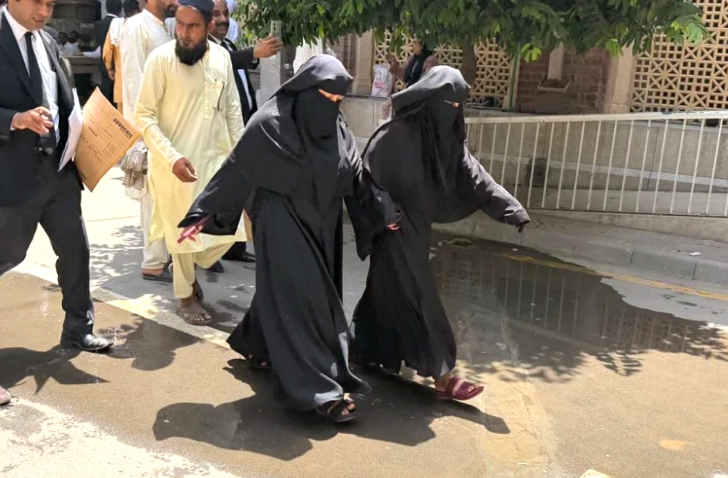
Members of the U.S. Congress have urged the Pakistani government to take steps to protect an 18-year-old Christian woman who her family says was abducted and forcibly converted to Islam.
In an Aug. 20 letter sent to Pakistan Minister for Law and Justice Azam Nazeer Tarar, the 11 congressional members expressed concern over legal procedures following the disappearance of Neha Faqir and her subsequent appearance in court after she was located in Lahore, according to Christian Solidarity International (CSI), which is supporting the family.
Faqir disappeared on March 24 after leaving her family home in Kot Radha Kishan, in Punjab’s Kasur District, to attend a course at a nearby sewing center and did not return home, according to CSI.
A attorney assisting the family later traced Faqir to an Islamic seminary in Lahore, where the family learned that she had converted to Islam mere days after her disappearance, CSI stated. The family disputes the validity of the conversion and says Faqir had never expressed an intention to change her religion, the group added.
The family subsequently petitioned the court seeking her return. The Lahore High Court heard their petition on June 9 but dismissed it, according to CSI. The organization said Faqir appeared in court accompanied by Islamic clerics and that her family was not allowed to speak with her.
The congressional letter stated the circumstances “have raised serious questions about the cause of her disappearance and whether she was able to communicate her wishes independently.”
“We are particularly concerned by reports that her family was not permitted to speak with her before or during those proceedings,” the lawmakers wrote, according to CSI.
Rep. Chris Smith (R-New Jersey) and 10 other members of Congress signed the letter: James P. McGovern, French Hill, Gus Bilirakis, Andy Harris, Maria Elvira Salazar, Riley Moore, Randy Weber, Michael Cloud, Brad Sherman and Blake Moore.
The lawmakers urged Tarar to take steps to ensure Faqir’s physical safety and well-being, provide her with confidential access to independent legal counsel, and allow her to communicate freely and privately with her family. They also called for any further judicial proceedings to be conducted in conditions that would enable her to express her wishes “freely and without intimidation or undue influence.”
Faqir is the third of four children of a Christian couple who work at a brick kiln. Her parents had enrolled her at a sewing center operated by a local Muslim family about two months before her disappearance, hoping she would learn a vocational skill and become more economically independent, according to CSI.
On March 24, Faqir did not return home. Her family was subsequently told that she had not attended the sewing center that day. A police report concerning her disappearance was registered on April 1. The complaint named the sewing center’s operators – Islamic cleric Muhammad Sajid – and his two wives, according to CSI.
The family alleged that they faced intimidation and pressure to withdraw the complaint and accused police of failing to act with urgency in investigating Faqir’s disappearance.
A lawyer engaged by CSI later filed a habeas corpus petition with the Lahore High Court. On May 6, the court directed the District Police Officer in Kasur to locate Faqir and submit a progress report. Police subsequently reported that Faqir had been located at a government shelter in Lahore, according to CSI. Because the shelter fell under the administrative jurisdiction of Lahore rather than Kasur, the organization said the jurisdictional issue delayed efforts to secure her appearance before the court.
The lawyer then filed a fresh habeas corpus petition on behalf of Faqir’s father, Faqir Masih, and the Lahore High Court subsequently ordered police to bring Faqir before the court on June 9. The family saw Faqir for the first time in more than two months at the hearing, according to CSI, adding that she appeared wearing Islamic clothing and accompanied by a Muslim woman and several Islamic representatives.
Faqir’s mother and sister attempted to speak with her but were not permitted to do so, and CSI noted that the court also did not allow the family to speak with her inside the courtroom. The court dismissed the family’s petition seeking her return.
The circumstances surrounding Faqir’s disappearance, conversion and subsequent court appearance have raised concerns among rights advocates about whether she was able to express her wishes independently. The U.S. congressional intervention follows similar efforts in the United Kingdom.
CSI presented Faqir’s case on June 16 to a meeting convened by British parliamentarian David Alton in the House of Lords. Alton subsequently wrote to the U.K. minister responsible for the Middle East and Pakistan, Hamish Falconer, asking him to intervene in the case.
“We are grateful to these members of Congress for taking this stand for Neha and for all persecuted Christians in Pakistan,” said Joel Veldkamp, CSI’s director for public advocacy. “This is an opportunity for the government of Pakistan to end the impunity that fuels violence and extremism in their country, and show that attacks on Christians and other religious minorities will not be overlooked. It is time to bring Neha home.”
Faqir’s case comes amid longstanding concerns over the abduction, forced conversion and forced marriage of Christian and other religious minority women and girls in Pakistan.
A report titled “Stolen Girls” presented by advocacy organization Jubilee Campaign at the European Parliament on July 14 documented 210 cases involving alleged abduction, forced religious conversion, child marriage and sexual violence against Christian and other minority girls between 2019 and 2025.
The report stated that the cases reflected a broader pattern of abuse facilitated by fraudulent documentation, manipulation of legal processes and institutional failures. According to the report, 186 of the 210 documented cases, or 88.6 percent, occurred in Punjab Province, while 22 cases, or 10.5 percent, were recorded in Sindh Province, and two, or 1 percent, in Khyber Pakhtunkhwa Province.
More than 83 percent of the victims were under 18. The report identified 134 victims aged 14 to 17, 41 younger than 14, and 35 adults. It put the average age of victims at 12.8 years and the average age of alleged perpetrators at 35.8 years.
In several of the documented cases, the age difference between the victim and alleged perpetrator exceeded 30 years.
Pakistan ranked eighth among the 50 countries where Christians face the most severe persecution in Open Doors’ 2026 World Watch List, which cited systemic discrimination, mob violence, forced conversions, bonded labor and gender-based abuses. The organization also said weak law enforcement and widespread impunity have enabled perpetrators of anti-Christian violence to escape accountability.