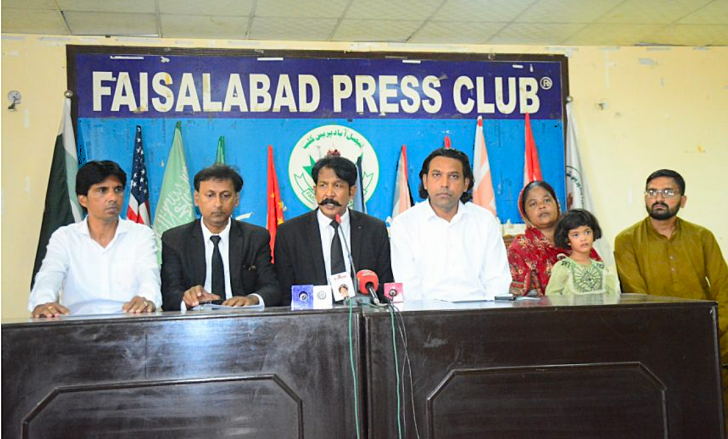
Christian rights advocates on Saturday (Aug. 29) condemned a Pakistani court’s decision to give custody of a 13-year-old Christian girl to a Muslim accused of abducting, forcibly converting and marrying her.
Warning that the ruling could expose Amber Nadeem to further abuse and coercion, the advocates along with the girl’s mother, Nadia Nadeem, called on authorities to protect the child.
At the Faisalabad Press Club, Minorities Alliance Pakistan Chairman Advocate Akmal Bhatti, Voice of Justice Chairman Joseph Janssen, Advocate Haroon Michael and Sadaf Adnan joined Nadia Nadeem to object to the July 25 ruling made by an additional district and sessions judge in Faisalabad, Punjab Province despite unresolved questions over Amber’s age and circumstances surrounding her alleged conversion and marriage.
Amber was allegedly abducted on June 12 by Mohsin Liaqat, according to Janssen. Following a police report, authorities recovered her and placed her in protective custody at a Gender-Based Violence Unit. Liaqat was arrested in connection with the case.
During initial proceedings before a judicial magistrate on June 27, Amber allegedly told the court that members of Liaqat’s family had pressured her to claim that she was an adult. The defense subsequently produced conversion and marriage certificates stating that Amber was 18 and giving her date of birth as June 2008.
Her family and legal representatives disputed the documents, pointing out that Amber’s parents were married in 2012. The magistrate, citing discrepancies over her age, ordered a medical examination to establish her actual age and directed that she remain in a government shelter pending the results.
Janssen said the age examination had not been submitted to the magistrate when Judge Rana Sohail subsequently granted Amber’s custody to Liaqat, whom the defense described as her husband, and granted him bail.
The judge accepted a newly submitted affidavit in which Amber stated that she had voluntarily converted to Islam, married Liaqat of her own free will and had not been abducted, according to Janssen.
The government prosecutor, Muhammad Anwar Naz, strongly opposed the bail application and urged the court to consider the existing case record, Janssen said.
He also alleged that defense lawyers warned Amber during the proceedings that she could face punishment for apostasy if she withdrew her conversion.
“The allegation has raised concerns that her statements may have been influenced by intimidation or coercion,” Janssen added.
Amber’s mother told reporters that the family had applied for registration of a criminal case over allegedly forged birth documents used to alter the ages of Amber and her sister, Jennifer.
The family has submitted a verified Family Registration Certificate that it says contradicts the disputed birth records. It has also filed a civil suit seeking cancellation of the marriage certificate and a declaration that the marriage is illegal and void, Nadia Nadeem said.
Janssen said the case illustrated the vulnerability of religious minority girls when allegations of abduction, conversion and child marriage intersect. He called on law-enforcement agencies and the judiciary to ensure that legal protections for children are applied without discrimination.
“Amber’s case is not only about one child; it is a test of whether Pakistan’s child-protection laws, constitutional guarantees and commitments to religious freedom are applied equally to every child, regardless of her religion,” Janssen said.
Akmal Bhatti of MAP told reporters that the Punjab Child Marriage Restraint Act 2026 provides stronger legal protection for children and criminalizes child marriage and related offences.
He said a child’s alleged consent or statement should not, by itself, determine custody or protection when there are credible allegations of abduction, grooming, coercion, intimidation or manipulation.
“The best interests, safety, dignity and long-term welfare of the child must remain paramount,” Bhatti said.
Rights advocate Sadaf Adnan called for comprehensive legislation criminalizing forced religious conversion, particularly when minors are involved. She also urged independent investigations into allegations of forced conversion, abduction, child marriage and sexual exploitation.
Advocate Michael appealed to the Punjab government, police and judiciary to intervene to protect Amber, investigate the alleged fabrication of documents and other offenses and ensure that the case is decided according to law and the best interests of the child.
Janssen also referred to a July 9 resolution of the European Parliament that called on Pakistan to investigate allegations of forced conversion and child marriage involving minors, prosecute perpetrators and accomplices, ensure the safe recovery and protection of victims, strengthen judicial capacity and fully implement child marriage laws.
The press conference came shortly after members of the U.S. Congress urged the Pakistani government to protect an 18-year-old Christian woman whose family says she was abducted and forcibly converted to Islam.
In an Aug. 20 letter to Pakistan’s Minister for Law and Justice Azam Nazeer Tarar, 11 members of Congress expressed concern over the legal proceedings involving Neha Faqir, according to Christian Solidarity International (CSI), which is supporting her family.
Rep. Chris Smith (R-New Jersey) and Reps. James P. McGovern, French Hill, Gus Bilirakis, Andy Harris, Maria Elvira Salazar, Riley Moore, Randy Weber, Michael Cloud, Brad Sherman and Blake Moore signed the letter.
According to CSI, Faqir disappeared on March 24 after leaving her family home in Kot Radha Kishan, in Punjab’s Kasur District, to attend a course at a nearby sewing center. An attorney assisting the family later traced her to an Islamic seminary in Lahore, where the family learned that she had converted to Islam several days after her disappearance, CSI stated.
Faqir’s family disputes the validity of the conversion and says she had never expressed an intention to change her religion.
The lawmakers urged Tarar to ensure Faqir’s physical safety and well-being, provide her with confidential access to independent legal counsel, and allow her to communicate freely and privately with her family. They also called for any further judicial proceedings to be conducted in conditions that would allow her to express her wishes “freely and without intimidation or undue influence.”
Rights organizations have long raised concerns over allegations of abduction, forced conversion and forced marriage involving Christian and other religious minority girls and women in Pakistan. A report titled Stolen Girls, presented by advocacy organization Jubilee Campaign at the European Parliament on July 14, documented 210 cases involving alleged abduction, forced religious conversion, child marriage and sexual violence against Christian and other minority girls between 2019 and 2025.
The report said the cases pointed to a broader pattern of abuse allegedly facilitated by fraudulent documentation, manipulation of legal processes and institutional failures. Of the 210 cases documented, 186, or 88.6 percent, occurred in Punjab Province, while 22, or 10.5 percent, were recorded in Sindh Province and two, or 1 percent, in Khyber Pakhtunkhwa Province, according to the report.
More than 83 percent of the victims were under 18. The report identified 134 victims aged 14 to 17, 41 younger than 14 and 35 adults. The average age of the victims was 12.8 years, while the average age of alleged perpetrators was 35.8 years. In several cases documented by Jubilee Campaign, the age difference between the alleged victim and perpetrator exceeded 30 years.
The report’s figures represent cases documented by the organization and do not constitute a comprehensive count of all alleged abduction, forced conversion or child-marriage cases involving religious minorities in Pakistan.
Pakistan ranked eighth among the 50 countries where Christians face the most severe persecution in Open Doors’ 2026 World Watch List, which cited systemic discrimination, mob violence, forced conversions, bonded labor and gender-based abuses. The organization also said weak law enforcement and widespread impunity have enabled perpetrators of anti-Christian violence to escape accountability.