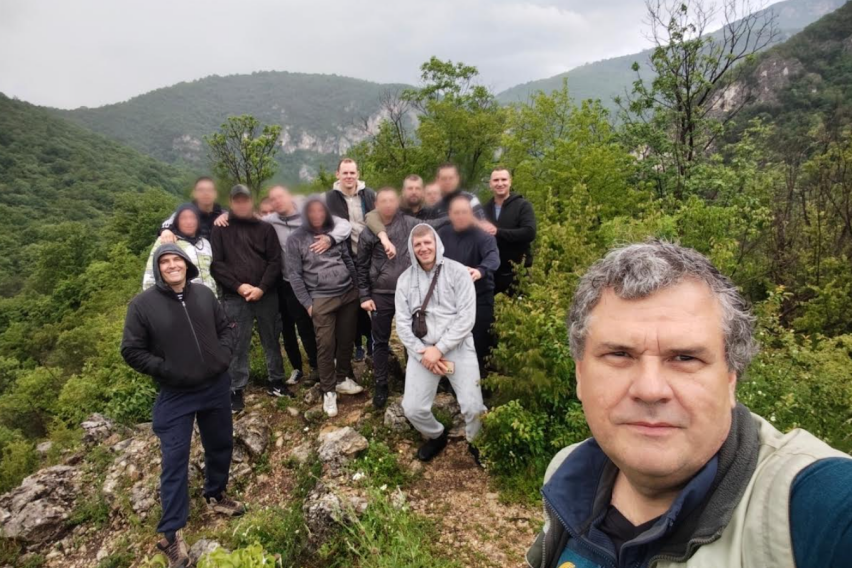
Jesus once said that he came “to seek and to save the lost” (Luke 19:10). These life-changing words certainly hold true for the line of drug addicts and alcoholics coming off the streets of Serbia’s second largest city, Novi Sad, and through the doors of the Rainbow Rehabilitation Center where they receive a warm welcome by members of the Protestant Christian Fellowship running the project. This is in a country with only 6,000 evangelicals, which is just 0.1% of the population.
Standing among the volunteers is a man who knows keenly what it feels like to feel astray from the pull of addiction. Rev. Dušan Beređi, the church pastor known as “Pastor Bera”, tells Christian Daily International that he used to be an alcoholic and glue sniffer without hope until the Holy Spirit entered his life and dramatically transformed him.
“For me, it’s easy to understand the pain of addiction, the struggle and the relapse and all those issues,” Bera says, matter-of-fact, recalling his singular moment of healing as a young man. “I came to Christ during the wartime [Yugoslav Wars] of 1994 and the church was small with no work with addicts. No rehab center in Serbia and no medical help for addicts. So the only solution for me was from God, his grace to give [the healing] to me.”
Bera previously tried to break his addiction in his own strength but it didn’t work: “I was like, ‘I promise from tomorrow I won’t drink anymore, just like every addict promises.’”
“But the desire is too strong and the drive to use it is so strong,” the pastor says. “So for me, with the healing [after prayer] I just lost the desire completely. I was free in a second and I have not touched alcohol for 32 years. Even if I sense alcohol in food, I become sick. I react against alcohol. So I can say that God just put something in my mind to never use it again, and also the drugs.”
Bera is fully aware of his vulnerabilities as a former addict and the need to be careful.
“I know the power of addiction so I’m not blind. But when they say once an addict, forever an addict, they think that you are struggling every day with the temptation of addiction. And I know people who are not free. They wake up every morning with a question in their mind, ‘Maybe today I will start to use it again. I need to resist.’
“We don’t think that somebody who struggles with addiction everyday is free. They are just addicts who don’t use drugs at that moment. Our goal is to bring people to the stage where they don’t have any more desire for them — and only God can do that.”
Bera explains the background to the drugs issue in Serbia after the Kosovo War of 1998. The country “flooded with heroin” as part of the central drugs smuggling route from Afghanistan to Europe. The price of the deadly, illicit narcotics plummeted and many people “hooked up on heroin.”
“It became a big need,” Bera elaborates, “especially from 2005 to 2010, it was like a disease on the streets. So many people were on heroin and many were my friends.
“At the beginning of our work, we sent them to other rehabs, especially to Croatia because that was possible. But we recognised an issue when they came back and didn’t have any established connection here. So they dropped again into addiction.”
In 2008, the church decided to start its own rehab center, at first aiming to help up to seven people. They learned from others experienced in working with addicts and, as demand for support from the church grew, developed a program based on the Teen Challenge approach, while also applying knowledge gained through experience of the issues involved.
Furthermore, Bera explains that although heroin use has dropped societally in Serbia, toxic cocktails of other drugs are often favoured instead such as Cocaine, Speed, Buprenorphine (Subutex), Synthetic Heroin and Methadone.
“It’s a combination of different addictions. What’s more, we don’t work only with drug addicts but also with alcoholics and gamblers. So it’s mixed and they usually have a mix of addictions with gambling, abusing drugs and alcohol. It’s still a big problem.”
The rehab and homeless projects are based in two buildings, one in the city and another in a nearby village. Clients, who are all men, are given space to work on their recovery — “if there’s too many of them together, that is not good for their rehabilitation.”
There is no facility for women at the moment. The church looked at this option but for various reasons it was not a successful route due to a lack of clients. However, Bera knows of other rehabilitation centers offering this support to the growing number of female drug addicts and particularly alcoholics.
Bera is aware that former clients can still return to addiction. He adds that people who have never struggled with this issue can find it hard to understand just how difficult it is to break free from it. Addicts can be told to “think about your family and you’ll stop” but the compulsion of addiction can dominate that sense of prioritising loved ones.
“In my opinion it is only God who is stronger. Because in addiction you feel deep pain or deep emptiness in your heart and you try to feed that in some way. And when you use something you just forget about that hole in your heart. But when substances stop working, the hole is again there.”
“When God comes into our life, the deep feeling of purpose gives a strength to deal with our pain, pain of our past,” adds Bera, saying that nobody becomes an addict for the sake of it. The addiction is a symptom of a person trying to deal with inner emotional pain.
“Addiction answers for the pain, pain of the past, pain of some experience of your broken image about yourself.”
An encounter with Jesus Christ may not mean the reason for the pain is forgotten, such as a difficult childhood, or forms of abuse, but God gives a strength to deal with that pain and associated memories.
“That is what is rehab,” adds Bera. “We bring the person first to Christ because Christ is real. He goes deep inside the person and the life is changed. That is what Christ said, that you need to be a newborn.
“From that moment we work on the developing of character and working habits and hygiene and skills for work and everything and work on the understanding issue or source of addiction. All the things are important, but if Christ is not in their heart, they'll go back. They'll go back, this is too strong, this desire.”
The pastoral support work focuses on addicts needing rehabilitation. It also helps people with life controlling issues, including mental illness, not needing rehab, but repurposing them to reintegrate with their families.
The addiction rehabilitation project, carried out in partnership with Teen Challenge and prayerfully supported by Transform Europe Network (TEN), is complemented by a partner initiative supporting homeless people, called “Hand for a Friend.”
The work supports the homeless struggling to eke a normal existence and “just need total love.”
“So we offer them love through ‘Hands for the Friend’ and try to be there for them to provide some food but also friendship and fellowship to see them become real people.”
Challenges for the ministry include the fact that the government offers no financial support. It is entirely self-funded and for that reason, Bera and his colleagues have devised business models for income.
“We try to be self-sufficient because that is our goal. We want to do so because fundraising can be a huge challenge for our organization.”
Bera adds that rehab clients may have a habit of asking for money and the organization does not want the same mentality. It wants to cater for its own needs and has hit a 75 percent target to date of covering its costs. Finding the other 25 percent is challenging.
“We’re really working hard to develop this self-sufficiency to put everything in order,” he says.
For example, the ministry has created a household items removal and transportation firm, with rehab clients helping to move goods. There is also a small farm machinery rented to households, such as for drying walls and deep cleaning. A Croatian businessman is also helping by providing his products for the ministry to sell to shops in Serbia.
“Our goal is to come to the level where we can cover our expenses. We don’t charge people for rehab. Why? Because you decide to work with people from the street who don't have money and they destroy their family. So we can't ask the wife of an addict, can you pay us 500 Euros every month? No, she barely survives every day. So we're trying to work.”
Bera adds that the thrust for profitable business faces an additional challenge because of the student protests happening in Serbia, as previously reported by Christian Daily International.
“This unstable political situation is influencing our work,” adds Bera. “That is a big issue now because all businesses are struggling at the moment.”
Former clients do go on to live productive lives with a number staying to become members of the church, and to serve others. He cites one former student who is now married and a church planter in Croatia. Another became a medical surgeon.
The homeless ministry actually started by a former client in the church who became concerned about the plight of people on the streets of the city.
“So we see many fruits of this ministry. They have a normal life, married, have children, really normal. You cannot, when you see them, think, ‘Oh this guy was a heroin addict five years ago or 10 years ago.’”
Bera is also careful to avoid a numbers game when it comes to ‘success’ of the ministry in regards to how many regain a normal life. He prefers a bespoke, individualised approach. “We have many stories of people who are good now at this moment, yes, we are doing this.”
Plans for the future include starting rehab centers in other Serbian cities, especially in rural areas with no church witness at all. There is also a prevailing need to refocus support on helping people not suitable for rehab but needing support with life controlling issues and various lower scale addictions, which are not devastating but still problematic for their lives.
Bera asked for prayers for the workers involved in the projects, which are not easy for them personally. Also for the ministry itself as it continues to develop and help, providing a crucial witness to the love of Jesus Christ by powerfully and practically serving the needs of addict and homeless people.
“I think this is our biggest need,” Bera concludes.