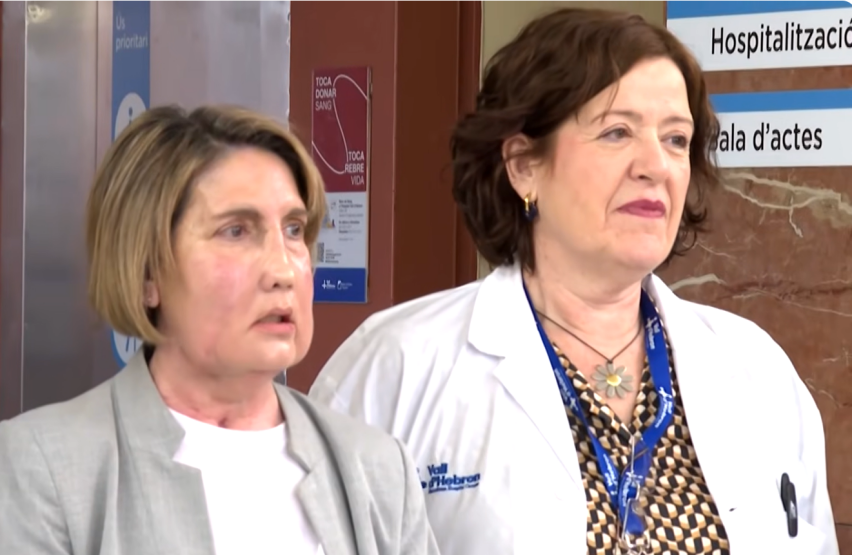
About 100 medical professionals took part in the operation at Vall d'Hebron University Hospital in Barcelona in September 2025, with the results announced on Feb. 2. The 24-hour surgery had been deemed highly complex and utilized microsurgical vascular and nerve techniques, according to a hospital press release.
The release pointed out that facial disfigurement is “one of the most devastating” physical disabilities, with profound psychological and social consequences, as well as negative effects on everyday activities such as speaking, eating, and seeing.
“Face transplantation is a functional surgery, carried out when a patient has lost areas of the face, such as the orbicular facial muscles and eyes, which cannot be restored through standard plastic surgery techniques. These are patients with severe facial disfigurement due to disease, burns, trauma or congenital defects affecting basic vital functions,” explained Joan-Pere Barret i Nerín, Head of the Plastic Surgery and Burns Department at Vall d'Hebron University Hospital.
In 2010, the Vall d'Hebron team led by Dr. Barret performed the world’s first full face transplant, following the world’s first partial face transplant carried out in Amiens, France, in 2005.
The Spanish hospital furthered its pioneering record in 2015 by performing the world’s first face transplant using controlled asystole (Maastricht type III). In this procedure, the donor does not meet the criteria for brain death but has an unsurvivable condition. Death is declared only after the planned withdrawal of life support and the subsequent permanent stopping of the heart (asystole).
The recent procedure was the first face transplant from a donor who had undergone assisted dying. Before she died, the donor decided to donate her organs, tissues, and also her face.
“Donors and their families always perform an immense act of generosity and altruism, but this case also demonstrates a level of maturity that leaves one speechless. Someone who has decided to end their life dedicates one of their last wishes to a stranger and gives them a second chance of this magnitude,” said Elisabeth Navas, Medical Coordinator of Donation and Transplants at Vall d'Hebron University Hospital.
The recipient, named “Carme” by Spanish press, required a type I partial face transplant (central part of the face) after suffering facial tissue necrosis caused by a bacterial infection, according to the hospital. Other reports said an insect bite while on holiday in the Canary Islands led to sepsis and then necrosis.
The lengthy procedure aimed to reconnect “all structures,” including skin, adipose tissue, peripheral nerves, and facial muscles in the recipient, creating a new facial appearance that is functional and allows the patient to perform vital functions normally.
After surgery, the patient spent a month recovering in the hospital’s Burn Unit Intensive Care Unit and later on the ward of the Traumatology, Rehabilitation and Burns Hospital.
This also allowed immunosuppressive medication to be monitored and enabled doctors to check for complications such as infections. Facial rehabilitation for actions such as chewing and speaking also took place, alongside psychological support in the post-transplant period.
The hospital said the patient is now adapting to a “second life, made possible by the immense altruism of her donor.”
“On behalf of the ONT [Organización Nacional de Trasplantes/National Transplant Organization], I want to sincerely congratulate Vall d'Hebron for the excellence demonstrated,” said Beatriz Domínguez-Gil, Director General of the ONT.
“Every donation and transplant process is the result of a collective effort. In this case, an exceptional number of professionals from multiple disciplines participated, whose coordinated work ensured the utmost care, respect, and support for the donor and her family, as well as a very high level of technical perfection to address a serious health problem in the recipient.
“Being able to perform procedures of this complexity with these results is a source of pride for the teams involved, the hospital, and society as a whole.”
Meanwhile, Dr. Xesús-Manuel Suárez-García, Secretary General of the Spanish Evangelical Alliance and a member of the Executive Committee of GBU España (IFES), said the operation was a “complex and advanced medical (not only surgical) procedure.”
“What has been repeatedly highlighted in the news is that the donor was a woman who had requested euthanasia,” Suárez-García told Christian Daily International, adding that “in my opinion, there are two aspects to differentiate in the evaluation.”
“On the one hand, organ transplantation — in this case, of the entire face — is a procedure that is ethically acceptable, no doubt; the case at hand is no different in this regard from any other.
“On the other hand, the media have emphasized that this is the first such procedure performed with a donor who had undergone euthanasia. And the generosity of the donor has been highlighted.”
Suárez-García said the generosity in this case is exactly the same as that of any other donor who had signed their decision to offer their body for organ donation before dying.
“It is exactly the same, neither greater nor lesser,” he added. “But the media have exalted the supposedly special generosity of the donor.”
That is where the secretary-general saw an ethical problem, “in this interest in presenting an exalted and edifying image of euthanasia.”
“We certainly appreciate the donor's generosity, but there is nothing special about this generosity compared to that of all other donors,” he said. “If someone wants to defend the promotion of euthanasia, let them do so with arguments, not with this manipulation of the message and the image.”
Suárez-García added that he had consulted other Christian doctors and lawyers in Spain about the issue, “and they plainly agree with me.”