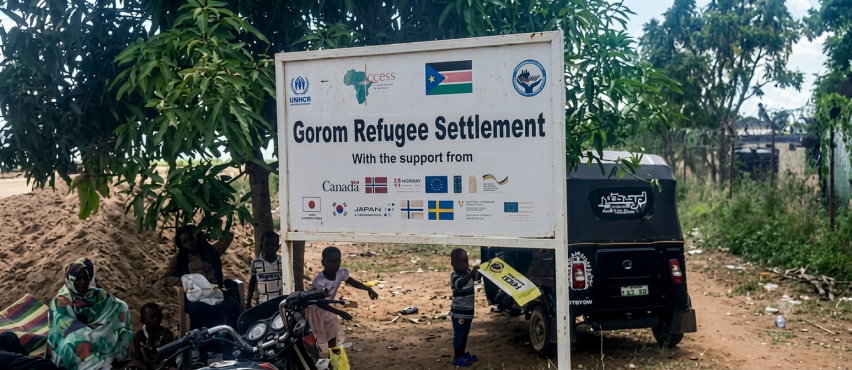
The assault of a Sudanese Christian inside a church in South Sudan's Gorom Refugee Camp has renewed concerns about the vulnerability of religious converts and the challenges facing displaced communities fleeing conflict in neighboring Sudan.
According to International Christian Concern (ICC), a Washington, D.C.-based aid and advocacy group that monitors religious persecution, a group of Muslims entered a church in the Gorom Refugee Camp on May 28 and assaulted a Sudanese Christian identified as Drake Haron. The organization said the attack took place inside the church building where Haron worships and serves among fellow refugees.
“The attack violated the sense of peace within the small refugee church,” ICC reported on June 15. The organization said the assailants have not been identified.
Haron said he has long understood the risks of his decision to convert from Islam to Christianity.
“For me, being a Christian is a privilege,” Haron said. “That Jesus had to die for my sins for me to be saved means a lot to me. Based on that reality, I have chosen to follow him and to do his will, which is preaching the gospel.”
The attack occurred inside a place of worship that many refugees view as one of the few safe spaces available amid displacement, uncertainty and trauma. Churches in refugee settlements often serve not only as religious centers but also as community gathering points, sources of emotional support and hubs for humanitarian assistance.
ICC described the incident as an unprovoked assault carried out inside a protected religious space. The organization argued that attacks on churches affect not only individual victims but entire communities already coping with the hardships of displacement.
Despite the assault, Haron said he remains committed to his faith.
“Becoming a Christian from a Muslim background puts me and many others at risk, but where God has delivered me is worth the risk," he said. "From a flesh standpoint, there is fear, but when I remember the promises of God in Jesus Christ, I become bold and strong.”
Unlike neighboring Sudan, where Islam is the dominant religion, South Sudan is a Christian-majority nation. Various estimates indicate that roughly 60 percent of the population identifies as Christian, while significant numbers follow traditional African religions and a smaller minority identify as Muslim. Churches play a prominent role in public life and have frequently served as mediators in peace efforts and reconciliation initiatives since the country's independence in 2011.
The country generally respects freedom of religion, and religiously motivated violence between Christians and Muslims is relatively uncommon compared with other parts of the region.
Converts face increased violence
Analysts note that most of South Sudan's conflicts have centered on political, ethnic and communal disputes rather than direct religious confrontation.
Nevertheless, tensions can emerge within refugee communities, particularly among people displaced by Sudan's ongoing civil war.
Since fighting erupted in Sudan in April 2023, hundreds of thousands of refugees have crossed into South Sudan. Many arrived carrying deep trauma, economic hardship and social divisions shaped by the conflict they fled. Gorom Refugee Camp, located near the South Sudanese capital of Juba, has become home to thousands of Sudanese refugees seeking safety.
Religious converts from Islam often face unique pressures. Advocacy groups like ICC say converts can encounter hostility from relatives, former community members or others who view conversion as a rejection of family or cultural identity. Such tensions are frequently social and personal rather than state-driven.
Recent reports from Christian advocacy organizations have highlighted additional cases involving Sudanese converts living in South Sudan. Earlier this year, Morning Star News reported that a Sudanese refugee in the same Gorom settlement faced death threats after converting to Christianity. Other reports have documented attacks and intimidation against converts who fled Sudan and later embraced Christianity while living in refugee camps.
The latest incident comes as church leaders continue to emphasize the role of faith communities in promoting peace in South Sudan. During a 2023 ecumenical pilgrimage, Pope Francis, Anglican Archbishop Justin Welby and Church of Scotland Moderator Iain Greenshields urged South Sudanese leaders and citizens to reject violence and embrace reconciliation after years of civil conflict.
For Haron, however, the issue remains deeply personal. Despite the assault, he appealed for prayer and support rather than retaliation.
“I ask that you always mention us in your prayers so that we remain strong in faith and do his will," Haron said. “We are optimistic that our Muslim families will be saved one day by the power of our Lord Jesus Christ.”
The attackers remain unidentified, and no arrests have been reported.