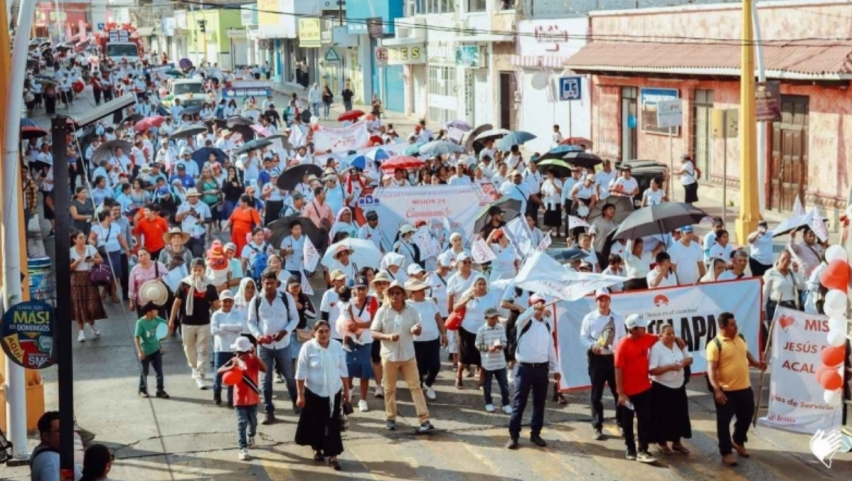
On Mexico’s southern border, more than 10,000 people and members of the Jesús es el Camino church took part in the “Thanksgiving March to God for 32 Years of Peace in Chiapas,” held under the theme “One and a Thousand Reasons to Thank God for Peace.”
The massive march aimed to recognize the stability the region has experienced since 1994 and to offer prayers for continued peace.
According to religious leaders, the event was organized as an expression of gratitude for the tranquility that, they say, God has granted Chiapas since the 1994 Zapatista uprising, when Tzotzil, Tzeltal, and Tojolabal communities took up arms to demand rights and recognition as Indigenous peoples.
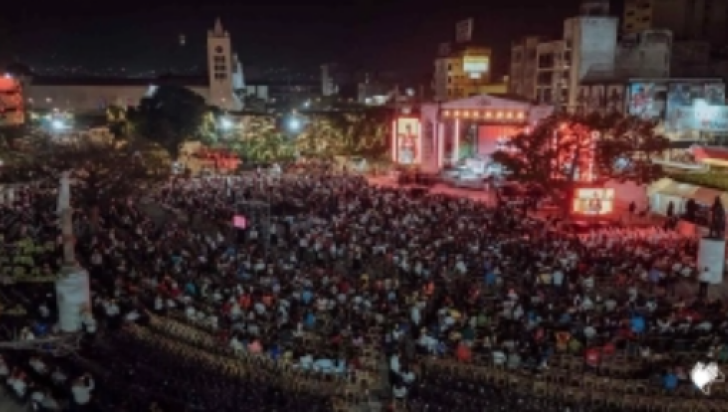
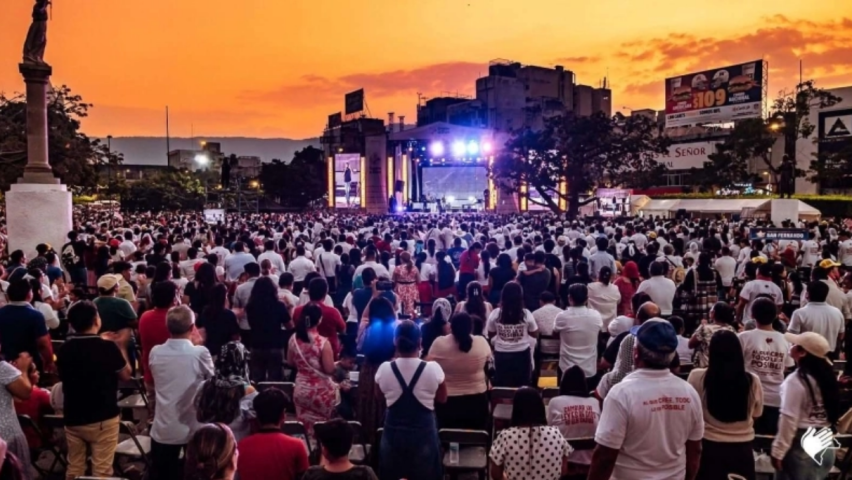
Thousands of Christians marched from the eastern side of Tuxtla Gutiérrez, the state capital, toward Central Park. Another group departed from the “bridge of colors” on the western side of the city. Both contingents met in the central plaza, where musical performances, preaching, and prayers for the peace of the state took place.
Cultural diversity and national participation
Pastors from various communities offered prayers in Spanish and Indigenous languages, asking for protection for each municipality. They also recalled past periods of violence, including in 1994 and again in 2004, when the presence of criminal groups affected several regions of Chiapas.
Pastors and believers from states across the country—including Quintana Roo, Campeche, Tabasco, Veracruz, Puebla, Hidalgo, Guanajuato, Nuevo León, Baja California, Oaxaca, the State of Mexico, and Mexico City—joined the march.
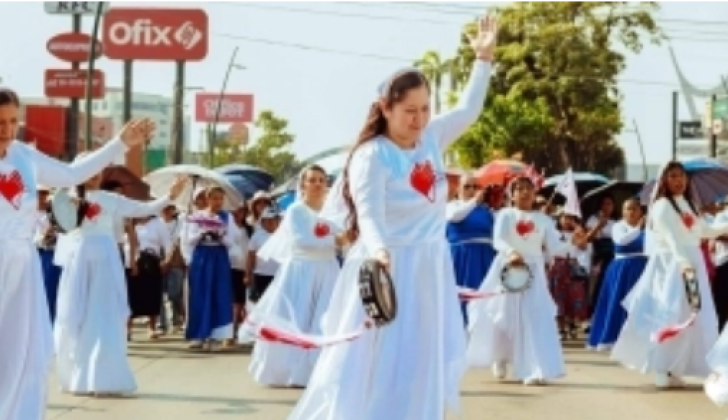
Praise and worship were led by psalmist Tomás Reyes, the sierreño group Clave 3.16, and musicians Erik Portal, Tony Pérez, and the Shekina RAV ministry.
Carrying white balloons as a symbol of peace, participants held signs with messages such as “God is Love,” “God Heals Our Land,” “We Pray for Tuxtla Gutiérrez,” and “God Bless Chiapas.”
During the gathering, attendees prayed for the state government and for local and federal lawmakers, asking that they make decisions guided by justice and committed to social well-being. The values of peace, unity, legality, and dialogue were emphasized as pillars of community life and family development.
Members of the Tzotzil, Chol, Tojolabal, and Tzeltal peoples, dressed in traditional clothing, joined in with songs in their native languages. Among them was Pastor Mario Choj of San Juan Chamula, who prayed in Tzotzil for peace in Chiapas and throughout the country.
Current challenges and faith in Chiapas
Pastor Josué Pérez Pardo, organizer of the march and leader of the “Jesucristo Esperanza Segura” ministry, said the event was motivated by recent outbreaks of violence in the state, particularly in the Altos region, the northern area, and municipalities such as La Concordia and Comalapa. He also mentioned the rise in traffic accidents in Tuxtla Gutiérrez. He noted that Chiapas continues to face issues stemming from religious intolerance.
According to the National Human Rights Commission, more than 30,500 cases of internal displacement due to religious conflicts were documented between 1974 and 2016. Today, Chiapas has more than 5.5 million residents, of whom 2 million identify as Protestant evangelicals.
The Coordination of Christian Organizations in Mexico reports that 6 out of 10 families in Chiapas have left their homes at some point to avoid religiously motivated aggression.
According to the National Institute of Statistics and Geography (INEGI), Chiapas is the most religiously diverse state in Mexico. In 2020, its population was 53.9% Catholic, 32.4% Protestant or evangelical Christian, and 12.5% nonreligious—making it the state with the highest evangelical presence in the country, ahead of Tabasco, Campeche, and Quintana Roo.
A continued commitment to peace
In this context, pastors said the march also aims to build unity among churches and maintain a constant focus on praying for peace. They announced that monthly prayer gatherings will soon be organized in different municipalities.
The march also included prayers for Central American countries and for migrants traveling through Chiapas’ border region—many of whom are fleeing violence. Pastors asked for protection and divine guidance for people in transit and for nations affected by insecurity.
Throughout the event, songs from children, youth, adults, and the elderly could be heard, accompanied by wind bands, tambourines, and parade floats.
The Jesús es el Camino church noted that in 2020 and 2021, it organized prayer caravans during the COVID-19 health emergency—efforts that, they say, were meant to bring comfort and hope to the population.
With this march, thousands of believers reaffirmed their conviction that peace in Chiapas is a gift from God that must be preserved through prayer, unity, and community commitment.
Original reporting by Diario Cristiano, Christian Daily International's Spanish edition.