
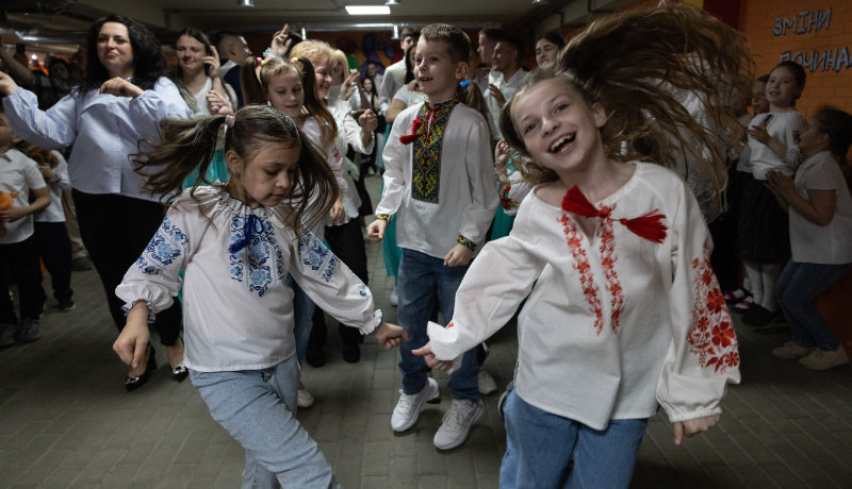
At 9 a.m. on August 23rd, inside a long hall in Kyiv where 1,500 people had gathered for Ukraine’s National Prayer Breakfast, a recorded ticking sound came through the speakers.
Conversations stopped. The coffee machines went quiet. Ukraine was observing its daily minute of silence—one minute, every day, for the soldiers and civilians killed since February 2022. When it ended, the room returned to prayer.
I came to bear witness to suffering, and I left feeling fortified.
I’ve been coming to Ukraine for several years through my documentary work—my company just released Faith in War, a five-episode series on what faith looks like in a country at war. Each time I leave, I’m surprised by the same thing: I came to bear witness to suffering, and I left feeling fortified. There’s something about watching people hold faith under pressure that recalibrates you.
This was the third annual National Prayer Breakfast, and more than 650 foreigners from 17 countries made the trip, many of them on overnight trains from Poland, sleeping to the sound of air raid alerts on their phones. The gathering was held the day before Ukraine’s Independence Day—35 years since the country broke free from the Soviet Union. That proximity was not accidental.
The version of diplomacy that doesn’t make headlines.
I spent part of the morning with a Ukrainian pastor I’ve known for years. His church narrowly escaped direct hits from two Iranian-designed, Russian-launched Shahed drones last year. We don’t share a language; I don’t speak Ukrainian, he doesn’t speak English. We just hugged it out for a bit. That’s the version of diplomacy that doesn’t make headlines, but it’s the kind that lasts.
Former Vice President Mike Pence addressed the room and said what needed saying: an occupying power may seize territory, but it cannot conquer a people whose faith remains unbroken. Retired Lt. Gen. Keith Kellogg paraphrased Psalm 20:7, “Some nations boast of their armies and weapons, but we boast in the name of God.”
The stories coming out of this conflict matter beyond the people living them.
Both men shook our hands and thanked us for our documentary work, Faith Under Siege in 2025 and Faith in War in 2026, which was a reminder that the stories coming out of this conflict matter beyond the people living them.
President Zelensky was in attendance, and his words have stayed with me: “The war has been going on for a long time, and the greatest danger now is not fatigue at the front. It is the world getting used to the war.” He also said that across Ukraine, people share the same prayer: asking God for the strength to see the morning.
Zelensky is right to name that danger. But there’s another danger worth naming, one that belongs to the other side.
This July was Ukraine’s deadliest month since the full-scale invasion began in February 2022. Russia is now running its most sustained aerial bombardment of the war, deliberately targeting water, energy, and sanitation systems ahead of winter.
Over a 24-hour period... Kyiv spent... nearly 15 hours under alert.
On August 27th, Kyiv recorded 13 air raid alerts over a 24-hour period, setting a single-day record for the capital since the start of Russia's full-scale invasion in February 2022. In total, Kyiv spent 872 minutes (nearly 15 hours) under alert. That morning, I witnessed Ukrainian forces down a Shahed drone in front of my hotel.
The strategy is textbook: make civilian life unbearable enough, long enough, and the population will demand that its government negotiate on any terms. Break the will, end the war. The problem is that this theory has been field-tested before, at enormous scale, and it failed spectacularly.
Surviving a bombing produces not trauma but a strange species of liberation.
In the autumn of 1940, the German Luftwaffe dropped thousands of tons of bombs on London. Both Churchill and the Nazi leadership expected civilian breakdown: panic, riots, demands for surrender. Instead, the opposite happened. Malcolm Gladwell examines this at length in David and Goliath, drawing on decades of psychological research that followed the Blitz. The key finding: surviving a bombing produces not trauma but a strange species of liberation.
Fear, confronted, lost its power.
A psychiatrist named J.T. MacCurdy identified two groups: “remote misses,” people far enough from the blast to be frightened but unharmed, and “near misses,” people who survived close calls. The remote misses were genuinely destabilized. Their fear compounded by imagination and distance. But those who lived through direct encounters experienced something different: the thing they had feared most had happened, and they were still here. The fear, confronted, lost its power.
Sociologist Charles Fritz found that shared catastrophe routinely produces the opposite of what aggressors intend. It dissolves social divisions, builds solidarity, and creates communities that are more cohesive under attack, not less. Londoners didn’t capitulate under the Blitz. They came out of it proud of what they had endured.
On August 24th, Independence Day, I traveled east to Kharkiv. Kharkiv sits roughly 20 miles from the Russian border. It is one of the most consistently targeted cities in Ukraine. Not occasionally, but constantly, relentlessly. When I arrived, an active air raid was underway.
The streets were full of flags. Ukrainian flags flew from honking vehicles and filled the hands of people who had come out to celebrate the 35th anniversary of their independence. There was music. There was noise.
It looked like a victory parade.
People were moving through their city with a kind of determined, collective joy that I struggled to find the right word for, until I found it: it looked like a victory parade. Not a defiant one. Not a desperate one. A victory parade. The kind where a people who have already settled something fundamental in themselves come out into the streets to mark it, because the city is theirs and the day is theirs and no amount of incoming fire changes that calculus.
The fear metabolized into... identity.
This is what Putin’s strategy keeps missing. He applies force and waits for submission. He is generating the opposite. The Ukrainians who have lived under sustained bombardment long enough have passed through something—the fear metabolized into a refusal that is no longer fully conscious. It has become identity.
You don’t fill the streets with flags during an air raid because you are reckless. You do it because you have already made your peace with the worst-case scenario, and you have decided that the city still belongs to you.
Let the people of Kharkiv show you what it looks like.
Zelensky is right that the real danger is the world getting used to the war. The answer to that is not to look away. It’s to go. Go stand on Ukrainian soil. Let the people of Kharkiv show you what it looks like when a population has passed through fear and decided not to come back from the other side of it.
The prayer breakfast grows every year. The bombs keep falling. And the Ukrainians keep praying, celebrating, and asking God for the strength to see the morning, which, in Kharkiv at least, they are apparently willing to do in the middle of the street.
Colby Barrett, JD (law), PE (engineering), is an entrepreneur, filmmaker, and former U.S. Marine Corps Captain who led infantry and scout/sniper platoons in the Pacific Rim and the Middle East. He is the producer of A Faith Under Siege and Faith in War.








