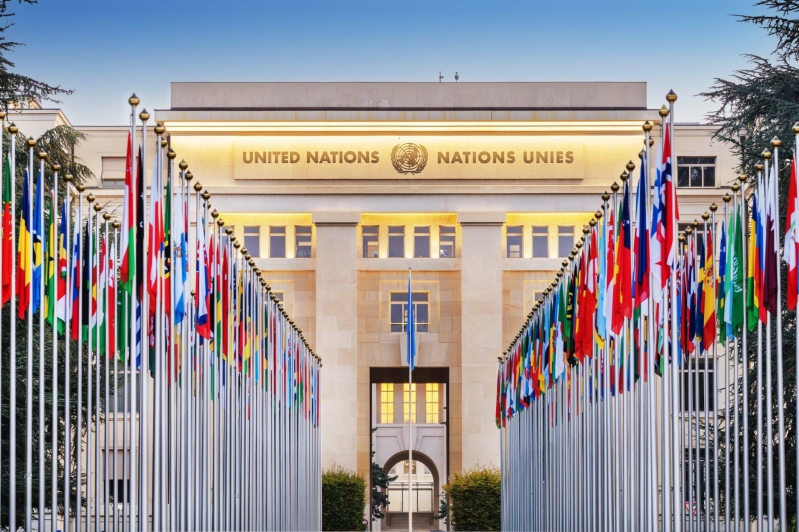
The global church must actively engage in international policy discussions and resist the temptation to remain silent at forums such as the United Nations, according to a senior Pentecostal policy adviser who argues that Christian voices are urgently needed amid growing global inequality, conflict and social fragmentation.
Mikael Jägerskog, senior policy adviser for Pingstmissionens Utvecklingssamarbete (Pentecostal Mission's Development Cooperation, PMU) and U.N. contact for the Pentecostal World Fellowship, made the case in a commentary published by the European Evangelical Alliance. Drawing on his experience representing faith-based organizations at U.N. meetings, Jägerskog said decisions made in global arenas “ripple across the world” and shape the daily realities of communities served by churches, making Christian engagement both a moral responsibility and a practical necessity.
In his article titled, “Why the church must lean in: lessons from Doha,” Jägerskog explained that he spends “a good chunk of time” in global meetings and believed the contribution of Christians at such events was greatly needed.
“The world is spinning fast — inequality grows, climate bites, trust erodes, and technology changes everything before we’ve even read the manual. These aren’t just headlines; they shape the communities we serve as churches,” said Jägerskog.
Decisions made in forums such as the United Nations have effects globally, Jägerskog opined, and added that “we can either talk to people in power — or stay silent. And silence rarely changes anything — except maybe making the church look irrelevant.”
The question then became where the church should engage and what message to bring at such secular meetings of global importance societally and politically.
Jägerskog pointed to the Second World Summit for Social Development, held Nov. 4–6 at the Qatar National Convention Centre in Doha, Qatar, which he described as one of the largest United Nations conferences this year. About 15,000 delegates attended, he said, with discussions frequently invoking terms such as “justice” and “human dignity” in connection with the 2030 Agenda for Sustainable Development, a 17-goal framework adopted by all 193 U.N. member states in 2015 to promote a more sustainable and equitable future.
Jägerskog called the discussions about the agenda “inspiring” but added the critique: “Concrete plans? Not so much” about the outcome.
“Back in 1995 in Copenhagen, the first World Summit for Social Development put people at the heart of development—a milestone in global policymaking,” he explained. “Thirty years later, that vision still matters—but progress is fragile. For instance, only an estimated 12% of the UN’s Sustainable Development Goals are on track.”
However, Jägerskog advised concerned parties to not be tempted in giving up on the goals, despite the apparent lack of progress.
“We need to protect what’s been achieved globally, learn from what failed, and help shape what’s next for social development,” he added, and suggested this is where the church can play a major role in contributing to the development of such an agenda.
“This is where the church can lead—not by imposing, but by serving. Not by retreating, but by leaning in to conversations.”
In Jägerskog’s perspective, when decisions are made about poverty, migration, climate, and justice — “the church must be there."
“Not to wave a Christian flag or carve out space for ourselves,” he said, “but because we bring something the world desperately needs: local voices with local solutions and a moral compass rooted in the Gospel.
“Presence isn’t enough—we need engagement. Too often, we speak loudly on spiritual matters but stay quiet on social ones. Yet Scripture calls us to love God and neighbour, seek justice, and defend the vulnerable.
“Yes, we need to do this sensibly and avoid partisan politics—but the first step is to engage with people in power, act in solidarity with the communities we serve, and speak up when power is misused.”
Jägerskog also challenged any notion that it may be naïve to talk about morality and hope in today’s world: “Hope is not wishful thinking—it’s fuel for action. It drives us to advocate for dignity, challenge injustice, and build peace."
Faith communities provide more than encouraging word but also practical remedies in the form of networks, local solutions and a “vision of flourishing beyond material wealth,” said Jägerskog.
“In crises, churches are often among the first responders. That is not marginal work—it is central to building a just future,” Jägerskog said. “Together with our global community of churches in every corner of the world, we have something vital to bring to the decision tables—something to say and something to give.”
He reminded evangelicals in Europe that Christian hope is anchored in Christ and carries an ongoing calling to be “salt and light” in a world searching for direction.
“So let us show up where decisions are made and contribute with hope and practical solutions,” Jägerskog concluded. “We must speak with humility and courage. The future of social development is not only political—it is moral. And the church cannot afford to remain silent at a time like this.”