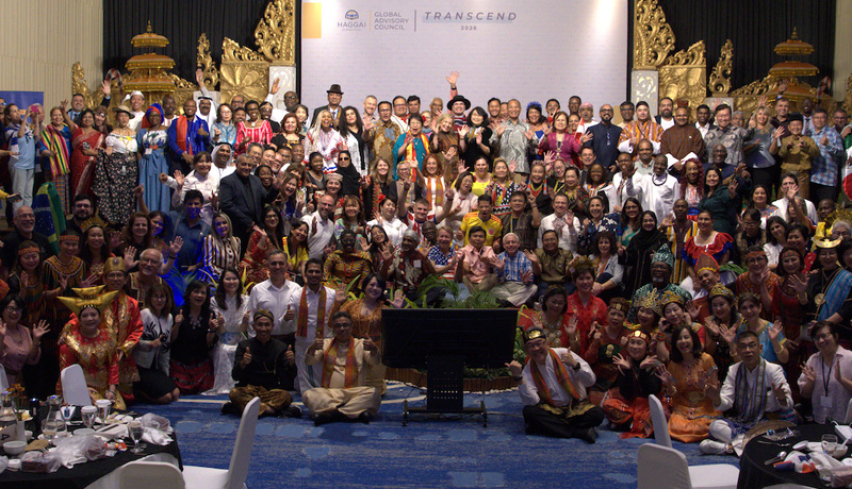
I recently began a series of speeches at Haggai International’s Global Advisory Council in Bali with a slide that read: “Meet Me in Galilee.” The conference theme was a single word: “Transcend.” Its grounding text was Isaiah 55:7–9, which reminds us that God’s thoughts and ways are higher than ours.
My title comes from the resurrection accounts. At the tomb, the angel tells the women, “He is going ahead of you into Galilee. There you will see him” (Matthew 28:7; see also Mark 16:7). As the women leave, the risen Jesus meets them and repeats the instruction: “Tell my brothers to go to Galilee” (Matthew 28:10). The eleven disciples go, meet Jesus on a mountain, worship him—though some doubt—and hear his words about making disciples of all nations (Matthew 28:16–20).
The call to meet Jesus in Galilee seems both instructive and perplexing.
The call to meet Jesus in Galilee seems both instructive and perplexing. It is a strange place for Matthew’s story to reach its climax. The ending could have remained in Jerusalem, the center of religious life and political authority. It could have turned toward Alexandria, Antioch, or Rome, the imperial capital. Instead, Matthew takes us back to Galilee.
Why Galilee, not Rome?
I do not mean that Galilee was untouched by power, or that every center is bad and every margin good. Galilee was a real place, shaped by its own histories and hierarchies. In Matthew’s story, it is where Jesus begins his public ministry, calls ordinary people, teaches, heals, and announces God’s kingdom. It is also where the disciples meet him again after his death.
Picture the church’s life from the standpoint of people at the edges.
But the call to meet Jesus in Galilee is about more than geography. It is about imagination and posture. “Galilee, not Rome” asks us to picture the church’s life from the standpoint of people at the edges, rather than from the center of institutional power. It invites us to listen before we plan, to serve without trying to control, and to recognize that the gospel may become clearer when we begin with people and places we have learned to overlook.
God’s higher way
The place where they had learned his way among ordinary people.
Isaiah reminds us that God’s ways are higher than ours. Matthew’s final scene gives that claim a place and a shape. The risen Jesus sends the disciples back to Galilee; not to an imperial center, but to the place where they had learned his way among ordinary people.
Perhaps God is showing them that bearing witness to the kingdom does not depend on mastering the centers of power. It can happen through a different kind of presence: teaching, healing, welcoming, serving, and accompanying others. God’s ways are higher—not because they reach above ordinary life, but because they transform how we live within it.
Galilee was Jesus’ school of mission.
Galilee was Jesus’ school of mission. There, the disciples learned to pay attention: to see the people in front of them, listen to their lives, and respond with compassion. They saw that the good news is spoken, but also embodied; in healing, welcome, shared food, and restored belonging. After the resurrection, Jesus sends them back to Galilee, as if to say: remember what you learned here, and carry this way of life outward.
Use influence without imitating domination.
The disciples are not simply told what to say, they are shown how to live the good news they will share. Their witness takes shape in how they are with people, and in how they use influence without imitating domination. The place where they learned Jesus’ way becomes the place from which they begin again.
Where does mission begin?
Before asking what a church or organization should do, we might ask where (and to whom) it is listening.
Churches and missions agencies often begin outreach with a plan: a strategy, a program, a budget, a set of targets. These can be useful. But before asking what a church or organization should do, we might ask where (and to whom) it is listening.
Missions activity that begins only in a meeting room can mistake a community for a problem to solve. It may arrive with its answers already prepared. Listening changes the order. It asks what people are experiencing, what they value, what they fear, and what forms of hope are already present.
Jesus... is moved with compassion.
Matthew gives us a picture of Jesus’ attention. He sees people who are sick, hungry, grieving, excluded, and worn down. He does not treat them as an abstract audience for a message. He meets them in particular places and responds to their lives. In Matthew 9, he sees crowds who are “harassed and helpless” and is moved with compassion.
Perhaps our participation in God's mission begins with seeing, and staying long enough to understand what we see. It begins when we are willing to be taught by our neighbors, rather than assuming wisdom travels in only one direction.
The gospel at the edge
Matthew introduces Jesus’ ministry in Galilee through Isaiah’s image of light shining in darkness (Matthew 4:12–16). Jesus teaches in synagogues, announces God’s kingdom, and heals people. His Gospel begins and ends in Galilee: the work that starts there opens outward to all nations.
Galilee is not simply a symbol for “the poor” or “the overlooked.” It is a place in the story. Furthermore, its place matters. Jesus gathers fishermen, speaks to crowds, touches those considered unclean, and makes room for people whose lives are easily pushed aside.
The message and the way people are treated belong together.
This should shape how we understand “good news.” In Matthew, it is announced through teaching and made tangible through healing, food, welcome, and restored belonging. The message and the way people are treated belong together.
Help us notice what we have learned to overlook.
Whose lives help us understand what the gospel means? If we listen only to those already comfortable in church, we may miss what good news sounds like to people facing poverty, migration, racism, loneliness, or exclusion. The view from the edge does not replace Scripture or theology. It can help us notice what we have learned to overlook.
Can the church speak without power?
The question is not whether churches have influence. They do. The question is what they do with it.
Words such as “impact” and “reach” can tempt us to treat people as outcomes.
Institutions can protect people and sustain good work. They can also become more concerned with reputation, growth, or access to decision-makers than with the people they exist to serve. Even words such as “impact” and “reach” can tempt us to treat people as outcomes.
Greatness among his followers is expressed through service.
Jesus gives his disciples a different pattern. In Matthew 20, he challenges the desire to rule over others and teaches that greatness among his followers is expressed through service. This does not mean Christians must be silent in public life or give up the pursuit of justice. It means our way of speaking and acting should not reproduce the domination we claim to resist.
Their work is grounded in presence, practice, and relationship.
In Galilee, the risen Jesus meets disciples who are still uncertain. He does not wait for them to become flawless before giving them a purpose. He asks them to teach others to live by his way—and promises to be with them. Their work is grounded in presence, practice, and relationship.
"Galilee, Not Rome" is an invitation to keep asking where the church’s life begins. With whom are we learning? Whose needs shape our choices? How might we use influence without trying to control? Perhaps the church finds its voice not by moving closer to power, but by learning again to see, listen, and serve—where Jesus first met his friends, and where he told them to begin again.
This opinion was originally published on Harvey's Substack, Global Witness Globally Reimagined. Republished with permission.
Dr Harvey Kwiyani is a Malawian missiologist and theologian who has lived, worked and studied in Europe and North America for the past 20 years. He has researched African Christianity and African theology for his PhD, and taught African theology at Liverpool Hope University. Harvey is also founder and executive director of Missio Africanus, a mission organization established in 2014 as a learning community focused on releasing the missional potential of African and other minority ethnic Christians living in the UK. More recently he became African Christianity Programme Lead for CMS (UK) Pioneer Mission Training and in August 2025 his book Decolonizing Mission was published.