
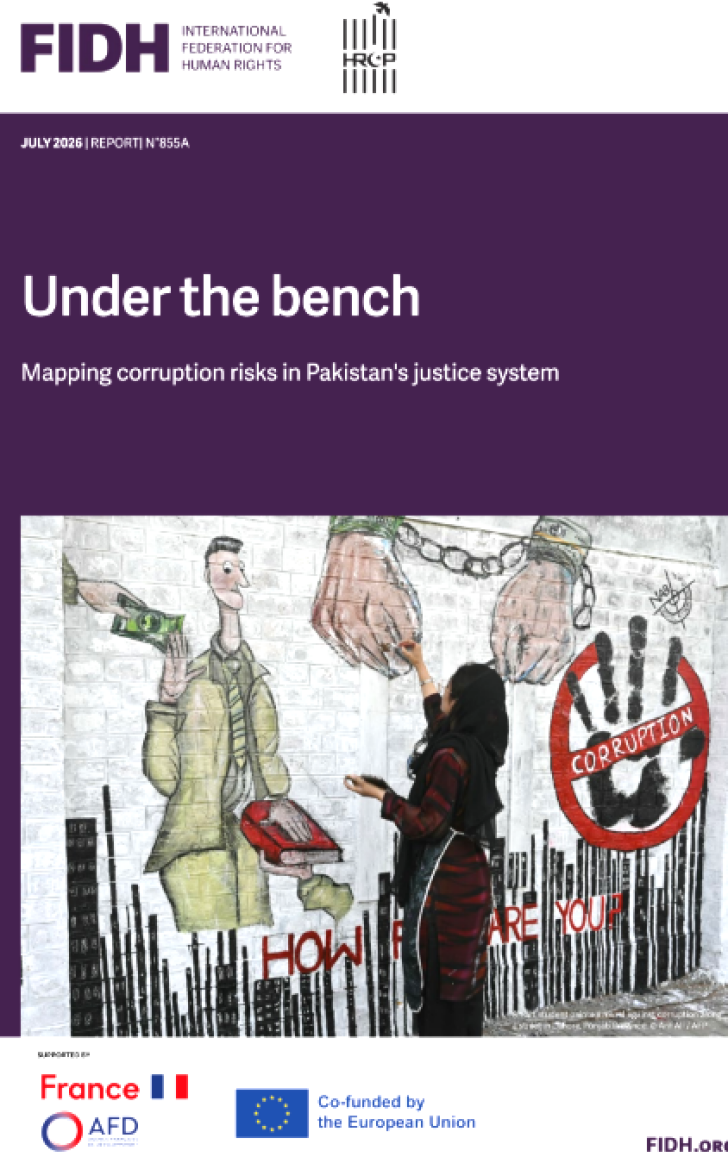
Entrenched corruption across Pakistan’s criminal justice system disproportionately affects poor and marginalized communities, particularly Christians prosecuted under the country’s controversial blasphemy laws, according to a new report.
The report by the International Federation for Human Rights (FIDH) and its member organization, the Human Rights Commission of Pakistan (HRCP), argues that poverty, discrimination and corruption combine to leave many Christians accused of blasphemy unable to secure effective legal representation or challenge wrongful prosecutions.
“Many of the victims in cases targeting Christians, for example, are sanitation workers or daily laborers, meaning that their resources to pay legal representation with necessary social and political connections or to pay bribes are very limited, if not absent, in effect widening the gap in access to justice,” the report states.
The 32-page study, “Under the Bench: Mapping Corruption Risks in Pakistan’s Justice System,” was released on Wednesday (July 8) and is based on 30 interviews conducted in February and March with Pakistani lawyers, judges, journalists, civil society activists and academics.
Those interviewed for the report described widespread corruption throughout the criminal justice process, with one saying families of accused persons often borrowed money, including from loan sharks, to pay police officers or court officials in an effort to advance their cases.
The report cites data from the National Commission for Human Rights (NCHR) showing a sharp rise in blasphemy prosecutions. As of July 25, 2024, 787 people were imprisoned on blasphemy charges, compared with 213 in 2023, 64 in 2022, nine in 2021 and 11 in 2020.
It also references a January 2024 report by the Punjab Police’s Special Branch, which uncovered a network that allegedly used social media and messaging platforms to entrap young people before initiating blasphemy complaints through the Federal Investigation Agency (FIA). Similar findings were documented by the NCHR and later echoed in a 2025 Human Rights Watch report, which found that blasphemy accusations were frequently motivated by financial or personal interests and that some police officials demanded bribes to refrain from registering false First Information Reports (FIRs).
According to the report, corruption in blasphemy cases differs from other criminal cases because public pressure on investigators and judges often limits the effectiveness of bribery itself.
“As several interviewees told FIDH and HRCP, in blasphemy cases, paying bribes to influence the police or court officials often had little impact, as the public pressure on the police and judges to ensure convictions was high,” the report states.
One interviewee said those accused of blasphemy have little confidence they will receive a fair trial.
“Overall, the sentiment on the street is that there is no justice for the poor and weak people,” he said, adding that many defendants believed convictions were almost inevitable because judges faced intense pressure from religious extremists.
A lawyer interviewed for the report said district court judges handling blasphemy cases were rarely willing to address clear evidentiary irregularities, including allegedly forged documents and contradictory witness testimony, because of fears of public backlash.
The report also highlights prolonged judicial delays, quoting a former Supreme Court judge who said, “Cases linger in the criminal justice system because the victims are voiceless.”
As an example, it cites the case of Junaid Hafeez, a Muslim university lecturer arrested in March 2013 on allegations of posting blasphemous material on Facebook. After nearly seven years of trial proceedings marked by repeated delays, Hafeez was sentenced to death under Section 295-C of the blasphemy statutes in December 2019. More than 13 years after his arrest, his appeal has yet to be heard, the report notes.
Interviewees also alleged that discrimination against religious minorities and low-income communities was reflected in some judicial decisions. One lawyer described a judgment in which a trial court suggested Christians were more likely to fabricate allegations against Muslims in order to acquit a Muslim defendant accused of committing a crime against a Christian minor.
“There is a clear anti-poor bias in the judiciary, and there is a perception that people from those communities are engaged in some sort of crime or will be in the future,” the lawyer told the researchers.
According to the report, such prejudice makes it more difficult for victims of abuses, including torture in police custody and violations of fair trial rights, to obtain justice because they often encounter hostile courtroom environments.
In a statement accompanying the report, HRCP said the findings indicate that corruption within Pakistan’s judiciary has become systemic and may amount to grand corruption.
“This report shows the extent to which corruption has become entrenched in all aspects of the judiciary, and the insidious impacts it has on the enjoyment of human rights,” said FIDH Secretary General Shahindha Ismail. “Far from being a victimless crime, corruption in the judiciary has demonstrably curtailed the right to a fair trial, particularly for the most vulnerable, such as minorities.”
The report examines the impact of judicial corruption on due process, equality before the law, torture, the use of the death penalty and gender equality within the legal profession.
HRCP Secretary-General Harris Khalique said tackling corruption required structural reforms rather than isolated administrative measures.
“Eradicating the risks of corruption in the judiciary at all levels will require much more than just increasing judges’ emoluments and perks or installing CCTV cameras in the courtroom,” Khalique said. “It needs to start with a comprehensive approach to restoring judicial independence and addressing the underlying factors that contribute to inappropriate practices and compromised judicial decisions.”
The report recommends strengthening judicial independence, improving transparency and oversight, enhancing accountability mechanisms, protecting whistleblowers and reforming the administration of justice.
Pakistan ranked 123rd out of 143 countries for absence of corruption in the World Justice Project’s 2025 Rule of Law Index, placing it second from the bottom among countries in its regional grouping.
International advocacy groups continue to rank Pakistan among the world’s most difficult countries for Christians. In its 2026 World Watch List, Open Doors ranked Pakistan eighth among the 50 countries where Christians face the most severe persecution, citing systemic discrimination, mob violence, forced conversions, bonded labor and gender-based violence.








