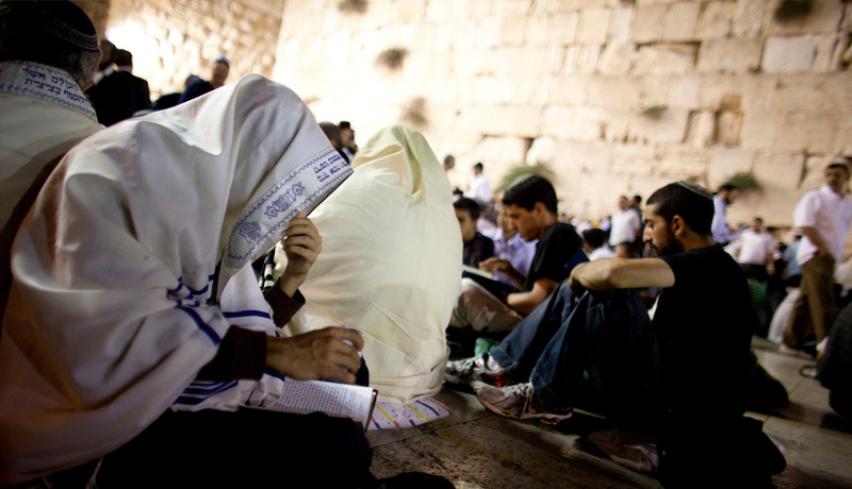
Tisha B’Av is the saddest day on the Jewish calendar—a day when we sit on the floor, read the book of Lamentations, and remember the tragedies that have marked our history. It is a day of fasting, mourning, and honest reflection. But it is also a day of profound faith. Even in our deepest sorrow, Tisha B’Av reminds us that God has never abandoned his people and that every moment of loss has carried the seeds of redemption.
Tisha B’Av is not abstract... It is part of (Jewish) identity.
When I was a child growing up in America, Tisha B’Av felt distant—an ancient tragedy, a story from long ago. But living in Israel, raising my children here, and walking the streets of Jerusalem have changed everything. The history we mourn on Tisha B’Av is not abstract. It is embedded in the stones beneath our feet. It is part of our identity. And it is part of our calling.
On Tisha B’Av, we remember the destruction of both temples. We remember centuries of exile. We remember generations of persecution. We remember the long, painful journey of a people who refused to give up hope.
In recent years, Tisha B’Av has felt especially heavy. Israel is still healing from the horrors of October 7, 2023. Families are still grieving. Communities are still rebuilding. And the wounds of our nation are still raw.
Tisha B’Av teaches us that Jewish suffering is not new. But it also teaches us that Jewish resilience is unending.
One of the most powerful truths of Tisha B’Av is that even in destruction, God’s presence remains.
One of the most powerful truths of Tisha B’Av is that even in destruction, God’s presence remains. The rabbis teach that when the Temple burned, the Shechinah (God’s divine presence) went into exile with us. He did not leave us. He walked with us.
This is the heart of Jewish faith: God is with us in our tears, with us in our rebuilding, and with us in every chapter of our story.
It is a truth our Christian friends understand deeply. Both of our traditions teach that God draws near to the brokenhearted, restores what is lost, and turns mourning into hope.
Tisha B’Av is not only about what was destroyed. It is about why it was destroyed. Jewish tradition teaches that the Second Temple fell because of sinat chinam—baseless hatred among our own people.
This lesson feels painfully relevant today.
Tisha B’Av calls us to something higher: to choose unity over conflict, compassion over judgment, and love over hatred.
In a world filled with division, anger, and fear, Tisha B’Av calls us to something higher: to choose unity over conflict, compassion over judgment, and love over hatred.
It reminds us that the greatest threat to our future is not only external enemies but also the way we treat one another.
As an American-Israeli, I often think about how both of my homelands understand the power of memory. America honors its history with reverence—its triumphs and its tragedies. Israel does the same. Both nations know that remembering the past is essential to building a better future.
Both nations also understand that faith is what carries us through hardship.
Our Christian friends around the world stand with us on Tisha B’Av—not by fasting or mourning in the same way, but by recognizing the spiritual significance of this day. They understand that the Jewish story is one of endurance, covenant, and God’s unfailing promises.
(The) day of mourning will one day transform into a day of rejoicing.
The most extraordinary truth of Tisha B’Av is that it is not the end of the story. Jewish tradition teaches that this day of mourning will one day transform into a day of rejoicing. It teaches that from the deepest darkness, the greatest light will emerge.
This is the heartbeat of our faith: Destruction is never final, God is always working behind the scenes, and hope is stronger than despair.
As we sit on the ground this Tisha B’Av, reading biblical words of sorrow, may we also feel the quiet whisper of redemption. May we remember that the same God who allowed the temples to fall is the God who brought his children home to Israel. The God who carried us through exile is the God who will carry us through today’s challenges as well.
And may we hold fast to the promise that one day, Tisha B’Av will no longer be a day of mourning but a day of joy.
Yael Eckstein is president and global CEO of the International Fellowship of Christians and Jews, one of the world’s largest religious charitable organizations. She is a respected Jewish leader, speaker, best-selling author, award-winning podcast host, and humanitarian. She received the 2025 Pillars of Jerusalem Award for her exceptional contributions to Israel’s public diplomacy and was named The Jerusalem Post’s 2023 Humanitarian of the Year. A Chicago-area native, Eckstein lives in Israel with her husband and their four children.