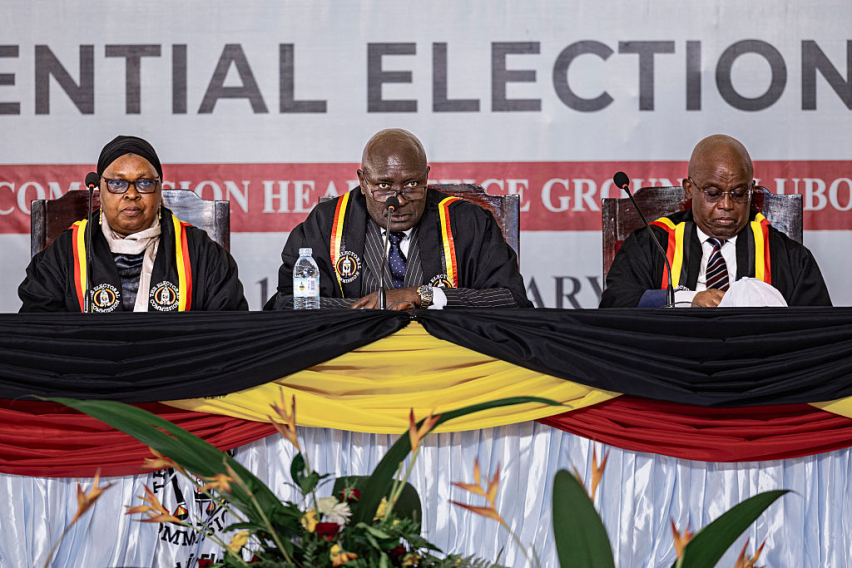
President Yoweri Museveni secured a seventh term in office following Uganda's general election on Jan. 15, a vote marred by intimidation, military involvement and an internet shutdown that was only lifted after results were announced.
The incumbent, who has ruled Uganda since 1986, secured 71.65% of the vote, according to official figures, but turnout hit a decades-low, raising questions about public confidence in the electoral process. International observers and opposition leaders cited constitutional violations and restrictions on political activity, even as religious leaders urged calm and national unity.
Of the 21.6 million registered voters, only about 11.37 million cast their ballots, representing approximately 52.5%.
The African Union observer mission team noted a calmer election period compared to the 2021 general election, yet they flagged irregularities that violated the Ugandan constitution.
"The Mission was briefed on the involvement of military in the electoral process contrary to the Ugandan 1995 Constitution, which prohibits the Uganda People's Defence Forces (UPDF) from engaging in electoral processes," the observer mission's preliminary report stated.
Opposition political parties briefed the Mission on numerous concerns about the electoral environment. They highlighted restrictions on campaign venue access, unequal political party financing, and perceived media bias.
The AU noted that opposition parties also raised allegations about the compromised independence of the Electoral Commission and the Judiciary. They pointed to high nomination fees and the abduction and arrest of opposition figures, candidates, supporters, and civil society actors, including cases where bail was denied.
"The Mission is concerned with reports of harassment, intimidation and arrest of opposition leaders, candidates, supporters, media and civic society actors, as well as the suspension of Non-Governmental Organisations (NGOs) and the internet shut down," the AU report warned.
Nevertheless, the Chairperson of African Union Commission, H.E. Mahmoud Ali Youssouf, issued a statement on Jan. 17, saying he “commends the conduct of elections in Uganda and congratulates President Yoweri Museveni on re-election [...] with 71.61% of the votes cast during the presidential elections held on 15 January 2026.”
Meanwhile, Kyagulanyi Ssentamu, known popularly as Bobi Wine, rejected the results that gave him 24.72% of the vote.
"I reiterate our COMPLETE REJECTION of the fake results Byabakama is reading. In addition to the ballot stuffing, the military take-over of the election, the detention of our leaders and polling officials, and other electoral offences, their results have zero backing!" he posted on X.
The opposition leader claims he remains in hiding after escaping from his house, where military forces were searching for him.
"Currently, I am not at home, although my wife and other family members remain under house arrest. I know that these criminals are looking for me everywhere, and I am trying my best to keep safe. I understand that there has been great concern and speculation regarding my whereabouts," Wine revealed from an undisclosed location.
Archbishop of Uganda Bishop Kaziimba Mugalu urged peace following the elections and internet shutdown.
"I pray that there won't be any bickering between the winners and losers of this election, and that the winners go forth and serve their electorate diligently, as they promised," Bishop Kaziimba Mugalu told Ugandan television.
Various religious voices called for peace ahead of the elections, as previously reported by Christian Daily International.
In a pastoral letter published on Jan. 8, the Inter Religious Council of Uganda (IRCU) encouraged voters to prioritize unity and peace when choosing their leaders.
"We therefore implore all citizens, as the primary stakeholders in this process, to be prayerful, sober, and mindful of the far-reaching implications of their choices. Let each voter weigh their decision not only in light of personal interest, but also in light of the common good, national unity, and the dignity of every Ugandan," the council wrote.
The IRCU acknowledged that Uganda bears deep scars across political, ethnic, religious, regional, economic, and generational lines. These divisions stem from history and long-standing structural injustices that elections alone cannot resolve. "For this reason, we remain committed to renewing the spirit of the National Dialogue as a pathway toward healing and inclusion."
Christian Daily International reached out to several church groups and Christian leaders, but most churches in Uganda have yet to comment publicly about the election results and what they mean for the country.
President Museveni, who is 81 years old, will now rule until 2031. Whether he will retire from active politics at that time remains unknown.