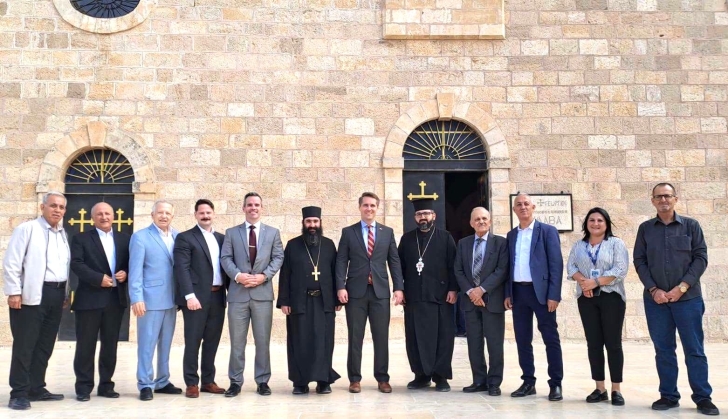
The status of evangelicals in Jordan and the region appears to have been a major focus during the visit of a U.S. delegation to Jordan and Jerusalem over the weekend.
Riley Barnes, U.S. assistant secretary of state for Democracy, Human Rights, and Labor, was part of a U.S. delegation that stopped in Madaba, Jordan on Saturday (Oct. 17), where they visited St. George’s Church, famous for its mosaic map, and the Latin Church.
At a luncheon, former Jordanian general and president of the Jordan Evangelical Council Emad Ma’ayeh praised King Abdullah II and the Jordanian government and told delegates of the freedom Jordanian Christians enjoy “and the absolute absence of discrimination they face,” he told Christian Daily International.
Ma’ayeh also raised to the U.S. diplomats the request of Jordanian evangelicals to have their own ecclesiastical court, which would deal with issues of personal status such as divorce, inheritance and adoptions.
Stating that evangelicals number about 10,000 and attend church services in 57 locations across Jordan, May’eh also noted the humanitarian work carried out by Jordanian evangelical para-church organizations in education, care for the elderly, refugee support, and prison services.
Earlier in the visit, the head of the Jordanian Baptist Convention, the Rev. Nabih Abbassi, accompanied by representatives from the Convention’s council, met with Barnes and his delegation. Abbassi highlighted King Abdullah II’s role in safeguarding religious freedoms and protecting the Christian presence in Jordan and across the wider region. He also described Jordan as an exemplary model for respecting religious pluralism, upholding the values of citizenship and coexistence, and ensuring the rule of law.
Abbassi also discussed concerns facing evangelicals across the region, including the need for continued dialogue on regulating evangelical churches’ legal and ecclesiastical status.
Leaders said such efforts could help preserve evangelical churches’ mission, increase their participation, and pave the way for broader, more structured representation within national ecclesiastical frameworks – foremost among them the Jordanian Council of Church leaders, thereby supporting the unity of Christian witness while protecting diversity within Jordan’s Christian family.
Evangelical leaders emphasized that churches in Jordan fulfill an important national, spiritual and social role by promoting a culture of peace, countering extremist ideologies and fostering a discourse of love and moderation through their spiritual mission and community service. The Rev. Rami Hussein Halseh, secretary of the Baptist Council, said Jordan serves as a model for an active Christian presence in the Arab region, adding that Jordanian Christians contribute to the life of the nation and society – not as an isolated minority, but as an integral part of the country’s social fabric and as partners in state and community development.
Barnes expressed appreciation for the steps Jordan has taken in human rights and religious freedom, according to the Jordanian Baptist Convention Facebook page. He commended religious institutions and churches for fostering stability and countering extremism, and expressed hope for continued progress.
Barnes also met with an interfaith group, which included clergy from the Roman Orthodox, Latin, Greek Catholic, and Episcopal Arab churches. He said that all participants spoke with complete transparency about the situation of Christians in Jordan and the relationships between the various churches. They said that their American guest was an attentive listener and showed genuine interest in the views expressed.
An Orthodox priest in attendance, the Rev. Romanos Samawi, told Christian Daily International part of the discussion touched on the relationship between local churches and missionary groups or organizations operating under the guise of “churches.”
“Some of these groups engage in proselytizing activities that reflect poorly on the Christian community in Jordan, a community that maintains excellent relations with others and is an integral part of the nation’s social fabric,” Samawi said.
Genuine churches within the Islamic-majority country enjoy full rights, and their presence is respected, he said.
He told Christian Daily International that concerns were also raised regarding potential links between some of the missionary groups and the global Zionist movement and their support for Israeli actions in the Holy Land.
He also said the Orthodox represent the churches of the early centuries, founded by Christ Himself, in a land that has been home to prophets and saints. The Orthodox priest expressed commitment to King Abdullah II bin Al-Hussein, “who serves as a staunch defender of Christians on the global stage. As the custodian of both Christian and Islamic holy sites, he ensures that we live in a Jordan defined by brotherhood.”
At St. George’s Church, Archimandrite Andraos Shamieh welcomed the delegation, along with Oikonomos Yousef Hamarneh and members of the church committee. Also present were the head of the Council of Evangelical Churches in Jordan (retired Maj. Gen. and former Member of Parliament Imad Ma’ayeh), former member of Parliament Majdi Al-Ya’qoub, Madaba Director of Tourism Wael Ja’nini, and several other guests.
At the end of the visit, Archimandrite Shamieh presented Barnes with a commemorative mosaic and a book explaining the map as a gesture of appreciation and goodwill.
Jerusalem meeting
In Jerusalem on Saturday (Oct. 17), Barnes along with Brian Burch, U.S. Ambassador to the Holy See; Darren Perdue, deputy political counselor at the U.S. Embassy in Jerusalem; Vincent Young, chief of staff to Assistant Secretary Barnes; and several other officials and staff members from the U.S. Embassy in Jerusalem and the Vatican met with Palestinian Christians, among them the Rev. Jack Sara, president of Bethlehem Bible College and secretary of the World Evangelical Alliance MENA branch.
Sara shared about “the realities, challenges, and concerns facing Palestinian Christians in the Holy Land, the ongoing ministry and mission of Bethlehem Bible College, and the wider struggles affecting Palestinian communities,” according to his Facebook page.
He emphasized the importance of protecting the Christian presence in the land of Christ’s birth, safeguarding human dignity, and ensuring that the voices of local Christians are heard in conversations that shape the future of our region.
Sara later told Christian Daily International that the meeting was positive.
“It was clear that the group is interested in changing how the U.S. engages with the Palestinian Authority and in providing assistance to people who are attacked by settlers,” he said. “They were also very keen to hear about the insults and mistreatment faced by Christians in Jerusalem, as well as the instances where attempts have been made to attack churches.”
Christian Daily International contacted the U.S. embassy in Amman for comment, but none had been received at this writing.
Part of the assistant secretary of state for democracy and human rights’ responsibilities is to ensure the U.S. State Department and other U.S. agencies’ annual publication cycle; relevant reporting timelines are tied to scheduled releases.
By law, U.S. Country Reports on Human Rights Practices are due to Congress by Feb. 25 each year, though in practice they are frequently published later in the spring; for instance, the 2024 report was released in August 2025.
The Department of State typically releases International Religious Freedom Reports separately later in the year (often around May or June), covering the prior calendar year.
A separate, independent U.S. Commission on International Religious Freedom (USCIRF) usually releases its annual report in the spring, typically around March.