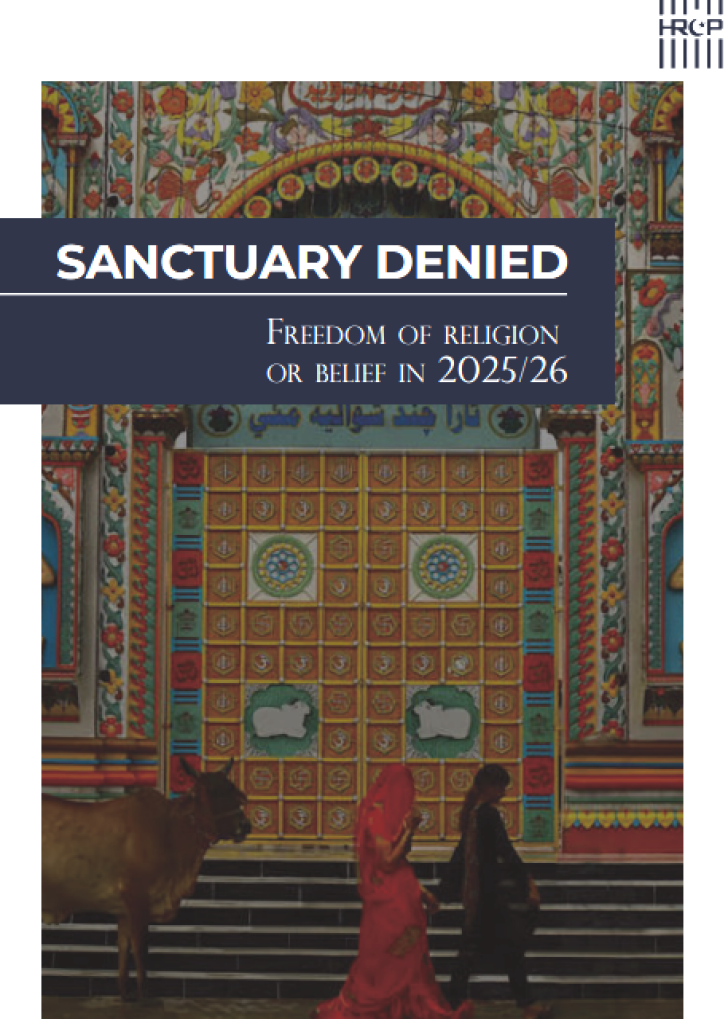
The Human Rights Commission of Pakistan (HRCP) on Thursday (Oct. 15) asserted that religious minorities in Pakistan, including Christians, continue to face forced faith conversions and marriages, blasphemy accusations and mob violence despite recent legislation intended to protect their rights.
In its seventh annual report on freedom of religion or belief titled, “Sanctuary Denied: Freedom of Religion or Belief in 2025/26,” the independent rights watchdog warned that the government’s failure to implement protective laws and hold perpetrators accountable was leaving vulnerable communities exposed to violence and persecution. It also noted religious minorities face institutional discrimination.
The report, covering the period from July 1, 2025, to June 30, documented attacks on Christians, Hindus and minority Ahmadi Muslims, as well as the continued misuse of Pakistan’s blasphemy laws. Hundreds of people accused of blasphemy remained imprisoned or caught in prolonged legal proceedings, while alleged perpetrators of an organized network accused of entrapping people in fabricated blasphemy cases had yet to be investigated.
“The state’s approach to religious minorities is becoming increasingly exclusionary,” HRCP Director Farah Zia warned at the report’s launch.
The HRCP welcomed the passage of the National Commission for Minorities Act 2025 and legislation raising the minimum marriageable age to 18 in Punjab and Balochistan provinces. It noted, however, that the minorities commission has still not been constituted about seven months after the law’s enactment, raising concerns about the government’s commitment to implementing its promises.
Forced Conversions/Marriages
Girls from Christian and Hindu communities continued to face abduction, forced religious conversion and marriage, often involving older Muslim men, the report said. Poverty, inadequate police responses and the failure to protect underage girls compounded the suffering of victims and their families, it added.
The report cited United Nations experts who said that in 2025, approximately 75 percent of victims of forced conversion through marriage were Hindu and 25 percent Christian. About 80 percent of reported incidents occurred in Sindh Province, with adolescent girls between 14 and 18 particularly vulnerable, although younger girls were also targeted.
According to figures provided to the HRCP by Hindu rights activist Faqir Shiva Kachhi, 36 underage Hindu girls, mostly from scheduled castes, were abducted in 2025. Another 32 cases were recorded in the first seven months of 2026. Kachhi cautioned that the figures represented only cases known to him and that many others might have gone unreported.
He also described difficulties obtaining police action, saying families and activists sometimes had to stage sit-ins outside police stations and senior police officers’ offices merely to have a first information report (FIR) registered.
The report said the recurring pattern involved minority parents reporting their daughters’ disappearances or abductions, only to learn days later that they had converted to Islam and married Muslims. Human rights organizations have raised concerns that forced religious conversion and marriage are used together to legitimize relationships involving underage girls and undermine protections against child marriage.
The HRCP also highlighted the case of Maria Shahbaz, a 13-year-old Christian girl whose father, Shahbaz Masih, reported her missing in Lahore on July 29, 2025, after she left home for a nearby shop. Maria appeared before a magistrate two days later saying she had converted to Islam and married a 30-year-old Muslim man, Sheharyar Ahmad.
Police closed the abduction case following her statement and the submission of a marriage certificate. A subsequent police reinvestigation led by a senior officer concluded that the marriage certificate submitted by the accused was forged, according to the report, citing human rights defender Safdar Chaudhry. Government-issued records, including her National Database and Registration Authority (NADRA) registration document, also indicated that she was a minor, he said.
The Federal Constitutional Court ruled in March that Maria was of mature age and that her conversion and marriage were lawful, dismissing official age records as unreliable, according to the HRCP report. Her case illustrates the legal and institutional obstacles confronting families seeking the recovery of girls they say have been abducted and forcibly converted.
The HRCP urged authorities to monitor seminaries linked to forced conversions and underage marriages and recommended that religious conversions take place in court or in the presence of a government official.
False Blasphemy Accusations
The HRCP said blasphemy accusations continued to be used for personal vendettas, extortion and other malicious purposes, with inadequate investigations and social pressure contributing to the prosecution of people on questionable evidence.
According to data published by the Punjab Prisons Department, 559 people accused of blasphemy were in custody on June 28. Five were women and one was a juvenile. Seven prisoners were listed as condemned prisoners, while 491 were awaiting trial, including four women.
The figures cover Punjab Province’s prisons and should not be interpreted as a national total. The report said comparable data for other provinces was not readily accessible through official websites.
The HRCP noted that the overwhelming majority of those held in Punjab were under trial, leaving them vulnerable to prolonged imprisonment without conviction. Security fears also resulted in accused people being housed together, further restricting their living space, the report stated.
The commission also revisited allegations involving an organized network accused of entrapping hundreds of young people, including Christians, in fabricated online blasphemy cases for extortion. An Islamabad High Court order directing an investigation into the allegations was overturned on review in July 2025, leaving the alleged victims and their families awaiting accountability.
Around 50 accused people had reportedly secured release through bail or acquittal by the end of the period covered by the report. The alleged perpetrators of the network, however, had yet to be investigated.
One victim was Nadeem Masih, a visually impaired Christian who was the sole breadwinner for his family, the report noted. Arrested in August 2025, he was accused of blasphemy after an alleged dispute with a park contractor who reportedly attempted to extort money from him. A Lahore additional sessions judge ordered his release on June 23, after finding that the prosecution had failed to establish guilt beyond reasonable doubt on reliable and legally admissible evidence.
At the report launch, HRCP Vice-Chair in Punjab Raja Ashraf said blasphemy accusations had become a “means of exploiting and endangering vulnerable people.”
Arafat Mazhar, director of research and advocacy collective Shehri Pakistan, urged the public to consult lawyers representing people accused of blasphemy and allow courts to determine the appropriate legal procedures, rather than turning defendants into symbols of the broader debate over the laws.
The report also highlighted the case of Kamran Gill Masih, a Christian medical practitioner from Sheikhupura whose dispensary was set ablaze by a Muslim mob on Oct. 9 following allegations that he had shared blasphemous content on social media. Minority rights defender Nabila Feroz Bhatti raised the case at the launch, underscoring the danger allegations can pose even before guilt is determined in court.
The HRCP called for investigations into cases registered under Section 295-C of the Pakistan Penal Code, which carries the death penalty, to be conducted by senior officials. It also urged the government to investigate alleged entrapment schemes and improve public awareness of sensitive laws and digital methods used to fabricate accusations.
Ahmadis Targeted, Minorities Excluded
The report also documented two shootings in Chenab Nagar, the headquarters of Pakistan’s minority Ahmadiyya community, during the review period.
On Oct. 10, 2025, six security guards were injured when an armed attacker opened fire outside an Ahmadi place of worship. On June 6, three Ahmadi community members were wounded in another shooting outside a place of worship in the city.
The HRCP said data provided by the Ahmadiyya community showed that nine of its places of worship were attacked and damaged during the reporting period. In five cases, law enforcement agencies carried out demolitions. The commission raised concerns about demolitions allegedly undertaken without proper notice or formal orders.
Ahmadis also faced growing social exclusion, including refusals of service by shops and businesses. The report cited an incident in which a courier company allegedly refused to deliver a parcel to Chenab Nagar because of its Ahmadi population.
Community representative Amir Mahmood, speaking at the launch, described severe restrictions on Ahmadis’ freedom of expression and assembly, recalling that the community’s last public gathering had taken place more than 40 years ago.
The HRCP further warned that hate speech against religious minorities had become increasingly normalized, creating an environment conducive to intimidation and violence. It cited derogatory remarks about Christian churches by a religious leader in Islamabad and campaigns against Ahmadis, including objections to a senior government official receiving a civil award.
Discrimination also extended to employment and education. Despite a 5 percent quota for minorities in government services, many Christians and lower-caste Hindus remained concentrated in hazardous sanitation work. The report documented deaths of sanitation workers in Karachi and Bahawalpur during the review period and cited evidence that religious identity influenced recruitment practices.
The commission also criticized school curricula for promoting religious uniformity rather than pluralism and said mainstream media increasingly marginalized minority concerns.
Former HRCP chairperson Hina Jilani highlighted the institutional nature of discrimination, saying, “Democracy should have no concept of ‘minority’ and ‘majority.’”
The HRCP urged the federal government to constitute the National Commission for Minorities, frame its rules and appoint its chairperson and members without further delay. It called on federal and provincial governments to publish annual, disaggregated data on blasphemy cases, mob violence, forced conversion complaints and prison conditions, enabling independent scrutiny of official responses.
The commission also urged Khyber Pakhtunkhwa to legislate a minimum marriageable age of 18 for both men and women, bringing the province into line with Punjab and Balochistan.
Other recommendations included mandatory freedom of religion or belief training for police and investigative agencies, stronger protection for human rights defenders and lawyers, prosecution of those inciting violence, and measures to prevent religious groups and bar associations from pressuring authorities to act against particular communities.
The HRCP further called for full implementation of the Supreme Court’s 2014 judgment on religious freedoms, protection of minority places of worship, and prosecution of those who vandalize religious sites.
While acknowledging recent legislative progress, the report warned that legal protections would remain ineffective without implementation, transparent data and accountability for abuses.
For Pakistan’s religious minorities, the HRCP said, the challenge remains ensuring that constitutional guarantees of religious freedom and equal citizenship are upheld in practice, rather than merely recognized in law.