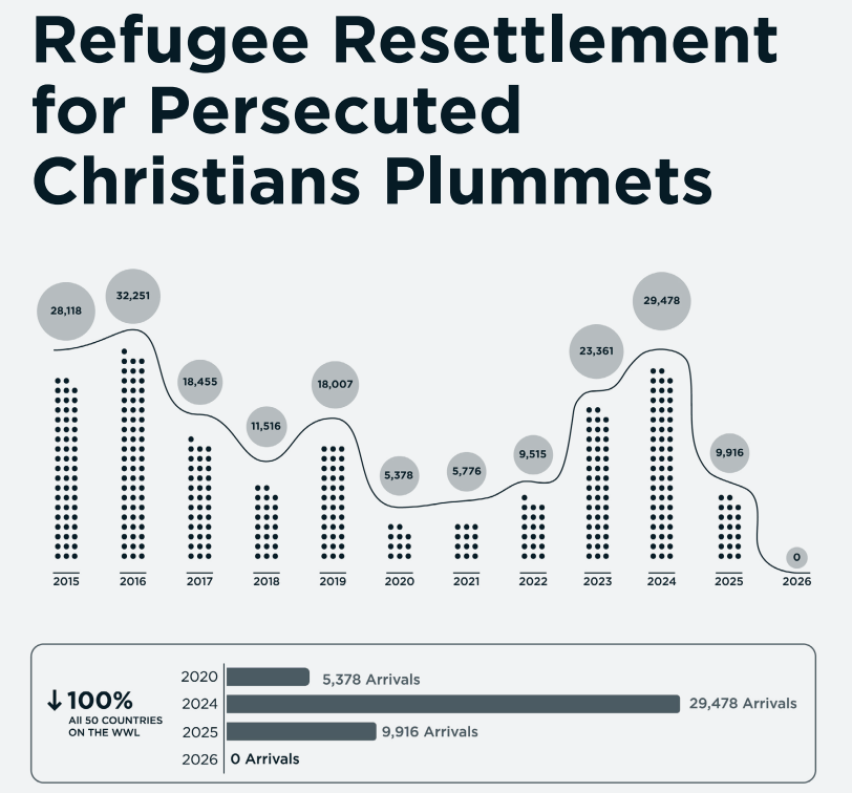
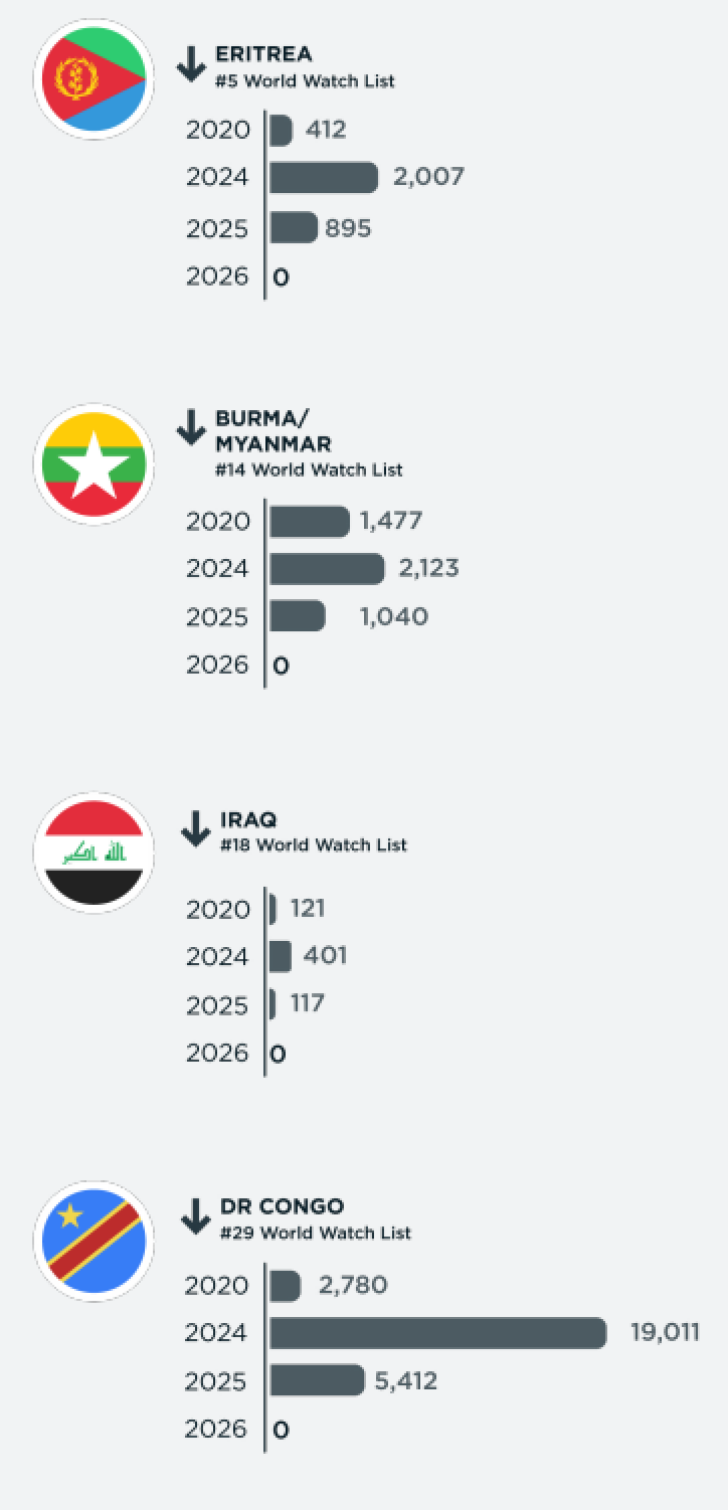
The U.S. government’s 2026 Fiscal Year ending on Sept. 30 likely will be the first in a quarter century in which no refugees enduring religious persecution are resettled in the United States, according to a report by two Christian aid agencies.
“Barring a significant change in U.S. policy in the final month of the federal fiscal year, we anticipate that FY2026 will be the first year in at least a quarter century, and likely in the entire history of the U.S. Refugee Admissions Program, in which persecuted religious minorities have been completely shut out,” concludes the report released today (Sept. 3) by humanitarian organization World Relief and Christian support group Open Doors US.
Amid unprecedented levels of persecution of Christians worldwide, the experience of seekers of asylum in the United States in 2025 and 2026 has been unpredictable and chaotic, states the report, “State of the Golden Door: Evaluating U.S. Refugee Resettlement and Asylum in Light of Global Christian Persecution.”
“While the leaders of both World Relief and Open Doors US affirm the need to ensure secure borders and the need for reforms to the asylum system, those goals cannot come at the cost of legitimate asylum applicants’ safety and right to a fair process,” it states. “The combination of changes outlined here have together, functionally discontinued the asylum system in the U.S. This means, in turn, that for those asylum seekers with legitimate concerns of persecution on account of their faith, the U.S. may not offer the safety it has for many years promised to provide.”
In a letter introducing the report, Myal Greene, president and CEO of World Relief, and Ryan Brown, president and CEO of Open Doors US, state that their organizations are politically non-partisan but that, as all human beings are created in God’s image with inherent dignity, they believe they are worth protecting.
“We also take seriously the Old Testament command to welcome the stranger, as well as Jesus’ admonition to care for the neighbor, illustrated in the parable of the Good Samaritan, as extending beyond those who happen to share the same ethnic or religious characteristics,” they write.
Many Christians agree with them, they stated, that the U.S. should keep open refugee access, termed the “golden door” as referenced on the pedestal of the Statue of Liberty. Recent polling by Lifeway Research found that 70 percent of evangelical Christians believe the U.S. has a moral responsibility to accept refugees, regardless of whether those refugees are Christian. Even more recently, 82 percent of Protestant pastors agreed, they stated.
Greene said at a briefing in Washington, D.C. on Thursday (Sept. 3), “The U.S. has taken this golden door and closed it.”
Ara Torosian, who arrived in the U.S. as a refugee from Iran, pastors Cornerstone Church in West Los Angeles, which includes other Iranian refugees. He said at the briefing that persecuted Christians trying to attain asylum are trying to save their lives and are not a danger to the United States.
“America has always been a place of refuge for Christian people,” Pastor Torosian said.
The U.S. administration of President Donald Trump in early 2025 halted all refugee resettlement via executive order with very narrow exceptions, and while the program was never officially restarted, the Presidential Determination on Refugee Admissions for Fiscal Year 2026 set a new precedent, the report notes.
“Disregarding the traditional international legal definition of a refugee, individuals identified outside of their country of origin who have a well-founded fear of persecution, it instead made a provision for resettling 7,500 white South Africans, mostly of the Afrikaner heritage, whom it describes as ‘victims of unjust racial discrimination,’” the report states, noting that the ceiling increased to 17,500 in June but with the same singular focus on one group. “Notwithstanding the hardship that some South Africans have experienced, South Africa is not known to be a country which restricts religious liberty, so any hardship experienced is unlikely to be religiously motivated. Because the three individuals resettled this fiscal year who were not from South Africa were not members of religious minorities in their country of origin, we can confidently conclude that, thus far in FY2026, no refugees experiencing religious persecution were resettled in the U.S.”
Since the Refugee Act of 1980 established the foundations of the modern resettlement program, the U.S. has accepted nearly 3.7 million refugees primarily through the Refugee Admissions Program, the report states. The law draws on the international definition of a refugee, determining that those fleeing credible threats of persecution due to race, religion, nationality, political opinion or membership in a particular group could qualify as a refugee with proper documentation and screening.
“On average, the nation has resettled an [annual] average of about 73,500, with more than 200,000 arriving in a single year in 1980 and several other years exceeding 100,000,” it states. “In recent years, this number has plummeted.”
The administration has also begun efforts to send away immigrants already accepted as refugees. In November 2025, the Department of Homeland Security (DHS) announced its intention to reopen the cases of some 230,000 refugees admitted under the previous administration, while also pausing green card processing for refugees who entered during the same time period. DHS then in January announced Operation Post-Admission Refugee Reverification and Integrity Strengthening (PARRIS), claiming it would address fraud in the refugee resettlement program, the report states.
“They began in Minnesota, specifically targeting 5,600 refugees who had not yet received green cards,” it states. “Through Operation PARRIS, around 150 refugees were detained, some through door-to-door arrests, and transferred to Texas for re-interviews. A number of these refugees were released in Texas without transportation back to Minnesota, and in some cases without their documentation.”
A court case, U.H.A v Bondi, halted Operation PARRIS’s arrests and detentions in Minnesota, accusing DHS of detaining refugees for lacking green cards while at the same time preventing refugees from receiving them. Another lawsuit, Jean A. v Noem, seeks to prevent similar tactics nationwide; it is ongoing but led to a nationwide pause on the policy until the case is decided.
DHS has since shifted from detentions to call-in letters for re-interviews across the country.
“The policy continues to cause fear for refugees and their families, employers and communities, including for many whose refugee designation was based upon religious persecution,” the report states.
The report highlights the case of Saw Shining, who fled Burma (Myanmar) and first arrived in Minnesota more than 15 years ago as a refugee after decades in a Thai refugee camp. He became pastor of a church in Minneapolis that included Christian Karen people, a persecuted ethnolinguistic group from southeastern Burma. He also became a naturalized U.S. citizen.
“When he and the Karen community heard President Trump’s calls for aggressive immigration enforcement, they thought that those without a criminal record would be safe, especially given their legal status as refugees,” the report states. “However, as Operation PARRIS rolled out, it soon became clear that even some immigrants who were lawfully present and had not been charged with crimes were being targeted for detention. Overnight, the community became fearful of law enforcement, evoking memories of encounters with police in Burma and Thailand, where refugees were closely monitored and kept apart simply due to their status as refugees.”
Older members of the Karen community in Minneapolis or who those who spoke less English began to stay at home, even U.S. citizens like Saw Shining’s parents.
“Nevertheless, between 30 to 50 lawfully present Karen refugees who had not yet received their green cards were detained during Operation PARRIS,” the report states. “One member of his previous church was separated for three weeks from her 5-month-old baby – whom she had been breastfeeding prior to her detention – while she was being reinterviewed in Texas.”
While all members of the community have returned after the judicial orders, call-in letters have continued to arrive for reinterviews, the report notes.
“What happened [during Operation PARRIS] was really hard for our Karen people,” Pastor Shining said. “We are not Thai or Burmese citizens; we are U.S. citizens. This nation is ours, and we must love, care for and support our Constitution. We do not want to become stateless again.”
At this writing the Trump administration had yet to respond to a request for comment on the Golden Door report.
Approval Rate Plummets
In the Refugee Act and as a party to an international convention, the U.S. has pledged not to turn away people who can demonstrate they meet the necessary conditions for asylum. Unlike refugees, there is no legal limit on the number of asylum seekers that can be approved each year.
The two main avenues for asylum are an “affirmative” claim, when applicants submit a claim to the U.S. Citizenship and Immigration Services (USCIS), and a “defensive” claim, when the DHS seeks to deport someone and the person pleads asylum at a removal hearing in front of an immigration judge.
“While data is not publicly available on the religious demographics of those who seek asylum defensively, it’s clear that as the overall asylum approval rate has plummeted, Christians fleeing religious persecution are much less likely to be approved as well,” the report states.
In FY2023, immigration judges granted asylum to 17,157 people of all religious backgrounds from countries on the World Watch List of the 50 countries with the worst persecution, accounting for 58 percent of all asylum decisions for those from those countries, according to the report. In FY2025, the approval rate declined to 26 percent for those from those 50 countries.
“During the first nine months of FY2026, the approval rate for these countries had declined further, to just 10 percent,” the report states. “Specific countries that rank high on the World Watch List for Christian persecution such as Iran (#10), India (#12) and China (#17) have been particularly affected by the stark decline in asylum approval rates in immigration court.”
For each year from FY2020 to FY2024, at least 62 percent of asylum decisions for Indian nationals were approvals, but for FY2026, the asylum approval rate has dropped to just 6 percent. Iran has historically had very high rates of asylum approvals before immigration judges, above 80 percent from FY2020 through FY2024, but for FY2025 and FY2026 year-to-date, it has fallen to just 38 percent, with most Iranian asylum applicants being denied, according to the report.
Rates of asylum approval for Chinese nationals fell from as high as 88 percent in FY2022 to just 29 percent thus far in FY2026, it states.
“The decrease in approved asylum cases coincides with a dramatic increase in the number of asylum claims being adjudicated,” the report notes. “FY2025 saw 121,936 decisions, the highest ever, likely due to the speed at which cases were being decided.”
Refoulement
The principle of non-refoulement, established in international law and in U.S. statute, states that countries will not deport anyone (especially refugees and asylum seekers) back to countries where their “life or freedom would be threatened” due to “race, religion, nationality, membership of a particular social group or political opinion.”
To avoid explicitly violating the principle of non-refoulement, the Department of State has made arrangements with third countries to allow the U.S. to deport would-be asylum seekers to those other countries rather than back to the asylum seeker’s home country, the report states.
“As a result, over 21,000 people have been deported to countries to which they have never been, have no connections in, and in some cases, do not even speak the language,” it notes. “The U.S. currently has third-country removal agreements with 35 nations, most of which are in Africa or Central America. Since these agreements are not public, the exact details of this process is unclear, but some agreements have resulted in people being repatriated by the third country back to the country where they initially fled persecution.”
Those removed have included asylum seekers at the southern border, those with pending cases in immigration court and others who have been granted protection from removal, the report states.
“Credible reports suggest that in transport, Non-refoulement & Deportation Agreements individuals have been shackled, held in primitive conditions and threatened with being sent back to their home country,” it states. “Furthermore, when people are being sent to countries where they have almost no resources, it renders them extremely vulnerable to abuse and injustice.”
These third-country deportations have impacted persecuted Christians. In February 2025, an Iranian woman who converted to Christianity and fled fearing persecution made it into the U.S. only to have her claims for asylum ignored, according to the report.
“She was subsequently sent to a detention camp in Panama’s jungle. There, she was held, along with several other Iranian Christians who had sought asylum in the U.S., only to be turned away,” it states.
These policies have been repeatedly challenged in court, both in the U.S. and in the third countries themselves, but as of this year, the deportations continue, according to the report.
“World Relief and Open Doors US firmly believe that returning someone to a place of persecution – however indirectly – is a stark violation of the principles on which our nation was founded, and in direct contradiction to our beliefs as Christians.”