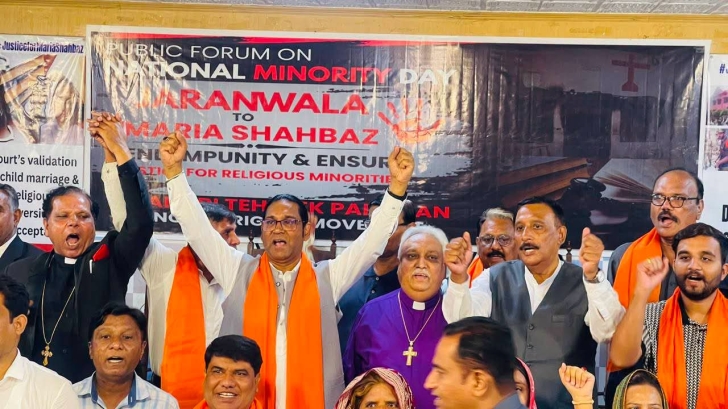
Christians and other religious minorities called for equal citizenship, religious freedom and stronger legal protections as Pakistan marked National Minorities Day on Tuesday (Aug. 11) with rallies and public forums in major cities.
The events, held in Karachi, Faisalabad and Lahore highlighted longstanding concerns over religious discrimination, forced conversions and marriages, abductions of minority girls, misuse of blasphemy laws, attacks on places of worship and the political representation of religious minorities.
The observances also revived debate over a pledge made by Pakistan’s founder, Muhammad Ali Jinnah, in his Aug. 11, 1947, address to the Constituent Assembly, in which he spoke of equal citizenship and religious freedom.
In Karachi, several hundred people, including Christians, Hindus, Sikhs, Ahmadis and liberal Muslims, gathered outside Jinnah’s mausoleum to demand equality before the law, religious freedom and greater separation of religion from state affairs. Human rights activist Sheema Kirmani told the gathering that religious minorities were still seeking implementation of promises made 79 years ago.
Christian rights activist Luke Victor said minorities were facing increasing persecution and discrimination, including targeted attacks, desecration and unlawful occupation of places of worship, discrimination in education and employment, abductions, forced conversions and marriages, sexual violence against girls and misuse of blasphemy laws to settle personal disputes.
“We are not gathered here to beg but to demand our rights,” Victor said. “We demand what Jinnah had wanted for us.”
Anthony Naveed, the first Christian deputy speaker of the Sindh Assembly, urged members of minority communities to participate more actively in politics and use their votes to influence the political process. Jinnah’s Aug. 11 speech, he said, provided a “guideline, guarantee and commitment” for peaceful coexistence.
“The commitment and guarantee promised to us by Pakistan’s founder are there in the 1973 Constitution,” Naveed said. “But you yourself should also come forward and be a part of the political process instead of protesting about your rights being violated. If I as a non-Muslim can become a deputy speaker of an assembly, so can you. Use your vote wisely instead of hiding in the shadows.”
Hindu activist Najma Maheshwari said members of the Hindu community continued to feel insecure, particularly because of the abduction of minor girls.
“How can we feel safe in a country where our little girls are kidnapped?” she asked, referring to the disappearance of 7-year-old Priya Kumari from Sukkur in 2021. Maheshwari, saying Priya would now be about 12, criticized authorities for failing to determine her whereabouts.
“How can we feel safe when our provincial government itself is against us?” she said.
Christian rights activist Pastor Ghazala Shafique called for stronger protection of minority-owned properties, particularly following the August 2023 mob attacks in Jaranwala, Punjab Province, which were triggered by false allegations of blasphemy and resulted in the destruction of dozens of Christian homes and churches.
Among the demands presented at the Karachi gathering were reforms to school curricula and textbooks to remove discriminatory material and hate speech; changes to constitutional and legal terminology concerning religious minorities; legislation against forced conversions; protection of communal properties and places of worship; restoration of properties that have been seized or desecrated; and implementation of the Supreme Court’s 2014 directives, including the establishment of independent and empowered commissions for minority rights.
In Faisalabad, the Minorities Alliance Pakistan (MAP) organized a rally calling for greater protection of freedom of religion or belief and freedom of expression.
Participants demanded an end to forced conversions of minors, a 5 percent quota for minorities in education, direct elections for reserved legislative seats, removal of religious qualifications for the offices of president and prime minister, and establishment of a constitutional National Minority Rights Commission.
They also criticized the federal Ministry of Religious Affairs and Interfaith Harmony over the functioning of the National Commission for Minorities, saying the commission had remained inactive after completing its three-year term in May 2023.
MAP Chairman Advocate Akmal Bhatti said Jinnah’s Aug. 11 speech should be adopted as a guiding principle of the state and incorporated into the Constitution’s preamble.
“Pakistan's prosperity and progress depend upon good governance, the eradication of corruption, and ensuring affordable and swift justice for every citizen,” Bhatti said in his speech.
He paid tribute to prominent members of religious minorities who contributed to Pakistan’s political, judicial, medical and educational development, including former federal minister Shahbaz Bhatti, Bishop John Joseph, former Supreme Court judges A.R. Cornelius, Bhagwandas and Dorab Patel, M.L. Shahani, Dr. Ruth Pfau, Dewan Bahadur S.P. Singha, Chandu Lal and C.E. Gibbon.
Bhatti also highlighted the contribution of minority members of Pakistan’s armed forces, saying many had died while defending the country.
“Love for the homeland and loyalty to Pakistan are deeply rooted in the hearts of minority communities,” he said.
Bhatti criticized successive governments for failing to resolve longstanding issues confronting religious minorities but expressed hope that future leadership would address their concerns. He also said MAP would support the creation of new provinces if any restructuring was undertaken constitutionally and ensured equitable political representation for minorities and other marginalized communities.
In Lahore, the Rwadari Tehreek organized a public forum at the Lahore Press Club, where speakers discussed access to justice, abductions and forced conversions and marriages of minority girls, and misuse of blasphemy laws.
Samson Salamat, chairman of Rwadari Tehreek, said National Minorities Day should not become an annual exercise in symbolism.
“The government should stop misleading the public through lip-service and by denying the grim and dismal reality faced by religious minorities,” Salamat said, alleging that minorities continued to face discrimination and lived in fear because of blasphemy allegations, abductions and forced conversions.
Safdar Choudhry, chairman of Raah-e-Nijaat Ministry, raised the case of Maria Shahbaz, a 13-year-old Christian girl abducted and forced into marriage with a Muslim.
Choudhry referred to a February ruling by Pakistan’s Federal Constitutional Court that upheld the validity of the marriage and said the family’s petition seeking a review of the ruling had subsequently been admitted for hearing.
“We are glad that the court has admitted for hearing a petition filed by the family to revisit its controversial verdict, which has instilled fear in the Christian community for the safety of their minor daughters,” he said.
He called for strict enforcement of laws against child marriage to prevent alleged perpetrators from exploiting religious conversion and marriage laws.
Other speakers, including Christians’ True Spirit Executive Director Katherine Sapna, Bishop Naeem Parshad, Lal Robin Daniel, Saeeda Diep and the Rev. Amjad Niamat, called for justice for victims of mob violence in Jaranwala and Kot Radha Kishan.
They also demanded reforms to the system of reserved seats for religious minorities in national and provincial legislatures, arguing that minority voters should have a direct role in choosing their representatives.
The federal and provincial governments also marked the day with official ceremonies emphasizing religious freedom, equality and interfaith harmony. At a ceremony at the Prime Minister’s House, Prime Minister Shehbaz Sharif said Pakistan’s minority communities had contributed to the country’s development and called for greater harmony and peaceful coexistence.
He said Christians, Hindus, Parsis and Sikhs had historically played an active role in building the country. Sharif also said his government was taking steps to establish an independent commission to protect minority rights.
“The commission, being established under legislation enacted last year, will address grievances, monitor constitutional and legal safeguards and issues involving places of worship and employment quotas, and make recommendations on government policies and laws,” he said.
National Minorities Day was formally declared on Aug. 11, 2009, following a campaign led by Shahbaz Bhatti, a Christian politician and prominent advocate for religious freedom. Bhatti, who served as Pakistan’s federal minister for minorities, was assassinated outside his Islamabad residence in March 2011 after publicly criticizing abuses of the country’s blasphemy laws.