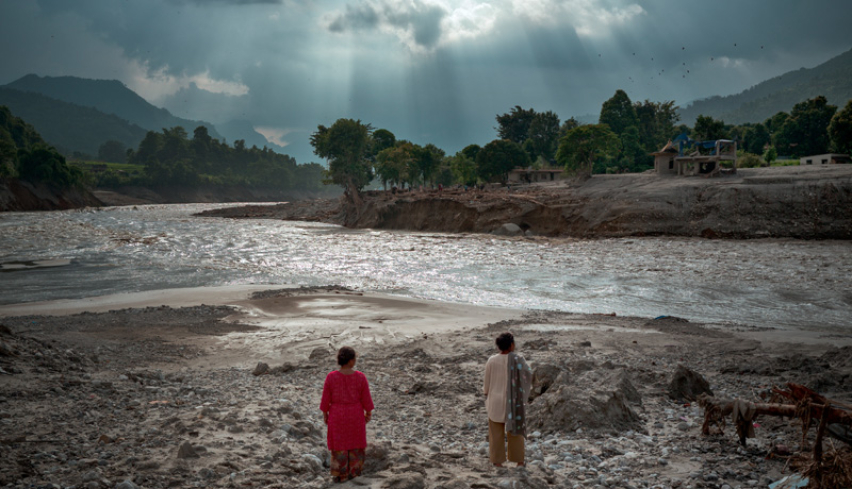
The shocking images of August 26, 2026 will stay with us for a very long time. The catastrophic glacial collapse and rock ice avalanche that launched colossal torrents of debris and water raging down the Trishuli river in Nepal. Like a soulless, raging serpentine, mercilessly drowning and desecrating all life, habitation, and creation along its path.
My encounters with the heart of Nepal... changed the trajectory of my life.
As searing as those images were and the stories that followed, that should not be what defines the Himalayan kingdom. Every place I have traveled to has left an impression on me. Nepal, however, stands apart from the rest. It was my encounters with the heart of Nepal that changed the trajectory of my life. Forever. The heart of this land is its people. Especially its little ones.
It was the early 2000s in Kathmandu. My friends and I were happily playing with the kids, when I first caught sight of her.
There was something special about her.
Through the window, I saw her trudge through the gate of the Children’s Home. Wearing a sea-blue maxi dress. Her dark ebony bob hair reached just above her shoulders. A pretty doe eyed girl. I sensed there was something special about her.
Moments later, I heard the caretaker of the home say, “The children have visitors and they are busy now. Come back in an hour.”
I took a peek out of the room and saw her standing at the main door. I watched as she made her way slowly out through the gate. It was then I noticed that she moved with a distinct limp.
Time passed. My friends and I wrapped up our games, story telling and sing along session with the kids. We decided to stay on for a bit before heading back to our lodging. As we walked into the living room, there she was. Sitting on a sofa, patiently waiting for the kids.
The kids whooped with delight on seeing her. They crowded around her with much love and affection. Even the older ones. She was definitely the crowd favorite. “You seem to be very popular with the kids,” I said with a smile. “We are good friends,” she replied as she hugged the younger ones. Her English had a Western accent which I couldn’t quite place.
Orphans are rarely chosen as friends.
Calling the kids her friends said a lot about her. Orphans are rarely chosen as friends. Not by children with families. Certainly not by someone like her, who clearly came from a middle class family. Kids without parents or families were considered lesser. Not to be associated with.
The kids excitedly started to head out. The little ones tugging at her arms, hurrying her along.
“Where are you all going?” I asked. “For an evening walk around the neighborhood,” she answered. “Can my friends and I come along? We’d love to see your neighborhood.” “Sure.”
She was never left to be by herself.
As the kids skipped ahead of her, she limped patiently behind with a smile. She was never alone, though. The kids took turns in small groups to stop in their tracks, turn around, and run back to keep her company for short stretches. She was never left to be by herself.
Their simple act of inclusivity was touching. She made room in her heart for them. They made room in their circle for her. No one was made to feel less than. No one was excluded.
It was quite the view of Kathmandu valley from up there.
The walk was a bit of an incline up a hill, with blue roofed houses of varying heights, lining both sides of the track. Finally, we came to an abandoned building at the peak. A climb three floors up along the stairs, on the outer wall of the building, led to an open rooftop. It was quite the view of Kathmandu valley from up there.
The kids leapt with joy and ran about wildly. While she slowly lowered herself against the parapet wall and sat herself down on the floor. Her legs stretched out before her. “My leg hurts. I need to rest it a little,” she looked at me and explained. “Is there anything I can do?” I asked. I could see she was in pain. “I’ll be fine after a rest. The brace hurts sometimes.”
Their joy gave her joy.
She lifted her dress a little to show me the metal brace on her right leg. It stretched from her ankle and beyond her knee. From the outline formed on her dress by the brace, I could tell it reached her mid thigh. She smiled as she watched the kids. Though she couldn’t join along with them, running, jumping, playing, their joy gave her joy. Her face lit up.
“What is your name?” I asked. “*Lina Fong.” I was confused. Here was a very tanned Indo-Aryan Nepali girl with an East Asian surname? Lina was very astute. She picked up on my perplexed expression. “I was adopted.” Now I felt bad. I really should learn to keep a poker face.
"I didn’t always limp."
“My parents came to Nepal as missionaries. After sometime here, they met me and decided to adopt me. That is why I have an East Asian surname. Many people get confused when I tell them my name. A dark skinned girl with an East Asian family name. That’s how the accident happened. I didn’t always limp, you know.”
“The accident?” I inquired, cautiously. “My parents and I flew to England to visit family to spend Christmas together. The rest of the family hadn’t met me yet. So my parents thought it would be nice for them to get to know me. For us to spend the holidays together. I was six years old then. I was excited to meet my cousins. I was also looking forward to snow! “One day my cousins asked me out on a walk. When we reached a cliff side, I was pushed off the edge.”
I gasped in shock! “Oh Lina, that is horrid! I am so sorry that happened to you.”
"They were just kids."
“It’s ok. They were just kids. They didn’t know what they were doing. They struggled to understand why I was so different from them. They had oriental features and were fair skinned. I am dark skinned and look nothing like my parents or anyone in the family. They couldn’t see how I belonged with them. They couldn’t accept that I was their family. I don’t blame them. They were just kids. It was difficult for them.”
“Lina, how old are you?” I asked. “Nine years old,” she replied.
How could this child feel empathy and forgive those who harmed her?
How can this little girl have the maturity to see from the lens of the other and perceive their fears? How could this child feel empathy and forgive those who harmed her?
“How did you ever survive such a fall?”
“Thankfully it happened in England with good medical rescue services. I was airlifted without too much delay. So doctors could still save me. I had many serious injuries and many, many surgeries. I was in intensive care for a very long stay. That was my Christmas.”
“Oh Lina, I am so, so sorry that happened to you,” I reached out and held her hand.
“It was a hard time but there was something good that came out of it,” she said with a smile.
“There was?” I responded with interest.
“While in the hospital, I saw for myself the work doctors and surgeons do. If it was not for them, I wouldn’t be here today. They saved my life. They fixed me. I also saw how they cared for me and the other patients. They were so kind and loving. I never knew how important doctors and the work they do was, until then.”
That answer took a turn I did not expect.
“So, that is what you want to be when you grow up?” I asked with a smile. “Yes! I want to be a missionary doctor and surgeon!” Now, that answer took a turn I did not expect.
“Why a missionary doctor?”
“I was blessed that I was in a country like England when my accident happened. I could receive the best care. I am here today because of those doctors and the medical facilities. But that is not how it is for poor people in rural places around the world."
I knew then what I want to do with my life.
"Like here in Nepal. So that’s what I want to be. I want to bring medical help and treatment to the poor in remote locations. They too deserve good medical care! That is why I say there was good that came out of my accident. God opened my eyes. I knew then what I want to do with my life.”
What Lina shared forced me to probe my own heart. Here we were. My friends and I. On a do-good, feel-good missions trip. A side activity to our busy corporate lives. Lives lived to the call of personal ambitions, achievements, and accolades. Works of charity were allocated whatever spare time and space we had.
Lina saw a way of being where the whole of her life can be lived in service of a purpose that was other-focused.
Living for a meaningful cause was not all of my life. It was just a well-meaning side initiative. It made me look good and it made me feel good. It was a box to tick. Lina saw a way of being where the whole of her life can be lived in service of a purpose that was other-focused, not self-focused.
This girl would be the first in a series of encounters in Nepal, that led me to pack up my life and course correct 180 degrees. Never looking back. Who would have thought that out of the mouth of babes would come truth. Truth that would reveal a clarifying vision for a meaningful life. Certainly not me.
The conversation with little Lina stayed with me, as my friends and I left Kathmandu on a very long bus ride to a tiny rural community. A story for next time.
*Lina's name has been changed to protect her identity.
Originally published on Meera's Love Always Prevails substack. Republished with permission.
A nomad at heart, Meera Mahadevan comes alive experiencing a diversity of cultures. A published author, she is passionate about the power of words to breathe life. Her childhood years were enriched by growing up in a multilingual, multicultural society in Southeast Asia. This setting, coupled with being raised in an extended family that blended interfaith and intercultural marriages, profoundly shaped her and cultivated in her an openness in embracing diversity and creating spaces for differences.
After over a decade in marketing and management consultancy industries, she trained as an accredited Life and Executive Coach before shifting to frontier missions. She has been engaged with missions organizations with work spanning from Europe, East Africa, South Asia, South East Asia to South Pacific and is now a trained Spiritual Director and a spiritual companion to mission workers. Meera's writing can be found at: https://lovealwaysprevails.substack.com.