Last Saturday, families waited at Ukraine's northern border with coffee, aid tents, and food for the pets their loved ones were bringing. The buses that finally arrived, after a 19-hour journey, carried hundreds of residents of Oleshky, a Russian-occupied town in the Kherson region.
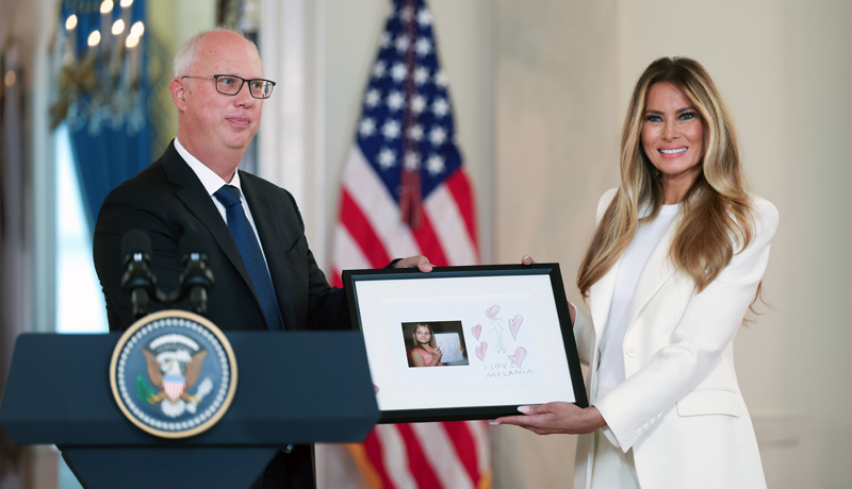
First Lady Melania Trump helped to broker a ceasefire.
They got out because someone asked. First Lady Melania Trump helped to broker a ceasefire through a channel to Moscow and Kyiv she built while helping reunite 34 children with their families. Pope Leo XIV pressed both leaders for the same mercy. For days, the guns along the Kherson front fell silent without a reported violation. That is real, and it deserves thanks.
But the evacuation was also a reminder of what hundreds of thousands of Ukrainians still living under Russian occupation endure. What they escaped was more than shelling. Oleshky's residents, most of them elderly, had gone without an official food delivery since May. Around 50 children were still living there, going hungry along with everyone else.
They also faced religious persecution.
Under occupation, they also faced religious persecution. In the whole occupied Kherson region, only 175 religious organizations have registered under Russian law, fewer than one in five of those that existed before the war. Russia's 2016 Yarovaya law made sharing the gospel outside a state-registered church an offense punishable by fines, and Russian-run courts now enforce it in occupied Ukraine, punishing believers for "illegal missionary activity."
Where occupation forces can abduct anyone, church leaders are not spared. About 30 miles away in Nova Kakhovka, Russian soldiers took Anatoliy Prokopchuk, a Pentecostal deacon, and his 19-year-old son, Oleksandr, from their garage in November 2022. Four days later, they were found in a forest, tortured and mutilated beyond recognition.
A crime against humanity.
Across the river in Kherson, the quiet was a gift. Russian drone operators have hunted civilians there so relentlessly that residents call it the "human safari," a campaign international war-crimes investigators have found to be a crime against humanity.
During the ceasefire, people walked streets that drones had emptied for years, city crews raked leaves in parks they hadn't been able to reach because of the drones, and one woman told a reporter simply, "I feel free.”
Russia will try to exploit any pause.
Russia will try to exploit any pause, and it may have exploited this one. Before the truce, Ukrainian drones kept Russian military supplies out of Oleshky, which Russian forces use as a forward position, launching the drones that hunt civilians in Kherson. During it, Ukraine's southern military command says Russian forces rotated units, fortified positions, and brought in ammunition.
Russian weapons and drones massing on the opposite bank.
There is no independent confirmation that an offensive is coming. But a devout Christian friend in Kherson wrote to us this week that reports keep coming in of Russian weapons and drones massing on the opposite bank. "I wake up in the middle of the night," he wrote, "and remember what may be about to begin."
The ceasefire ended Sunday night after Russia refused Ukraine's offer to extend it. By Monday morning, Russian drones had struck a hospital in central Kherson and hit a car carrying a 62-year-old woman and a 73-year-old man.
Diplomacy without leverage can deliver only temporary relief.
A ceasefire that saves lives today is still worth having. That is exactly why its terms, and the pressure behind them, matter. The lesson from Oleshky is not that diplomacy is futile, but that diplomacy without leverage can deliver only temporary relief.
If one request from the First Lady could quiet a front and bring hundreds of people home, how much more could the President do with the tools he already holds? In September he signed the Lindsey O. Graham Sanctioning Russia and Iran Act, passed by large bipartisan majorities in both chambers. Last month he waived its new sanctions while his team studies their impact.
When that review ends, he should put the law he signed to work until Russia stops its attacks and accepts a peace Ukraine can sign. That peace must include congregations in occupied Ukraine free to worship without Russian permission, with detained clergy released; the return of Ukraine's deported children, 20,651 verified cases; and a verified way home for anyone in occupied territory who wants one, as Oleshky got.
Speak up for those who cannot speak for themselves.
Scripture tells us to "speak up for those who cannot speak for themselves" (Proverbs 31:8). The people of Oleshky could not. Neither can the children still held in Russia. We can.
One polite request opened one road home. Firm pressure on Putin could open many.
Colby Barrett, JD (law), PE (engineering), is an entrepreneur, filmmaker, and former U.S. Marine Corps Captain who led infantry and scout/sniper platoons in the Pacific Rim and the Middle East. Colby has traveled to Ukraine four times with humanitarian aid convoys. He is the producer of Faith in War, a documentary series about Ukrainians whose faith is carrying them through the war, including The Stolen Children, which follows a U.S. Army veteran working to draw the world's attention to Ukraine's abducted children.