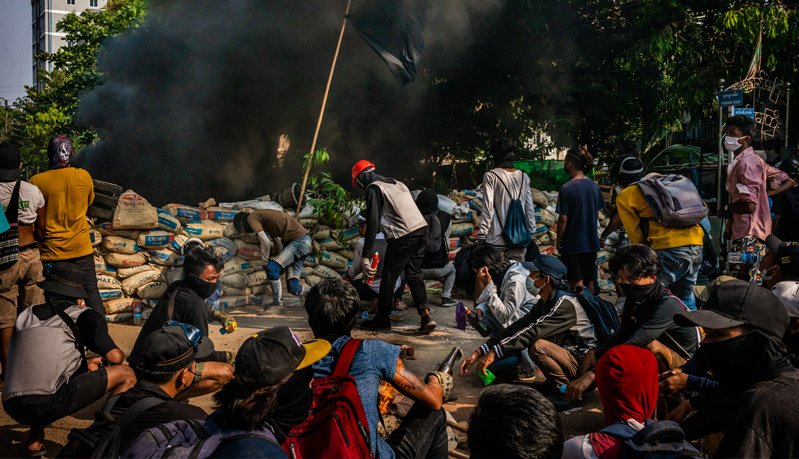
In Thantlang, a Christian town in Myanmar’s western Chin State, 21 of 22 churches have been destroyed since the military seized power from its democratic leader, Aung San Suu Kyi, in 2021. Houses were shelled and burned until almost the entire population fled. Pastor Cung Biak Hum was shot while trying to organize residents to extinguish fires started by soldiers. His wedding ring was taken from his hand, mutilated by the junta’s troops.
This story will be familiar to those who follow the plight of Myanmar’s Rohingya Muslim minority from neighboring Rakhine State, most of whom have been forced over the border into refugee camps in Bangladesh.
The stories of Christians of Myanmar are seldom heard internationally.
At least three quarters of a million Rohingya, more than half of all Rohingya peoples, have been displaced across that border. Lost in the media coverage of violence and the mass displacement, the stories of Christians of Myanmar are seldom heard internationally, yet there are many more—some four and a half million of them.
Christians are often thought of as collateral damage in Myanmar’s civil war. It’s true that Christians are suffering within a national catastrophe, but they are also being targeted at the point where ethnicity, religion and political resistance meet.
Christians, including Christian Rohingya converts, face persecution both from the regime, Buddhist armed groups such as the Arakan Army (AA) and from the Islamist forces known as the Arakan Rohingya Salvation Army (ARSA).
More than 22 million people now require humanitarian assistance.
In Myanmar, more than 22 million people now require humanitarian assistance, around 12 million face acute food insecurity, and roughly 3.7 million are internally displaced. In 2025, targeted military airstrikes killed at least 982 civilians, including 232 children, a 52 per cent increase on the previous year, many of them Christian. Even after the March earthquake killed more than 4,000 people, the military continued bombing disaster-stricken areas during its own declared ceasefire.
Christians... suffer a disproportionate amount of both collateral and deliberate damage.
Christianity accounts for only around six per cent of Myanmar’s population, but it is concentrated among ethnic minorities inhabiting the country’s contested borderlands. Christians therefore suffer a disproportionate amount of both collateral and deliberate damage.
Christians make up 85 per cent of Chin State (where more than 70 churches have been firebombed), 34 per cent of Kachin State and 46 per cent of Kayah (or ‘Karenni’) State. These are also regions where the Tatmadaw, Myanmar’s military, has fought ethnic armed organizations for decades.
Christians were subjected to forced labor, torture, arbitrary detention and extrajudicial killing.
Christian persecution did not begin with the 2021 coup. Under successive military governments, including the State Peace and Development Council (SPDC), Chin Christians were subjected to forced labor, torture, arbitrary detention and extrajudicial killing.
The military also pursued forced assimilation into the ways of the Buddhist majority. Soldiers were reportedly encouraged to marry Chin Christian women and induce or compel them to convert to Buddhism, using marriage as an instrument of state religious and demographic control.
These abuses drove generations of Chin people across the borders into India, Thailand and Malaysia, where many have lived without secure refugee status, legal employment or protection from detention and deportation. Much like with the Muslim Rohingya, the post-2021 atrocities are only the latest phase of a longstanding effort to ethnically cleanse Myanmar of its Christian people.
Buddhist nationalists have portrayed Christianity as foreign... despite more than 150 years of Christian Burmese history.
One cause is the strictly Bamar-Buddhist conception of national identity. The 2008 constitution gives Buddhism a so-called “special position”; discriminatory laws regulate religious conversion and interfaith marriage; and Christian communities have long faced restrictions on building churches, building crosses on mountaintops and registering their faith. Buddhist nationalists have portrayed Christianity as foreign, Western and potentially disloyal—despite more than 150 years of Christian Burmese history.
Because the Church is often the strongest surviving institution in an isolated community, destroying it weakens... the community’s capacity to resist Naypyidaw.
Since the 2021 coup, that suspicion has merged with counter-insurgency. The military treats villages in resistance areas as enemy territory and churches as legitimate targets, along with clinics, Christian schools, meeting places and Christian aid centers. Precisely because the Church is often the strongest surviving institution in an isolated community, destroying it weakens not only worship but the community’s capacity to resist Naypyidaw (the new Capital City, and the center of power since 2005).
Chin State’s Dr Sasa (whose full name is Salai Maung Taing San), a doctor who served as a minister in the National Unity Government, described the worsening systematic persecution, saying: “They raped women. They torture our parents. They destroyed crosses… across the Christian regions.”
The USCIRF reports that the military destroyed 379 religious sites in 2025, killing more than 259 clergy and civilians sheltering or worshiping inside them. The Zup-ra Kachin Baptist Church was struck in January (2026), killing six. St Patrick’s Cathedral in Banmaw was torched in March this year. Separate April airstrikes destroyed three churches in Chin State and killed a pastor.
Damage consistent with large aircraft bombs and identified an A-5 fighter jet, an aircraft operated only by Myanmar’s military.
Back in January 2024, military aircraft bombed civilians gathering near Saint Peter Baptist Church in Kanan village. Seventeen people were killed, nine of them children. Amnesty International found damage consistent with large aircraft bombs and identified an A-5 fighter jet, an aircraft operated only by Myanmar’s military.
The Burma Research Institute estimates that, since the coup, 11 pastors have been killed and 21 arrested, including Reverend Thian Lian Sang and Reverend Hkalam Samson, who was freed only under restrictions that prevented him from preaching again.
In the most northerly Kachin state, which border’s China’s Yunnan province, churches were ordered in December 2025 to hold Christmas celebrations early so they would not interfere with voting. But it was a cynical and tragic ruse. On Christmas Day, aircraft struck houses in Mindat where officials reportedly believed Christians had gathered.
The military destroys these churches and Christian homes because they sustain communities it cannot control.
The military destroys these churches and Christian homes because they sustain communities it cannot control. It imprisons pastors because they command the moral authority that the state cannot, and it bombs Christian towns because their people resist its rule. It only gets away with it because the world refuses to hear the suffering of Myanmar’s Christian minority.
Azeem Ibrahim is the Chief Strategy Officer at the New Lines Institute for Strategy and Policy and a columnist at Foreign Policy magazine. He has written extensively on the persecution of religious minorities, including essays for Foreign Policy on the targeting of Christian communities in Myanmar and China. See Azeem's website for more information: https://www.azeemibrahim.com/.