

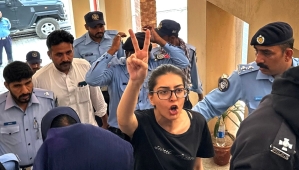
The imprisonment of prominent Pakistani human rights attorney couple Imaan Mazari and Hadi Ali Chattha has triggered strong condemnation from the United Nations, international legal bodies and domestic rights groups.
The critics warn that the case represents a dangerous escalation in the suppression of dissent and legal advocacy in Pakistan.
The couple were sentenced in January 2024 by a sessions court in Islamabad under Pakistan’s Prevention of Electronic Crimes Act (PECA) for social media posts critical of state institutions. Rights groups and legal observers have described the convictions as politically motivated and the trial as deeply flawed, raising alarm over shrinking civic space and judicial independence in the country.
They each received multiple concurrent sentences of imprisonment totaling 17 years, with the longest being a 10-year sentence for cyber-terrorism. They were also fined a total of 36 million Pakistani rupees ($128,830) each.
The U.N. Human Rights Office (OHCHR) released a statement asserting that it was “deeply disturbed” by the convictions and that criminal sanctions for peaceful expression are incompatible with Pakistan’s obligations under international human rights law. The U.N. warned that Pakistan’s cybercrime laws are increasingly used to silence dissent, intimidate lawyers and deter legitimate criticism.
The European Union echoed those concerns, stating that the sentencing undermines freedom of expression and the independence of the legal profession, principles essential to the rule of law. EU officials urged Pakistan to ensure fair trial standards and to protect lawyers from retaliation for their professional work.
Amnesty International called for the immediate and unconditional release of Mazari and Chattha, describing their detention as “arbitrary” and part of a broader pattern of harassment of human rights defenders. The rights watchdog highlighted irregularities in the proceedings, including restrictions on legal representation and what it termed an unusually expedited trial process.
A coalition of international legal organizations, including the International Commission of Jurists, Lawyers for Lawyers and the International Bar Association’s Human Rights Institute, issued a joint statement condemning the convictions and warning that prosecuting lawyers for online speech sets a “chilling precedent” for the entire legal community.
Within Pakistan, the case has sparked protests and strikes by bar associations.
The Human Rights Commission of Pakistan (HRCP) described the sentencing as symptomatic of a rapidly deteriorating environment for activists and lawyers who take on sensitive cases involving state power, religion, or national security.
Mazari, 32, has built a national profile as one of Pakistan’s most outspoken human rights lawyers, representing victims of enforced disappearances, custodial abuse, extrajudicial killings, blasphemy and journalists facing prosecution. Chattha is also widely known for his work defending people accused under Pakistan’s controversial blasphemy laws, which are among the most controversial and dangerous legal cases in this Muslim-majority country.
In several high-profile blasphemy cases, the couple went beyond routine defense work. They publicly and formally exposed in court what they described as an organized “blasphemy business group” allegedly fabricating blasphemy accusations for financial gain, property seizure or personal vengeance. Court records and legal submissions in cases handled by Chattha and Mazari detailed recurring patterns, including coordinated complainants, coerced confessions, and monetary demands linked to accusations.
Christian and other human rights advocates say that challenging these networks is exceptionally dangerous in Pakistan, where allegations of blasphemy have led to mob violence, assassinations and long prison sentences. By confronting what they argued was a systematic abuse of the blasphemy laws, Mazari and Chattha exposed themselves to severe personal, professional, and security risks, according to fellow lawyers and rights groups.
A Christian attorney told Christian Daily International that lawyers who question the integrity of blasphemy prosecutions often face threats, surveillance or retaliatory legal action. Against this backdrop, he said that many rights advocates view the couple’s imprisonment as part of a broader attempt to neutralize lawyers who disrupt powerful interests.
“This is not just about two individuals,” said the lawyer, speaking on condition of anonymity as he’s actively involved in defending several innocent persons, including Christians falsely charged with blasphemy. “This is about sending a message to anyone who dares to challenge misuse of religion, abuse of law, or misconduct by powerful actors.”
The convictions have also drawn political attention. Mazari’s mother, former federal minister Shireen Mazari, has filed petitions challenging her daughter’s detention conditions, alleging denial of visitation rights and access to counsel.
The Pakistani government has defended application of PECA, insisting that the law is necessary to combat online disinformation and threats to national security. Critics, however, argue that vague provisions are routinely weaponized against journalists, activists and lawyers, while powerful actors remain largely immune.
For Pakistan’s already fragile human rights situation, the imprisonment of Mazari and Chattha is widely seen as a major setback. Observers warn that the removal of lawyers willing to defend blasphemy accused, political dissidents and marginalized communities will further erode access to justice.
Appeals against the convictions are expected, but rights groups say the damage is already significant.
“When lawyers are jailed for their words and their work,” Amnesty International said in a statement, “the rule of law itself is on trial.”
As international pressure continues to build, the case has become a focal point for broader concerns about freedom of expression, judicial independence and the future of rights advocacy in Pakistan.


