Syria broke into the top 10 countries where it is most difficult to be a Christian for the first time in nearly a decade in Open Doors’ 2026 World Watch List (WWL) as more than 388 million Christians worldwide faced high levels of persecution or discrimination last year.
“The intensity of persecution and discrimination continues to increase, with more than 388 million Christians worldwide, one in seven, facing high levels of persecution and discrimination for their faith,” the WWL report states. “This accounts for 8 million more people than last year.”
Facing at least high levels of persecution or discrimination for their faith are one in five Christians in Africa; two in five Christians in Asia; and one in 12 in Latin America.
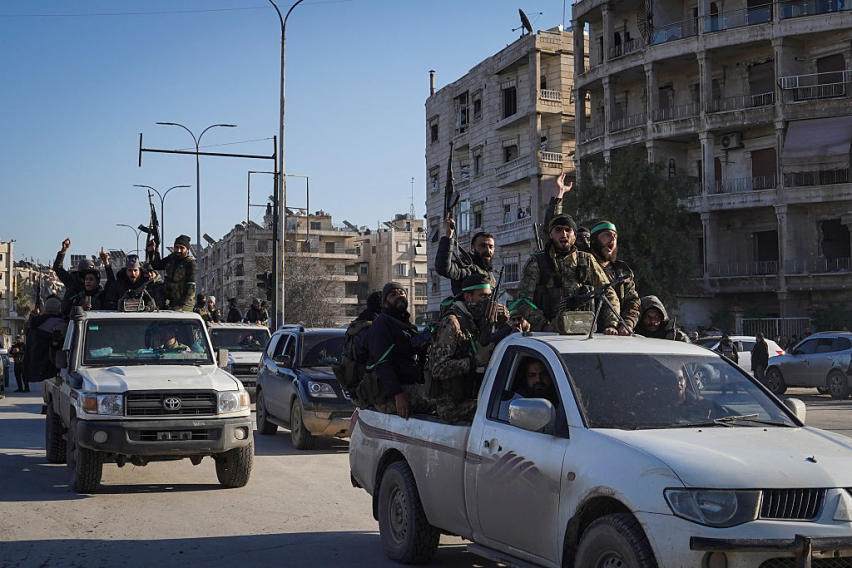
With a surge of anti-Christian violence, Syria vaulted from No 18 in 2025 to No. 6 in the 2026 report released today (Jan. 14).
“It is the only newcomer to the Top 10. The biggest reason was a sharp, 9-point increase in the score for violence,” the WWL report states, noting that Syria’s violence score – with a maximum possible 16.7 – jumped from seven the prior year to 16.1 in this year’s report, which covers the period from Oct. 1, 2024 to Sept. 30, 2025.
Syria’s overall persecution score jumped from 78 to 90, its highest ever.
“The 12-point jump is among the largest single-year increases registered by any country under the World Watch List methodology in place since 2014,” the report states. “A surge of violence returns the country to the top 10, and the Christian population continues to diminish.”
In the absence of reliable statistics, Open Doors estimates about 300,000 Christians remain in Syria today, hundreds of thousands fewer than 10 years ago. Their dwindling number leaves them more vulnerable. Tribal affiliations that provide some measure of protection amid the absence of state-provided security is unavailable to many native Christians and nearly all converts.
“Throughout the country tribalism, intertwined with Islam, considers conversion from Islam to Christianity treason, leading to fierce opposition from families and local leaders,” the report noted.
At least 27 Syrian Christians were killed for their faith during the reporting period, but the report noted that the true number likely is greater.
“In the previous 12 months, the total was zero,” it noted. “This, combined with an increase in attacks on churches and forced closures of Christian schools, explains the sharp rise in the country’s violence score.”
Following the fall of the regime of Bashar al-Assad in December 2024, in June 2025 a suicide attack attributed to an Islamic State cell during services at Mar Elias Greek Orthodox Church in Damascus killed 22 Christians and wounded 63. The attack prompted many Christians to stop attending services and churches to curtail their activities, according to the report.
“In December 2024, the Assad regime fell, the jihadist group Hay’at Tahrir al-Sham, or HTS, took control of the government, and the situation for Christians once again changed dramatically,” the report noted.
Violence was not the only reason for Syria’s fall in the rankings. The March 2025 interim constitution centralizes power in the president and establishes Islamic jurisprudence as the main source of legislation.
“At this still-early post-Assad stage, political power remains fragmented, and the widespread disorder leaves room for radical and militant actors to target Christians, which has resulted in increasing pressure in other areas of Christian life aside from violence,” the report states.
Throughout the country, Christians feel the impact of HTS rule.
“The law gives little recognition to Baptist, Evangelical and Pentecostal congregations, exposing them to significant pressure because of the popular perception that they evangelize Muslims and are sympathetic to the West,” the report states. “The historical Orthodox Church is not free of risk, either, because of its perceived ties to the previous regime.”
At the same time, the government is reforming education according to Islamic ideology – eliminating pre-Islamic history, removing female figures and incorporating Quranic interpretations that, for example, describe Jews and Christians as “those who are damned and have gone astray,” according to the report.
Worst 10
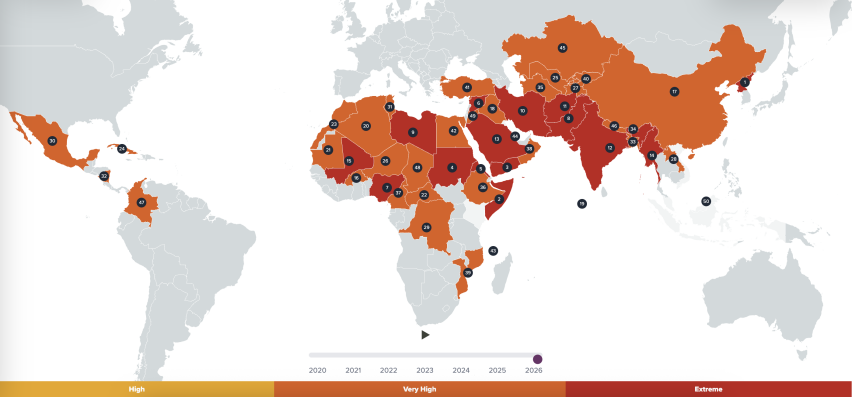
As in the prior year, the three countries where it was most difficult to be a Christian were North Korea, Somalia and Yemen in that order. In fourth place Sudan replaced Libya, which rose to No. 9.
Eritrea went from No. 6 to No. 5, and Nigeria remained the same as the prior year at No. 7. Pakistan remained at No. 8 and, with Libya at No. 9, Iran went from ninth place to No. 10.
Rounding out the worst 15 were Afghanistan at No. 11, India at No. 12, Saudi Arabia at No. 13, Myanmar at No. 14 and Mali at No. 15.
After Syria, Tajikistan was the country with the sharpest drop on the list, falling from No. 39 to No. 27. Nepal fell from No. 54 to No. 46.
Nigeria remained the global epicenter of violence against Christians; of the 4,849 Christians killed worldwide for their faith during the reporting period, 3,490 – 72 percent – were Nigerian, an increase from 3,100 last year.
In the 50 worst countries, 315 million Christians face very high or extreme levels of persecution and discrimination for their faith, the report noted.
The report notes that governments are adopting new methods to pursue Christians, such as North Korea’s use of artificial intelligence to identify suspicious behavior patterns that might indicate someone is a Christian.
“Yet remarkably, in these same impossible situations, the Christian church is continuing to grow,” the report states.
Among countries making improvements, notable was Sri Lanka, outside of the worst 50 as it improved four points and four places to rank No. 65 from No. 61 the previous year with improvements in government reducing discrimination and improving access to justice.
Sub-Saharan Africa
The spike in violence against Christians in Sub-Saharan Africa of the past decade continued during the period, with the only three countries with a maximum
16.7 score for violence all being from the region: Sudan, Nigeria and Mali.
Since 2016, the total violence score of Sub-Sahara African countries increased from 98.71 (12 countries) to 206.12 in this year’s report (14 countries). The average violence score for the region increased during that period from 8.2 to 14.7.
“Nigeria’s violence score has been at the highest possible for eight consecutive years, and nine of the past 11,” the report states. “Each year, thousands of Nigerian Christians are killed because of their faith.”
The report cites ethno-religious hostility, Islamic militancy, weak governance and organized crime as primary drivers of persecution in Nigeria.
“In June 2025, the Christian farming community of Yelwata in Benue state came under a four-hour attack by Muslim ethnic Fulani militants who shot or burned to death 258 people, mostly women and children,” the report states.
The Observatory for Religious Freedom in Africa has noted that Nigeria suffers from a convergence of threats from existing and newly emerging Islamic terror groups, including a resurgence of Fulani ethnic militia attacks in the country’s Middle Belt. In the northwest, the Islamic extremist Lakurawa employs sophisticated weaponry to advance a radical Islamic agenda that is affiliated with Jama’a Nusrat ul-Islam wa al-Muslimin, an expansionist al-Qaeda insurgency.
“Reports emerged in 2025 of a new group, Mahmuda, reported to be affiliated with the Islamic State group, attacking rural communities in the west,” the report notes. “The Observatory reported that Ansaru terror cells are setting up operations in Kogi state, squarely between Nigeria’s capital, Abuja, and its heavily Christian south.”
In the Northeast, Boko Haram and Islamic State West Africa Province (ISWAP)
launched attacks on military facilities, demonstrating improving tactical capabilities, with the Observatory stating, “Their ability to challenge the Nigerian military directly represents a significant shift in the security landscape.”
Among the approximately 3.4 million Nigerians who remain internally displaced, Christians in camps in the northeast report discrimination in aid distribution.
Other categories of persecution in the Sub-Saharan region have risen. The combined total scores for 14 sub-Saharan countries increased by 19 points over the prior year, and more than half of that increase was due to an increase in
pressure on Christians in their “national life”: interaction between Christians and their countries as determined by rights and laws, the justice system, national public administration and public life.
“Significant score increases for this category were concentrated almost entirely in
Burkina Faso, Cameroon and the Central African Republic, and to a lesser extent,
Sudan,” the report states.
In Sudan, Christians are caught between the Sudanese Armed Forces (SAF) and the opposing Rapid Support Forces (RSF), each trying to win the support of the majority Muslim population.
“In Khartoum and beyond, hundreds of churches have been damaged, religious gatherings disrupted, and faith leaders detained,” the report states. “Christians face widespread discrimination in education, employment, and access to courts. Sudan’s Christians have been targeted in conflict zones such as the Nuba Mountains, and the Darfur and Blue Nile regions.”
In Somalia, Al-Qaeda affiliate Al-Shabaab has resurged, exploiting fragmentation and tensions between the central government and regional states.
“All registered churches have been closed or destroyed,” the report states. “Converts from Islam are seen as traitors to clan and identity, often resulting in community-driven violence, including public execution as warnings to others.”
Christian survival depends on total secrecy, limited to the most private inner life, the report states.
“Parents confront an impossible dilemma: protect their children by concealing faith or risk losing them to indoctrination or retaliation,” it notes. “Only North Korea is more hostile to Christians.”
Burkino Faso, which worsened to No. 16 from No. 20 the previous year, saw its violence score near the maximum as its overall score reached 80, its highest ever, the report states.
“Where they are unchecked by state authority, jihadists infiltrate local economies, trafficking weapons, minerals, and people. Accountability is lost in a fog of bribery and collusion among officials, security forces, and business networks,” the report states.
Christians in Burkina Faso are frequently extorted, abducted or targeted for economic gain, and churches are raided or taxed.
“The two strongest sources of persecution were, as elsewhere in Sub-Saharan Africa, Islamic oppression and organized corruption and crime,” the report notes.
China
China’s WWL score rose to a record 79 points, but not due to violence. A surge in the national life category accounted for its decline.
Ranked No. 17 (up from No. 15 the prior year), China’s government in September published “Regulations on the Online Behavior of Religious Clergy,” a list of 18 rules that, among other things, require religious leaders to support the Chinese Communist Party, to “guide religions to adapt to socialist society,” and to preach only on licensed websites.
“The rules forbid the use of ‘religious topics and content to attract attention,’ and outreach to youth,” the report states. “No fundraising. No use of live video on social-media apps. No Bible apps or distribution of religious publications. No talk about ‘healing.’ Regulations like these, implemented in a strict and uniform manner, are making it increasingly difficult for churches to avoid having to fall in line with official Communist ideology.”
The online rules implemented in 2025 fit into regulations implemented since 2018 governing internet use, social media, non-government organizations and religious venues.