When Russia invaded Ukraine in 2022, I was serving as CEO of Global Connections, a network organization for evangelical mission agencies in the United Kingdom. Almost immediately, I found myself at the center of difficult conversations among leaders of mission organizations about how we should respond to the invasion of one historically Christian European nation by another historically Christian European nation.
In the end, we agreed that the most appropriate response was to pray. I had hoped we might find ways to do more, but I was glad that Global Connections could at least host a regular prayer gathering for peace—not only for Ukraine, but also for places like Yemen, Sudan, the Democratic Republic of Congo, and many other regions where armed conflict has long been devastating communities.
How quickly attention faded.
One thing that stayed with me was how quickly attention faded. By the fourth prayer meeting, attendance had dwindled to just me and members of my team.
But what struck me most was something deeper. Much of the reaction—across Europe more broadly, not only within our network—seemed driven less by theological reflection on war and Christian witness than by the shock of seeing war unfold within Europe itself.
For many people, it was the sight of white Europeans suddenly fleeing armed conflict that stirred such urgency. Wars that had long devastated places like Yemen, Sudan, or the Congo—often treated as distant tragedies—suddenly appeared much closer to home.
Why are the anti-war voices of non-Western Christians so often ignored?
This realization raised uncomfortable questions for me. Why had the global church not developed deeper theological instincts about war long before Ukraine? Why were our reactions shaped more by proximity and familiarity than by a consistent moral vision? And why are the anti-war voices of non-Western Christians so often ignored?
These questions inevitably lead me to the long shadow of the "Just War" Christian doctrine.
The long shadow of "Just War" thinking
The doctrine, usually associated with Augustine, sought to place moral limits on violence and guide Christian participation in political life. But we need to remember that Augustine was responding to a new historical moment.
Christianity had become imperialized.
The Church had moved from being a persecuted minority to living within a Christianized empire. Within the Roman Empire, Christianity had become imperialized.
I admire Augustine deeply. I often remind audiences that he was an African bishop from Hippo in North Africa. Yet Augustine was also a citizen of the Roman world (his father was Roman) and his theological imagination developed within a political order attempting to reconcile Christian faith with imperial responsibility.
If, therefore, a just man is perhaps serving as a soldier under a godless human king, he can correctly fight at his command so as to preserve the order of civil peace. This is certain when what is commanded is not against the commandment of God, or when it is not certain whether it is or is not. In the latter case, the injustice in commanding perhaps makes the king guilty, but his order in obeying proves the soldier innocent.
Augustine argues that a just person may serve as a soldier even under an unjust ruler. As long as the command does not clearly violate God’s law, the soldier may obey without guilt. If the command proves unjust, responsibility lies with the ruler who issued it. In other words, the moral burden of war is shifted upward to the authority that commands it. The soldier’s duty is obedience.
It... proved extraordinarily convenient for empires.
The logic is elegant. It also proved extraordinarily convenient for empires.
For centuries this reasoning allowed Christians to live comfortably within imperial systems. Believers could serve the state, fight its wars, and still consider themselves morally innocent as long as the command had not explicitly contradicted God’s law.
Augustine’s attempt to guide Christians navigating imperial realities was, to some extent, understandable. Yet the result was a theology that made it easier for the Church to accommodate and serve imperial power. But this tradition deserves renewed biblically faithful scrutiny today.
War and the temptation of empire
Decide which empire God must be supporting.
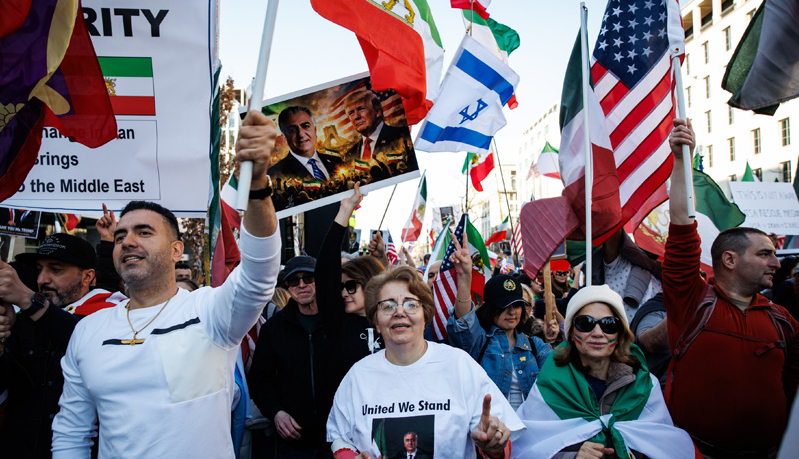
Whenever war begins, Christians face a quiet but dangerous temptation: to decide which empire God must be supporting. As Israel and the United States wage war against Iran, that temptation is once again in front of us.
Public conversation quickly becomes dominated by strategy, retaliation, and national interests. Governments explain their actions through the language of security and deterrence. Commentators debate the balance of power.
Yet behind the headlines are ordinary people—families trying to sleep through the sound of air-raid sirens, pastors preparing sermons for congregations living with fear, and communities wondering whether their cities will still be safe tomorrow.
What should Christian witness look like in a world still shaped by empire?
In moments like this, followers of Jesus must ask a deeper question: what should Christian witness look like in a world still shaped by empire?
The Bible was written under empire
The biblical story unfolds under the shadow of empire.
Israel’s prophets spoke during periods when powerful empires—Egypt, Assyria, Babylon, and Persia—dominated the political landscape. These empires promised order, stability, and security. Yet the prophets repeatedly warned that imperial power carried a profound spiritual danger: the belief that peace could ultimately be secured through domination.
The cross itself was an imperial instrument.
By the time of the New Testament, Rome ruled the Mediterranean world. Jesus was born into a land occupied by imperial forces. Even the cross itself was an imperial instrument, designed not simply to punish criminals but to demonstrate Rome’s overwhelming authority.
When the earliest Christians confessed that Jesus is Lord, they were not making a purely private spiritual statement. In a world where Caesar was also called lord, this was a quiet but radical claim about where ultimate authority truly lay.
From the beginning, the Church learned to live within the empire without surrendering its deepest allegiance to it.
Empire and the spread of the gospel
The relationship between the early Christian movement and empire was not entirely adversarial. The Roman Empire unintentionally created conditions that allowed the gospel to spread far beyond Palestine.
The Pax Romana, Rome’s relative stability across the Mediterranean, combined with an extensive network of roads, sea routes, and administrative systems that made long-distance travel far easier than in earlier centuries.
The empire that crucified Jesus also provided the infrastructure through which the news of his resurrection traveled.
Apostles and early Christian missionaries traveled along these imperial routes, carrying the message of Christ throughout the Roman world. In this sense, the empire that crucified Jesus also provided the infrastructure through which the news of his resurrection traveled.
The early church grew within the very imperial systems whose power it simultaneously challenged. History would complicate this relationship even further.
From the fifteenth century onward, European expansion opened global routes through which Christianity traveled. Ships that carried traders and soldiers often carried missionaries as well. In many places, the gospel arrived alongside colonial administration and military protection, and in some cases it arrived prior, via commercial means.
This history remains complex. While Christianity arrived via colonial structures in what is now know as the Majority World (in global Christian studies), it also became a source of spiritual renewal and helped ferment the resistance that was needed to end colonialism.
The global Church
Christian identity can no longer be easily tied to a single civilization or geopolitical bloc.
One of the quiet transformations of the past century has been the emergence of a truly global Church. Migration, diaspora communities, and the rapid growth of Christianity across Africa, Asia, Latin America, and Oceania mean that Christian identity can no longer be easily tied to a single civilization or geopolitical bloc.
The Church tends to view global conflicts differently from the way nations do.
As an African Christian living and teaching in Europe, I have often noticed that the Church tends to view global conflicts differently from the way nations do. Nations instinctively ask which side must prevail, which interests must be defended, and which alliances must be protected. The Church, at its best, asks a different question: how reconciliation might still be possible even when conflict seems inevitable.
Because the Church is global, it refuses to fit neatly within national narratives. In the same conflict, there are Christians praying in US and Israeli cities, and Christians praying in Iranian cities and around the world, as well as believers across neighboring countries whose futures may also be shaped by the outcome of war.
The body of Christ, therefore, carries within itself the tensions of the world, yet it is also called to embody a deeper unity that transcends them.
In many parts of the global Church this perspective also shapes how Christians relate to people of other faiths. The categories that often dominate Western political discourse—dividing the world sharply between Christian and non-Christian, friend and enemy—do not always shape the imagination of missiology (transcultural theology) in the same way. As I argue in my new book, Decolonizing Mission, much Western missiology still carries assumptions formed in the fifteenth century, when the fall of Constantinople intensified Christian fears of Islam.
Witness beyond empire
The Church loses its credibility whenever it allows the gospel to be absorbed into the ambitions of empire.
The Church loses its credibility whenever it allows the gospel to be absorbed into the ambitions of empire.
The calling of the Church is not to sanctify the strategies of powerful states but to bear witness to the kingdom of God—a kingdom that does not emerge through domination but through reconciliation, justice, humility, and sacrificial love.
The Church must resist the instinct to imagine that the purposes of God advance through military victory.
This does not mean Christians ignore political realities. Governments do face genuine security challenges, and conflicts often grow out of long histories of fear and mistrust. But the Church must resist the instinct to imagine that the purposes of God advance through military victory.
The earliest Christians lived under one of the most formidable empires the world has ever known. Yet their witness did not depend on Rome’s armies or institutions. Instead, they formed communities where ethnic boundaries were crossed, enemies could become brothers and sisters, and allegiance to Christ reshaped every other loyalty.
A quiet but difficult witness
In times of war, faithful Christian witness may look quieter than the rhetoric of politics and media. It may mean refusing to demonize entire peoples. It may mean praying for those we are taught to fear. It may mean resisting propaganda—even when it comes from our own side.
The future of the world does not ultimately depend on the success of empires.
Such practices may appear small in the face of geopolitical conflict. Yet they embody a different imagination and moral commitment—one that trusts that the future of the world does not ultimately depend on the success of empires.
Empires rise and fall throughout history. The question for the Church is whether its witness will rise with them—or remain faithful when they fall.
Originally published on Harvey's Substack, Global Witness Globally Reimagined. Republished with permission.
Dr Harvey Kwiyani is a Malawian missiologist and theologian who has lived, worked and studied in Europe and North America for the past 20 years. He has researched African Christianity and African theology for his PhD, and taught African theology at Liverpool Hope University. Harvey is also founder and executive director of Missio Africanus, a mission organization established in 2014 as a learning community focused on releasing the missional potential of African and other minority ethnic Christians living in the UK. More recently he became African Christianity Programme Lead for CMS (UK) Pioneer Mission Training and in August 2025 his book Decolonizing Mission was published.