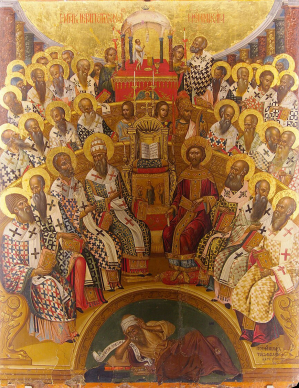
A recently published scholarly essay contends that the Council of Nicaea in 325 A.D. was a turning point not only in Christian theology but in the institutional separation of the church from its Jewish origins — a separation shaped as much by politics as by Scripture.
The essay, written by Dr. Thomas Paul Schirrmacher, German theologian and former Secretary General of the World Evangelical Alliance (WEA), appears in "Their Lord and Ours: The Enduring Legacy of Nicaea," a collection of scholarly contributions marking the 1,700th anniversary of the council published as part of the World of Theology series by the WEA's Theological Commission. Schirrmacher's contribution titled "Nicaea and the Separation of the Christian Church From Its Jewish Roots" was highlighted in Bonn Profiles on May 15.
While affirming the theological weight of the Nicene Creed, Schirrmacher argues that decisions made at Nicaea — and the broader atmosphere of Emperor Constantine's reign — drove Christianity toward a distinct, non-Jewish identity in ways that were not primarily grounded in biblical reasoning.
A key example, according to the essay, was the council's decision to decouple the date of Easter from the Jewish Passover calendar. Schirrmacher characterizes this as emblematic of a wider effort to define Christian identity in opposition to Jewish practice, driven by anti-Jewish attitudes that were prevalent in the Roman world of the fourth century.
The essay also draws attention to the apparent absence of Jewish-Christian representatives at Nicaea, interpreting this as evidence that institutional leadership in the church had already moved away from its Jewish-origin communities. Schirrmacher points to historical records suggesting that Jewish followers of Jesus continued to exist for centuries after the council, even as the broader institutional church increasingly marginalized them.
Constantine's own policies and public rhetoric toward Jews receive critical attention in the essay. Schirrmacher describes the emperor's posture as openly hostile, and argues it left a lasting imprint on Christian attitudes and legislation in the centuries that followed.
Despite his critique of these historical dynamics, Schirrmacher maintains that the core Christological affirmations reached at Nicaea remain grounded in the biblical tradition. His essay calls for greater scholarly attention to early Jewish-Christian communities and encourages readers to reckon honestly with the historical relationship between Christianity and Judaism.
The volume in which the essay appears brings together multiple scholars examining the Nicene Creed's continuing theological and practical significance for the church.