I had coffee with a friend from church recently and was able to hear more of their life story. As I listened to them describe where they’ve been and who they’ve become, I found myself thinking again about all the elements that had worked together to refine them into the person sitting across from me. It reminded me of an illustration I have never been able to forget.
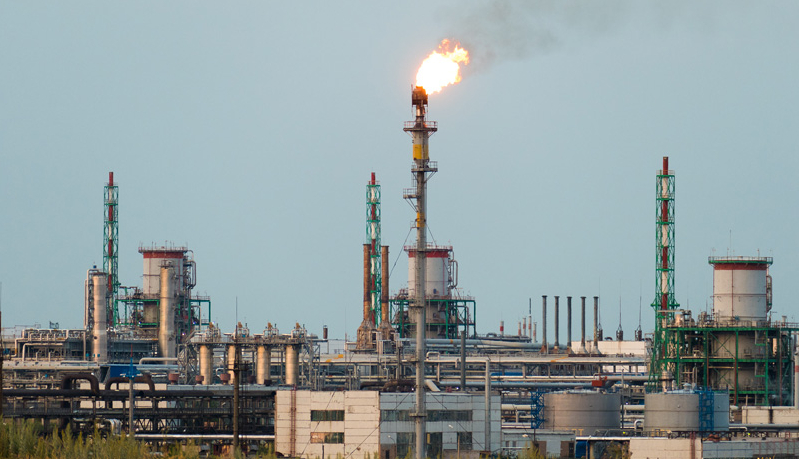
In the late ’90s I had a six-month stint working at an oil refinery here in the Midwest. I was mostly filling in administrative gaps during a union strike, but those of us in management had to learn the basics of the refinery in case something went awry. Which you never want at a refinery.
There is a canal next to the refinery where crude oil arrives on big barges. It is black, thick, and sludgy. The crude is pumped out and begins a refining process, a transformational one, that turns it into multiple by-products. It runs through an array of pipes and heating sources. Some of the heating elements blaze with fire so intense it’s like the fiery furnace from Daniel. So hot the soldiers who threw Daniel’s friends in were killed by the heat alone. You can feel it radiating from yards away. No human is walking up to yank open that door.
Crude oil... has been so thoroughly refined that it has transformed from that black sludge into something clear.
The crude is heated and cooled, repeatedly. At the end of the process, one of the by-products is gasoline. It has been so thoroughly refined that it has transformed from that black sludge into something clear. It looks like water. In fact, the refinery adds colorant and odor to the gasoline so you don’t mistake it for water. Can’t have someone pulling up to a pump on a hot summer day thinking they found a drink!
Of course, crude oil has no say in the matter. We do. And that’s exactly where things get complicated.
The more we resist (refining), the more we limit ourselves from reaching our potential.
Refining is a process, and it’s the perfect illustration of life transformation. The more we resist it, the more we limit ourselves from reaching our potential, and the more we negatively impact the people around us.
If a valve is turned off, if the heaters aren’t set to the right temperature, if the cooling doesn’t happen at the right time, the crude won’t become what it was meant to be. It might still become something, but it won’t be the intended product.
So many things I went through... refined down pride, arrogance, ignorance, insensitivity, judgmentalism, and unkindness.
How much have I resisted the elements of refining that God has placed in my life, for his glory, and for me to become the person he wants me to be? Now in my mid-50s, I can look back and see the benefit of so many things I went throughthat refined down pride, arrogance, ignorance, insensitivity, judgmentalism, and unkindness, to name only a few.
I don’t think there’s anything wrong with praying for difficult situations to go away. But there also needs to be a very clear “Your will be done” aspect to our prayers: a submission to the elements that God has allowed, prepared, and designed to do the work of refining in our lives.
Jeremiah chapter 6 is one of my favorite chapters. Verse 16 says:
“Stand by the roads, and look and ask for the ancient paths, where the good way is; walk in it, and find rest for your souls. But they said, ‘We will not walk in it.’”
It continues in verses 27–30:
“I have made you a tester of metals among my people, that you may know and test their ways. They are all stubbornly rebellious, going about with slanders; they are bronze and iron; all of them act corruptly. The bellows blow fiercely; the lead is consumed by the fire; in vain the refining goes on, for the wicked are not removed. Rejected silver they are called, for the Lord has rejected them.”
I had to look this up, and it’s fascinating. In metallurgical terms, the process Jeremiah describes is known as cupellation, a high-heat refining method where lead acts as a sacrificial scavenger. In a successful refine, the lead melts and oxidizes, bonding with impurities to pull them away from the silver.
“Rejected”... it has endured every possible test and proven to be counterfeit at its core.
But the passage depicts a failure: despite the bellows blowing fiercely, the lead is entirely consumed before the impurities are removed. The “bronze and iron” are so deeply integrated that they refuse to separate. What’s left behind is a worthless, slag-heavy mass. Not silver. The metal is “rejected” because it has endured every possible test and proven to be counterfeit at its core.
This is what happens when we become what I'll call “metallurgically unreachable.” It suggests there is a point where the trials we face, “the fire,” can no longer shape us, because we have allowed our hearts to become so fused with base metals like pride and stubbornness that transformation simply can’t take hold.
It’s a sobering picture of what we might call the “exhaustion of grace.” The lead entirely consumed suggests God has thrown every resource at the problem: prophets, warnings, sacrificial love. Until the scavenger itself is used up. The tragedy isn’t that the Refiner isn’t skilled enough, or that the fire isn’t hot enough. It’s that when the smoke clears, the silver isn’t there.
Am I living as a “counterfeit”?
It makes me ask: Am I living as a “counterfeit,” presenting a silver exterior to the world while being bronze and iron at my core? We risk becoming a material that even the most intense heat can no longer change.
Malachi 3:1–4 gives us a contrasting perspective:
“Behold, I send my messenger, and he will prepare the way before me. And the Lord whom you seek will suddenly come to his temple… But who can endure the day of his coming, and who can stand when he appears? For he is like a refiner’s fire and like fuller’s soap. He will sit as a refiner and purifier of silver, and he will purify the sons of Levi and refine them like gold and silver, and they will bring offerings in righteousness to the Lord.”
Notice that the Refiner sits. He doesn’t walk away and leave the metal to chance. He keeps his eyes fixed on it, knowing exactly when to pull it from the fire, not a moment too soon, not a moment too late.
The key difference between Jeremiah and Malachi is pliancy: the willingness to let transformation take place. In Jeremiah, the people have become stubbornly rebellious. They have integrated their sins so deeply into their identity that they are fundamentally incompatible with the Refiner’s work. The fire is just as hot, and the Refiner is just as present, but the material refuses to yield.
The refining is not punishment. It’s maturing.
In Malachi, the refining is not punishment. It’s maturing. Because these people are precious to the Refiner, He stays. He watches. He’s not trying to destroy them. He’s trying to burn away the dross of daily distraction, fear, and pride so that eventually, when He looks at the metal, He sees His own face reflected back.
So where does that leave me? Am I going to resist transformation? Will I let the impurities of my heart harden my mind, my soul, my spirit into something unworkable?
Will I conform to the patterns of this world, or be transformed by the renewing of my mind? Will I allow Him to remove the impurities, or will I hold on to them?
How am I resisting transformation right now?
How am I resisting transformation right now? Where am I being unpliable? And how am I positioning myself each day to receive, to listen, to learn, to understand, and to become someone who embraces the Refiner rather than someone who insists on staying exactly as he is?
The fire is the same. The Refiner is the same. What changes is whether we yield.
Originally published on Michael VanHuis' Substack. Republished with permission.
Michael VanHuis has served with Missio Nexus since September of 2015 and as Executive Director since September of 2023. His ministry and leadership experience includes field service in Ghana, West Africa with Pioneers; operational leadership at both Pioneers and OneWay Ministries; serving as the missions pastor at Northland Church in Longwood, Florida; and managing a private family foundation. At Missio Nexus, Michael advises mission agencies and churches, oversees research initiatives and leads organizational strategy and staff development. He holds a Master’s in Global Leadership from Fuller Theological Seminary in Pasadena, California.