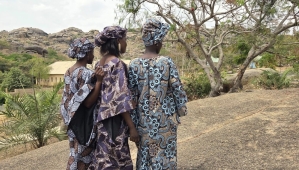
Eight years after 14-year-old Leah Sharibu was kidnapped by Islamic extremists along with 109 others from a girls’ school in Nigeria’s Yobe state on Feb. 19, 2018, she is the only remaining captive.
Now 22, Leah refused her captors’ demands to deny Christ and convert to Islam in order to be released after the attack by Islamic State West Africa Province (ISWAP) on the Government Girls’ Science and Technical College in Dapchi. Most of the other kidnapped girls have been released, with some dying in captivity.
Ahead of the U.N.’s International Day for the Elimination of Sexual Violence in Conflict on Friday (June 19), Leah and other Nigerian girls and women targeted for their faith are the focus of the Religious Liberty Partnership’s Voices for Justice (V4J) campaign of coordinated events and actions to address the issue of such abuse.
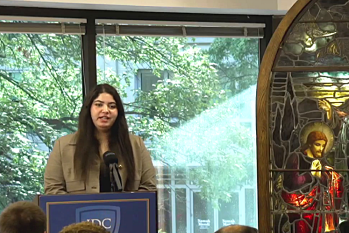
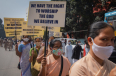
The collaborative effort by multiple RLP member organizations in different countries involves concerted advocacy, awareness and prayer. In Washington, D.C., a protest near the Embassy of Nigeria is scheduled for Thursday (June 18) at 11 a.m., organized by Jubilee Campaign, Christian Freedom International and 21Wilberforce. Scheduled to speak are Gloria Puldu, CEO of The Leah Foundation, and Mariam Ibraheem, sentenced to death as a Christian mother of two after being wrongly convicted of apostasy in Sudan in 2014, and then freed as authorities came under international pressure.
In Sweden, advocacy group Set My People Free on Thursday (June 18) is leading a protest near the Nigerian embassy in Stockholm at 10 a.m. On Friday (June 19) a protest will take place in Switzerland near the Nigerian embassy in Bern at 2:30 p.m. Also on Friday, Voice of the Martyrs New Zealand is leading a walk/march for Leah in Christchurch at 10 a.m. Many other prayer events, social media campaigns and letter-writing campaigns will be taking place globally, with more information at hashtag #Voices4Justice and Facebook page Voices4JusticeRLP.
Leah’s parents, Nathan and Rebecca Sharibu, said in a press statement today that she stood firm in her belief, choosing to remain true to Christ even at the cost of her freedom.
“For this courage, she has endured unimaginable hardship in the wilderness; reports from those who escaped speak of forced marriage, repeated trauma, childbirths in captivity, and the constant shadow of sexual violence used as a weapon of war and control,” they said. “As her parents, every day without Leah is a wound that deepens. We miss her and her dreams of a better future. Birthdays pass in silence, milestones are stolen, and our family lives with a pain no words can fully capture.”
The added that they hold onto their faith and believe, “as we have always told Leah and the world, that God who sees the oppressed will bring her home.”
Between October 2024 and September 2025, 771 Christian women and 68 girls were abducted in Nigeria, according to the Observatory for Religious Freedom in Africa (ORFA), which notes that many abductions go unreported.
Abductions often lead to sexual violence and forced marriage. The V4J campaign is encouraging people to communicate to Nigerian consular officials in their countries that Leah’s lengthy captivity is emblematic of the gender-specific suffering of many abducted women and girls.
The campaign urges people to acknowledge to Nigerian officials that security challenges are complex, but that they are charged with fulfilling their constitutional obligation to safeguard the lives and livelihoods of citizens others within the country’s borders.
Officials are urged to intensifying efforts to secure the safe release and return of Leah and all other abducted women and girls, providing them with appropriate medical, psychosocial, and reintegration support; ensure prompt, impartial, and thorough investigations into abductions, sexual violence and forced marriage; arrest arrest and prosecute perpetrators; and enhance protection for vulnerable communities in conflict-affected areas by ensuring the presence of sufficient, accountable, and well-resourced security personnel mandated to prioritise civilian safety.
Alarm
U.N. experts earlier this month expressed alarm to Nigerian officials over the risk to women and girls in the country.
The deteriorating security situation in northern Nigeria and the Middle Belt, they stated, has created an environment in which armed extremist groups, including Boko Haram, Islamic State West Africa Province (ISWAP) and “radicalized individual herdsmen involved in the ‘farmer-herder’ conflict” continue to attack “amid persistent reports of impunity, institutional failures, and inadequate protection by authorities.”
“The testimonies we have received paint a horrifying picture of fear, trauma, coercion and abandonment,” the experts told Nigerian officials. “Victims and survivors must not be left without protection, justice, reparations, including rehabilitation and meaningful support.”
Violence targeting Christians and other religious minorities continues to be rampant, they said, pointing to the application of local interpretations of sharia (Islamic law) in 12 northern states, enforcement of blasphemy codes and the long-standing absence of effective access to justice.
“We are particularly alarmed at the very specific and heightened risks of discrimination, violence and exploitation that Christian women and girls are exposed to, as we continue to document grave cases of sexual violence, abductions, acts tantamount to enforced disappearances, forced conversion and child marriage amongst them,” the experts reported. “In many cases, those who resist are reportedly threatened, punished, disappeared or killed.
The experts lamented the abduction and sexual assault of Christian women; disappearance of girls abducted from a church in Borno state; forced conversion and child marriage of a 13-year-old girl in Bauchi state; and a 16-year-old Christian girl whose hand was cut off because her family rejected militants’ forced marriage proposal by militants.
“These crimes took place within a broader pattern of violence and persecution disproportionately affecting Christian communities in some northern states, including killings, attacks on churches and villages, mass displacement, mob violence linked to accusations of blasphemy, and severe insecurity affecting women and children in internally displaced persons camps,” the experts stated.
In Borno state on Nov. 15, ISWAP militants kidnapped two Christian women in separate attacks in Gwoza County – with one giving birth while in captivity, rights watchdog Truth Nigeria reported in May. Comfort Sunday, a 25-year-old member of a Baptist church, told Truth Nigeria that she was kidnapped from her native Pumpum village when she was three months pregnant and married less than a year.
“We suffered greatly in captivity because we refused to convert to Islam,” Sunda told Truth Nigeria.
Sunday and Rose Adamu, 20 of Kwang village, the other woman abducted on Nov. 15, escaped from the terrorists’ camp in the Yuwe area of Gwoza County on May 13, though the Nigerian government claimed soldier rescued them.
Their escape was their third attempt, and after the two prior attempts the Islamic extremists tortured them so severely they thought they would die, and miraculously she did not lose preganancy, Sunday told Truth Nigeria while nursing her newborn.
“If they had caught us this last time, they would have killed us immediately,” she said. “It was not soldiers that rescued us. We were the ones that walked to their post after Jesus helped us to escape.”
Lt. Sani Abubakar Muhammad, spokesman of the 21 Special Armoured Brigade in Bama, the Nigerian Army had issued a statement on May 15 claiming that, “the women were rescued during an offensive operation conducted under the leadership of Brig. Gen. Tosin Ayoola.”
The women’s account echoed longstanding reports of Nigerian security agency “rescues” that victims, witnesses or local communities later challenged.